Microclimatic gradients regulate germination phenology in alpine communities

Clara Espinosa del Alba, Biodiversity Research Institute (IMIB, University of Oviedo – CSIC – Principality of Asturias), part of the Vegetation and Biodiversity Lab, discusses her article: Microclimatic variation regulates seed germination phenology in alpine plant communities, in English, Spanish, and Catalan. Background Seeds are essential for plant regeneration, but not only the quantity and…
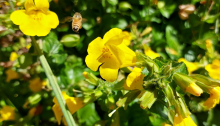
Genetic differentiation able to develop even in “jack-of-all-trades” weeds

Aaron Millar, from the University of Canterbury discusses his article: Altitudinal Differentiation Occurs Alongside High Plasticity in a General-Purpose Genotype Invasive Plant In 1965, Herbert Baker imagined a super-weed, a plant that could invade anywhere and deal with anything. He called it the “general-purpose genotype”, a plant which could adapt to any environment with massive…

The rhizosphere: A hub for enhancing soil carbon storage

Qitong Wang and Huajun Yin, Chengdu Institute of Biology of the Chinese Academy of Sciences, discuss their article: Rhizosphere as a hotspot for microbial necromass deposition into the soil carbon pool When it comes to soil organic carbon (SOC) storage, the rhizosphere – a zone of soil around plant roots – plays a pivotal yet…

Understanding edge effects on seed production

Katherine Hulting, from Michigan State University’s W.K. Kellogg Biological Station, discusses her article: Habitat edges decrease plant reproductive output in fragmented landscapes Fragmentation and demography Habitat fragmentation is widespread globally. However, understanding how to conserve in fragmented landscapes is challenging. Breaking habitats apart leads to multiple changes, such as decreased connectivity and increased edge habitat,…

Above-ground Disturbances and Below-ground Litter Decomposition

Meijie Xi and Weile Chen from Zhejiang University, China, discuss their article: Soil moisture mediates the effect of plant below-ground carbon allocation on the decomposition of root litter in a subtropical forest Forests are critical allies in the fight against climate change because they are major carbon sinks. Yet, the carbon stored in forests is…

Reproductive phenology mediated the sexual reproduction of alpine plants under future climate change

Miaojun Ma, Lanzhou University, discusses his article: Indirect effects of warming via phenology on reproductive success of alpine plants Background More and more empirical evidence shows that climate change has altered the reproductive performance of alpine plants, including reproductive phenology and reproductive output. Altered plant phenology can expose species to novel abiotic conditions during growth…

How Insularity Shapes Plant-Herbivore-Predator Interactions

Carla Vázquez-González, University of California, Irvine & Misión Biológica de Galicia (CSIC), discusses her article: Testing the contribution of vertebrate predators and leaf traits to mainland-island differences in insect herbivory on oaks Insularity research on plant-herbivore interactions Islands have long fascinated evolutionary ecologists, beginning with the early observational studies of naturalists like Charles Darwin and…

Understanding How Climate Change Affects Plant Growth Through Soil

Anna Florianová (@IBOTCZ; @popecolIBOT), Institute of Botany of the Czech Academy of Sciences, describes her article: Climate-driven shifts in plant-soil feedback of a perennial grass species As the climate changes, scientists are becoming increasingly interested in how these shifts impact plant growth. Climate change does not only have direct effects on plants, but may also affect…