Drought-tolerant species also resist competition in grasslands

Hailey Mount discusses her recent article: ‘Drought tolerant grassland species are generally more resistant to competition.’ Background The success of the different plants in a community depends both on the available resources and the intensity of local competition for those resources. To conserve and restore plant communities in the face of our changing climate, we…
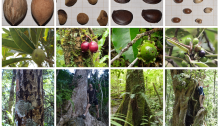
The tragic fate of lowland tropical forests in the lost land of the dodo

Sébastien Albert and Olivier Flores discuss their article: ‘Defaunated and invaded insular tropical rainforests won’t recover alone: recruitment limitation factors unravelled by hierarchical models of spontaneous and assisted regeneration.’ For text in French and Spanish, please see below. Background It is well known that wild populations of large vertebrates are in decline worldwide, with strong…

The generality of plants’ positive interactions

Nicolas Velasco Saragoni discusses his article: ‘Large-scale facilitative effects for a single nurse shrub: impact of the rainfall gradient, plant community and distribution across a geographic barrier.’ For text in Spanish, please see below. Are you curious about how common it is for plants to positively influence each other? This intriguing question formed the basis…

Plants Facing Double Trouble: The Impact of Simultaneous Drought and Herbivory on Chemical Variation Within a Species

Aramee Diethelm discusses her article: ‘Herbivores disrupt clinal variation in plant responses to water limitation.’ Factors Shaping Plant Traits Plants, often perceived as static, exhibit remarkable resilience in challenging environments involving rapid adjustments (plastic responses), and evolving (evolutionary responses) to cope with challenges. Research has predominantly focused on single stressors, despite the increasing occurrence of…

Evolutionary pressures from a harsh environment maintains similarities between closely related species of seagrasses.

Fernando Tuya Cortés, from ECOAQUA’s Biodiversity and Conservation Group, discusses his article: ‘Strong phylogenetic signal and models of trait evolution evidence phylogenetic niche conservatism for seagrasses.’ Aquatic flowering plants Seagrasses are a group of marine angiosperms (i.e., flowering plants) fully adapted to a submerged life. They are found thoughout the world’s oceans, distributed from tropical…

Neighbouring tree effects on leaf herbivory: why should we care about insect specialization?

Shihong Jia and Bastien Castagneyrol discuss their article: ‘Neighbouring tree effects on leaf herbivory: insect specialization matters more than host plant leaf traits.’ Background Insect herbivores feed on plants and play a crucial role in determining plant performance, population, and community dynamics. This role is particularly significant in forests where insect herbivores can change the…