The March Art Gallery

This month our artists include Zuojie Li, Prashanth M.B, Huiyan Zhang, Luis Guallichico and Stephanie Clark. Mediums include performance art, oils, palette knives, printable screen enamel, stencils, watercolours and moss. Artist: Zuojie Li Title: Snail House Snail House depicts a snail man’s world in a surreal way, regardless of age or sex. Life in cramped…
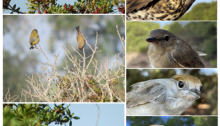
Elena Quintero disentangles the lasting effects frugivore birds have in the early recruitment of plant species

Some of the most common species of frugivorous birds known to consume and disperse Pistacia lentiscus fruits. In clockwise order starting from top left and with their migrant behaviour code in brackets: Saxicola rubicola (R), Curruca melanocephala (R), Turdus philomelos (W), Sylvia borin (TS), Sylvia atricapilla (W), Phoenicurus phoenicurus (TS), Erithacus rubecula (W), Turdus merula…

The February Art Gallery

The February Art Gallery features the work of NeoMeta, Wiebke Pandikow, Agnese Bankovska and Sophie Anna Gibbings. Mediums include jewellery, plastics, living organisms, drawing, installation, sound, printmaking, alternative process photography, painting, and sculpture. Artist: NeoMeta Title: MetaNature NeoMeta explores hidden narratives and unheard stories of slime and plants with the non-living post-human ecosphere of the…

Carine Emer on the intricate interactions between plants and their natural enemies in tropical forests

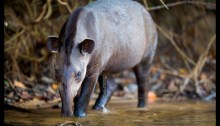
Once upon a time… large mammals flourished in the lush tropical forests of South America. Those giants evolved as key ecosystem engineers, acting as top-down regulators of ecological processes, either by predating on other smaller-sized animals, or feeding on plants, eating fruits and seeds, browsing and chewing leaves and branches, or even by trampling and…

Dr Xoaquin Moreira talks species interactions in natural or agro-forestry systems

This work came up on a solid and long-lasting collaboration between four institutions (from Spain, Mexico, Netherlands and Switzerland). This collaboration focussed, to a large extent, on investigating the ecological drivers and consequences of species interactions in natural or agro-forestry systems. Our research has focused on understanding the role of “bottom-up” factors (e.g., variation in…

The January Art Gallery

Welcome to the January Art Gallery. This month we are excited to feature found objects, video art, AI, linocuts, watercolours, immersive installation, collage and photography. Our artists are Jitka Klimešová, Jenny Jih, Sanji Yang, Pocoyo, Neal Haddaway, Annette Raffan, Iris Hill and Shengdi Cui. Shengdi Cui This art project focuses on exploring the small and…

Mismatched responses of plant and microbial biodiversity to climate warming and anthropogenic activities in the Third Pole

Biodiversity supports the foundation for ecosystem functions and services. Extensive research has shown that global changes have significantly impacted above-ground biodiversity and its associated ecosystem functions and services. However, below-ground soil microbial biodiversity has received relatively less attention, leading to significant knowledge gaps. It remains uncertain whether below-ground biodiversity responds to global changes in a…

The December Art Gallery

Welcome to the December Art Gallery features the art of Ellie Biggs, F. Curtis Lubbe, Rebecca Buchs, Jude Wild and Vicky Bowskill. Mediums include: pen and watercolour, ceramics and pipe cleaners, ballpoint pen, AI and oils on canvas. These artworks come from Australia, The Czech Republic, Switzerland and the UK. Ellie Biggs Ellie Biggs is…

Succession: a key to understanding biodiversity loss and restoration

Lucy Ridding discusses the background, work and findings on her recent research for Do plant traits influence primary succession patterns for bryophytes and vascular plants? Evidence from a 33-year chronosequence on bare chalk with fellow ecologists Peter Hawes, Robin Walls, Sharon L. Pilkington, Richard F. Pywell and Oliver L. Pescott. Background We’ve been researching succession…