Are large grazers a boon or bane for temperate salt marshes? Exploring context-dependency in the top-down trophic interactions of charismatic megafauna

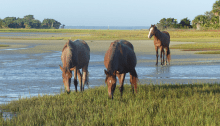
Sean J Sharp (@seancologie, Linkedin), from University of Maryland, discusses his article: Large grazers suppress a foundational plant and reduce soil carbon concentration in eastern US saltmarshes Grazing has been a common practice in temperate salt marshes for millennia. In European saltmarshes, the grazing activity of large animals like sheep and cows can boost plant…

Understanding how diversity and disturbance affect biomass stock and productivity

Erica Rievrs Borges, Institut de recherche pour le développement in France, discusses her article: Evolutionary diversity impacts tropical forest biomass and productivity through disturbance-mediated ecological pathways in both English and French. Understanding Biodiversity and Biomass We know that tropical forests are incredibly important, partly because they account for around half of global forest aboveground carbon…

Bringing habitat patches into the species distribution models world

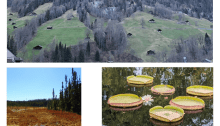
Federico Riva, Environmental Geography Dept. of the Institute for Environmental Studies (IVM),Vrije Universiteit Amsterdam, discusses his review article: Incorporating effects of habitat patches into species distribution models Habitat patches are everywhere – forests surrounded by agriculture, pastures within Alpine forests, or green areas in a city. This patchiness of many ecosystem types is key to…

How mycorrhizal associations are growing our understanding of plant-soil feedback across plant communities

Andrew Eagar and Sara Moledor, from Michigan State University’s Department of Plant Biology, discuss their research group’s new review paper: Setting the Stage for Plant-Soil Feedback: Mycorrhizal Influences over Conspecific Recruitment, Plant and Fungal Communities, and Coevolution A holistic view of plant-soil feedback Research over the last 20 years on plant-soil interactions has greatly advanced…

Entangled? How to resolve feedbacks between diversity and productivity in natural systems

Karl Andraczek (@KarlAndraczek), from the German Centre for Integrative Biodiversity Research (iDiv) Halle-Jena-Leipzig, discusses his article: Weak reciprocal relationships between productivity and plant biodiversity in managed grasslands Setting The Scene Global change impacts both plant diversity and ecosystem functioning with detrimental consequences for nature’s contributions to people. Predicting these consequences has emerged as a focal…

Timing of nutrient resorption from senesced leaves: steady-and-slow versus late-and-fast

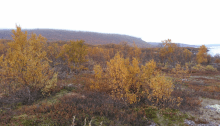
Yu-Kun Hu, from Lanzhou University, discusses his article: Leaf functional traits predict timing of nutrient resorption and carbon depletion in deciduous subarctic plants Nutrient resorption from senescing leaves is an important way that plants maintain their nutrient balance, meeting more than 1/3 of their total nutrient requirements. Thus, these nutrients are critical for plant growth…

Why it makes sense for trees to reproduce in synchrony

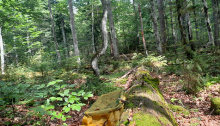
Mario B. Pesendorfer, Institute of Forest Ecology, Department of Forest and Soil Sciences, BOKU – University of Natural Resources and Life Sciences, Vienna, Austria, discusses his article: Positive spatial and temporal density-dependence drive early reproductive economy-of-scale effects of masting in a European old-growth forest community In temperate forests, tree populations often produce large bumper crops…

Do Phylogenetic Relationships Influence Priority Effects in Grassland Plants?

Julia Dieskau, from Martin Luther University Halle-Wittenberg, discusses her article ‘Phylogenetic relationships and plant life stage but not biogeographic history mediate priority effects of European grassland plants’ Background What factors determine the composition of plant communities? Many scientists have been exploring this question from various perspectives throughout the past century. Despite their efforts, there are…

A mini-review as a true team effort

Karen De Paw, Dries Landuyt and Kris Verheyen talk teamwork at ForNaLab. Approximately one year ago, the Journal of Ecology invited plant ecologists to write mini-reviews on the theme of nature-based solutions. Given our background in forest ecology, this sparked the idea within our research group of coming up with a review that would summarise…