Unraveling the Complex Interactions in Tallgrass Prairie Ecosystems

Eric Duell, from the Kansas Biological Survey & Center for Ecological Research, discusses his article: ‘Mycorrhizal-herbivore interactions and the competitive release of subdominant tallgrass prairie species‘ Tallgrass prairies of central and eastern North America are characterized by diverse plant communities consisting of grasses and forbs (often called wildflowers or broadleaves) which possess a variety of…

Fofos e Ecologicamente Relevantes! Pedro Hoffmann, Andy Green and Leonardo Maltchik on how cute rodents can be ecologically relevant

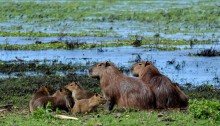
O Papel de Capivaras e ratões-do-banhado em Áreas Úmidas / The Role of Capybaras and Nutrias in Wetlands Capivaras na área de estudo / Capybaras at the study site (Foto: Pedro Hoffmann) Roedores como pequenos camundongos, esquilos e porquinhos-da-índia, são mundialmente conhecidos por sua aparência amigável e fofa. Assim como os maiores roedores do mundo…

Jaime Moyano on the negative impacts of planting trees in treeless ecosystems to mitigate climate change

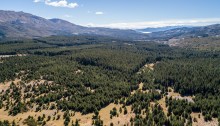
Climate change is one of the most important challenges of our time. Although reducing energy use and limiting the emission of greenhouse gases are the most effective solutions, this may not be feasible in many countries yet. On the other hand, replacing naturally treeless ecosystems (such as grasslands, shrublands and wetlands) with tree plantations (afforestation)…

The Biological Flora champions Sea Campions

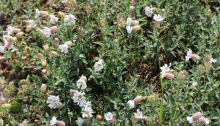
Biological Flora author (and editor) Anthony Davy introduces a fascinating coastal species that offers many more ecological insights than one might imagine. This account of the Sea Campion (Silene uniflora) is the latest contribution to the long-running Biological Flora of Britain and Ireland series. The article itself has a long history: unusually, the authors include…

Always put eggs in two baskets? The “wisdom” of a seed-dimorphic aster to cope with environmental uncertainty.

Huixuan Liao and Qian Gan, Sun Yat-sen University School of Life Sciences, discuss their article: ‘Spatiotemporal interaction of risk-spreading strategies for a seed-dimorphic plant’ Background Maternal modification of offspring stress tolerance is a ubiquitous phenomenon in plant and animal kingdoms that affects population persistence and growth. When looking into this phenomenon, one can’t help but…

Joshua Brian explores the link between plant damage and performance

Plant enemies like insect herbivores and fungal pathogens eat or degrade plant tissue. How does this affect performance? Photo: Josh Brian We are invasion biologists, studying how and why species become invasive. One of the biggest hypotheses in our field is the ‘enemy release hypothesis’, which says that species become invasive because they escape from…

Mariona Pajares-Murgó on how mutualistic and antagonistic phyllosphere fungi contribute to plant recruitment in natural communities

The interest on the microbial ecosystems that inhabit leaves is rapidly increasing due to their participation in basic ecosystem functions. One of the aspects of plant dynamics which leaf fungi can most clearly affect is recruitment, since the success of newly germinated plants can be seriously compromised by pathogenic activity or by the absence of…

Evolving into weirdness

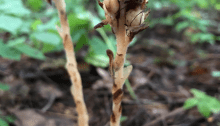
Richard P. Shefferson, University of Tokyo, discusses his article: ‘Life history costs drive the evolution of mycoheterotrophs: increased sprouting and flowering in a strongly mycoheterotrophic Pyrola species’ Background When we think of plants, we think of trees and grasses, flowers, and ferns. The single most obvious and important characteristic of plants is that they are…

Understanding the success of invasive plants through community assembly

Urmi Poddar discusses her paper ‘Similar trait-based successional assembly in native and introduced plants despite species pool differences.’ Background Invasive species are one of the major threats to biodiversity. These species tend to take over natural communities, leading to the displacement of native species, loss of biodiversity, and disruption of ecosystem functions. But not all…