Shaping tropical montane orchid communities

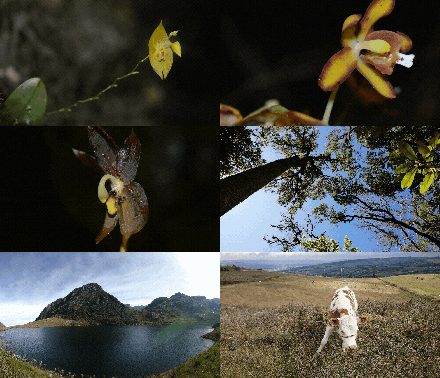
Edicson Parra-Sanchez discusses his recent article, ‘Neutral-based processes overrule niche-based processes in shaping tropical montane orchid communities across spatial scales‘: Orchid species are among the richest and most popular horticultural plants on the planet. They have been featured in films, used as symbols of biodiversity in governmental institutions, and utilized in traditional medicine for centuries.…

🌳Neighbours matter & the weak succumb

David Cracknell, George Peterken and John Healey discuss their recent article, ‘Neighbours matter and the weak succumb: ash dieback infection is more severe in ash trees with fewer conspecific neighbours and lower prior growth rate‘: Lady Park is an ancient, mixed deciduous woodland on the flanks of the Wye Gorge between Symonds Yat and Monmouth…

Why unmanaged forests are crucial for understanding long-term forest dynamics

Yannek Käber discusses his recent article: Sheltered or suppressed? Tree regeneration in unmanaged European forests. Find out how the intricate relationships between tree species, competition, and stress responses are vital for devising effective conservation and management strategies in the face of climate change: Forest regeneration is a complex process influenced by a multitude of factors, making it challenging…

Great Expectations, Hard Times: a tale of competition-induced tree mortality across Europe

Niko Kulha discusses his recent article: Competition-induced tree mortality across Europe is driven by shade tolerance, proportion of conspecifics and drought. Climate change is altering the conditions and context for tree growth in myriad ways, including increasing forest stand density and tree biomass. These changes in tree neighborhoods suggest increased tree-tree competition, which may increase…

Can ecosystems recover after tree invasions?

Sarah Sapsford discusses her recent article: Slow soil enzyme recovery following invasive tree removal linked to bacterial and fungal communities. 🌲 The tree invasion problem Pine trees have been planted around the world for their fast growing and useful timber. But sometimes these trees can become highly invasive – and when they do, they may change…

Unlocking the potential effect of transposable elements on ecosystems

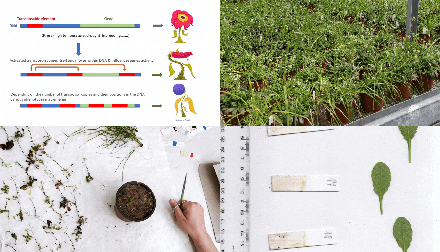
VĂ­tek Latzel and colleagues discuss their latest research, published in the Journal of Ecology: Phenotypic diversity generated by a transposable element increases productivity and resistance to competitors in plant populations. Read on to find out more about the role of transposons in biodiversity and resilience: The last decades of biodiversity-ecosystem functioning experiments have attempted to…

Exploring the drivers of temporal stability in coastal dune plant communities

Greta la Bella discusses her recent article: Drivers of plant community (in)stability along a sea-inland gradient. Read on to find out about the species ecological characteristics that promote the stability of coastal dune ecosystems: ————————————————————————————————————————————– âť“ What is stability? Global change pressures are threatening the stability of natural ecosystems worldwide, i.e. an ecosystem’s ability to…

Nutrient enrichment alters seasonal β-diversity in global grasslands

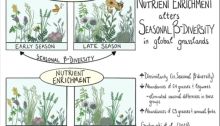
In this video, Magda Garbowski summarises their recent article: Nutrient enrichment alters seasonal beta-diversity in global grasslands: 📽️ Transcript: Plant communities are constantly changing, sometimes even with in a single growing season. For example, some species may grow in the spring, whereas others may dominate in the fall. This temporal niche partitioning allows plants to use…

Marcescence as a puzzle piece to the nutrient cycle

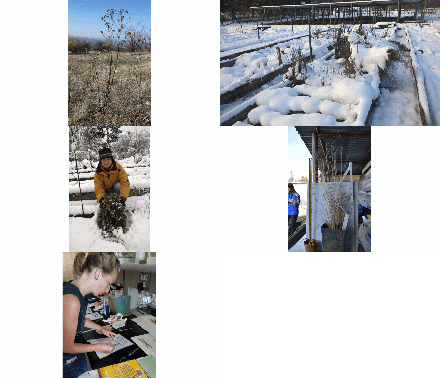
Mudrák Ondrej discusses his recent article: Ecological significance of standing dead phytomass: Marcescence as a puzzle piece to the nutrient cycle in temperate ecosystems. ❄️ Why do some plants retain their dead tissues and others don’t? As the winter approaches and the first freezing temperatures sweep across temperate climates, plants become dormant and shed their leaves.…