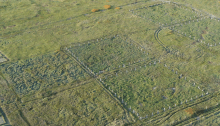
Why does heather self-organise into wave-like patterns? A mathematical investigation

Toyo Vignal, Okinawan Institute of Science and Technology in Japan, discusses her article: Surviving the winds through pattern formation: Mathematical modelling of heather stripes in Scotland. In some remote areas of the Scottish highlands, one can encounter intriguing vegetation patterns consisting of regularly arranged plants and bare soil. The first time I encountered such patterns…

Striking shifts in the timing of bryophyte spore dispersal: What 35 years of airborne DNA revealed about climate change

Fia Bengtsson, Lund University and Norwegian Institute of Nature Research, discusses her article: Rapid shifts in bryophyte phenology revealed by airborne eDNA Most of us walk past mosses and liverworts without really noticing them. But these small plants, known as bryophytes, are vital to ecosystems, including in Arctic and sub-Arctic regions. They retain water, regulate…

Living in a rainbow: How the light spectrum shapes phytoplankton communities and trophic transfer in aquatic ecosystems

Sebastian Neun, Institute for Chemistry and Biology of the Marine Environment (ICBM) at the University of Oldenburg, Germany, discusses his article: Light spectrum matters: Interactive effects of light and nutrients on phytoplankton communities and trophic transfer Where is the rainbow? All lakes are characterised by a tightly linked network of food chains, and phytoplankton forms…

Evolving the ability to stock up nitrogen

Alice Ardichvili, Sorbonne University, discusses her article: Spatial context allows the evolution of the control of nitrification by plants Once upon a time The project began a long time ago, in the late 1990s, when my PhD advisor J-C was still a carefree and enthusiastic individual. He and his colleagues observed that a common grass…

Scaling Up Phenology: What Millions of Volunteer Observations Can Tell Us About the Effects of Climate Change on Plants

Amanda Gallinat, Colby College, USA, and Theresa Crimmins, USA National Phenology Network, discuss their article: Combined volunteer and ecological network observations show broad-scale temperature-sensitivity patterns for deciduous plant flowering and leaf-out times across the Eastern USA Around the globe, the timing of seasonal activity in plants and animals – termed phenology – is shifting substantially…

The critical role of plant phenology in the biomass production of alpine plants under climate change

Miaojun Ma, Gansu Gannan Grassland Ecosystem National Observation and Research Station, State Key Laboratory of Herbage Improvement and Grassland Agro-ecosystems, College of Ecology, Lanzhou University, discusses his article: Asynchronous phenological responses to warming affect biomass production contrastingly in flowering functional groups Background Plant phenology and productivity changes represent two of the most critical climate-induced changes…

When plants gain (or lose) ground in the French Alps

Romain Goury, University of Grenoble Alpes in France, discusses his article: Recent vegetation shifts in the French Alps with winners outnumbering losers, in both English and French. When we walk through the mountains, it is often easy to notice plants that have not been there before. But spotting those that are quietly disappearing is a…