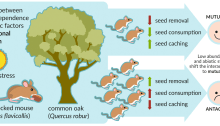
Mariona Pajares-Murgó on how mutualistic and antagonistic phyllosphere fungi contribute to plant recruitment in natural communities

The interest on the microbial ecosystems that inhabit leaves is rapidly increasing due to their participation in basic ecosystem functions. One of the aspects of plant dynamics which leaf fungi can most clearly affect is recruitment, since the success of newly germinated plants can be seriously compromised by pathogenic activity or by the absence of…

Evolving into weirdness

Richard P. Shefferson, University of Tokyo, discusses his article: ‘Life history costs drive the evolution of mycoheterotrophs: increased sprouting and flowering in a strongly mycoheterotrophic Pyrola species’ Background When we think of plants, we think of trees and grasses, flowers, and ferns. The single most obvious and important characteristic of plants is that they are…

Understanding the success of invasive plants through community assembly

Urmi Poddar discusses her paper ‘Similar trait-based successional assembly in native and introduced plants despite species pool differences.’ Background Invasive species are one of the major threats to biodiversity. These species tend to take over natural communities, leading to the displacement of native species, loss of biodiversity, and disruption of ecosystem functions. But not all…

Meet our new Blog Editor: F. Curtis Lubbe

We’re pleased to introduce our new Blog Editor! Curtis Lubbe joins the team to help manage the Journal of Ecology blog and publish author’s stories behind their research. Find out a bit about Curtis below: Name: F. Curtis LubbeLocation: Třeboň, Czech RepublicKeywords: belowground storage organs, drought, functional ecology, nonstructural carbohydrates, overwintering, storage Tell us a bit…

Biodiversity supports grassland resistance and recovery under extreme drought

Manuele Bazzichetto discusses his article: ‘Biodiversity promotes resistance but dominant species shape recovery of grasslands under extreme drought.’ Background A hot idea in ecology is that biodiversity helps ecosystems do better. For instance, high biodiversity should help ecosystems to maintain their functions (e.g., biomass production) over time. In other words, biodiversity should stabilise ecosystem functions.…

Tyler Coverdale – 2023 Harper Prize Winner!🏆

We’re delighted to announce that the winner of the 2023 Harper Prize is Tyler Coverdale! The Harper Prize is awarded annually for the best paper published in the journal by an early career researcher. Winner: Tyler Coverdale Paper: Unravelling the relationship between plant diversity and vegetation structural complexity: A review and theoretical framework “As Tyler´s succinct review points out, we…

Does drying make peat mosses more vulnerable to drought?

Nicola Kokkonen, Anna Laine-Petäjäkangas, and Eeva-Stiina Tuittila discuss their article: ‘A deepened water table increases the vulnerability of peat mosses to periodic drought.’ Background Around the world, we are witnessing warmer temperatures and extreme weather caused by climate change. However, these changes are not affecting all regions equally; northern regions are being hit hardest. While…

The April Art Gallery

This month we are featuring Chethana V. Casiker, Luiz F. C. Serigheli, Marta Barberis, Stephanie Glendinning and Bethany Bridge. Mediums include tapestry, pen, coloured pencils, drag, tattoo, make up, look and performance, paint, sound, graffiti and watercolours. Artist: Chethana V. Casiker I am a researcher who studies bees in urban landscapes. I wanted to paint…

Understanding the Impact of Deer and Earthworms on Forest Understories

Annise Dobson discusses her article: ‘Individual and combined effects of invasive earthworms and native white-tailed deer on understory plant survival, growth, and reproduction.’ Background In northeastern U.S. forests, understorey plant communities are undergoing sweeping transformations. Knowing what to do to achieve our conservation goals is complicated by the fact that many of these stressors co-occur…