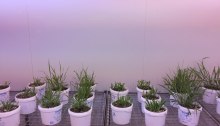
Exploring the drivers of temporal stability in coastal dune plant communities

Greta la Bella discusses her recent article: Drivers of plant community (in)stability along a sea-inland gradient. Read on to find out about the species ecological characteristics that promote the stability of coastal dune ecosystems: ————————————————————————————————————————————– ❓ What is stability? Global change pressures are threatening the stability of natural ecosystems worldwide, i.e. an ecosystem’s ability to…
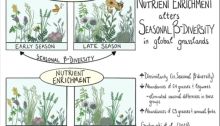
Nutrient enrichment alters seasonal β-diversity in global grasslands

In this video, Magda Garbowski summarises their recent article: Nutrient enrichment alters seasonal beta-diversity in global grasslands: 📽️ Transcript: Plant communities are constantly changing, sometimes even with in a single growing season. For example, some species may grow in the spring, whereas others may dominate in the fall. This temporal niche partitioning allows plants to use…

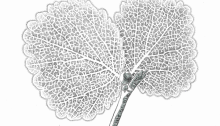
Marcescence as a puzzle piece to the nutrient cycle

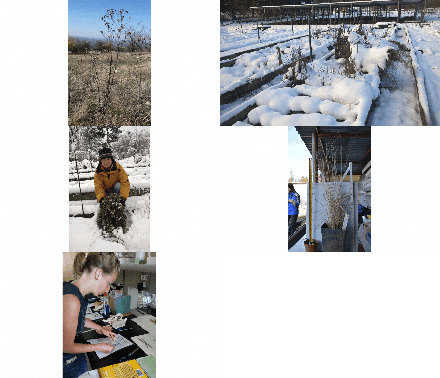
Mudrák Ondrej discusses his recent article: Ecological significance of standing dead phytomass: Marcescence as a puzzle piece to the nutrient cycle in temperate ecosystems. ❄️ Why do some plants retain their dead tissues and others don’t? As the winter approaches and the first freezing temperatures sweep across temperate climates, plants become dormant and shed their leaves.…

Editor’s Choice (111:08): Seasonality drives ECM fungal community composition in neotropical dry forests

The editor’s choice for our August issue is “Seasonality regulates the structure and biogeochemical impact of ectomycorrhizal fungal communities across environmentally divergent neotropical dry forests“ by Katilyn Beidler et al. Here, Associate Editor James Dalling discusses the importance of this research: We usually think of ectomycorrhizal (ECM) tree species in the tropics as occurring on the tops of mountains…

Time & place matter: understanding diverging responses of dwarf shrubs to a changing Arctic climate

Runa Magnusson discusses her recent article: Spatiotemporal variability in precipitation-growth relations of Betula nana in the Siberian lowland tundra. Warming, greening, thawing – The Arctic is a place of rapid warming and environmental change, with temperatures increasing three to four times faster than the global average. Impacts on Arctic ecosystems and communities include, among many…

Blog Editor vacancy – join the team!

Role: Blog Editor, Journal of EcologyLocation: Anywhere (fully remote)Working pattern: 8-10 hours per monthSalary: Voluntary (with benefits)Closing date:  31st July 2023Interviews: 23rd August 2023, online We’re seeking an ecologist with a passion for communicating research to help grow the Journal of Ecology blog, and lead on commissioning and editing scientifically robust, high-quality content! Journal of Ecology publishes cutting-edge research to…

Cover stories (111:06): Always look deeper

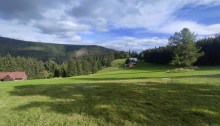
The cover image for our June issue shows a ‘deeper look’ into species-rich mountain grassland in the Krkonoše Mountains, Czech Republic. This image relates to the article ‘Plant–soil feedbacks in a diverse grassland: Soil remembers, but not too much‘, by Eliška Kuťáková et al. Here, Eliška tells us the story behind the image: Being a plant ecologist,…

Climate crisis threatens Caatinga’s plant biodiversity

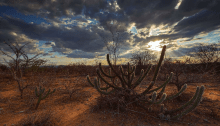
Mario Moura discusses his recent article: Pervasive impacts of climate change on the woodiness and ecological generalism of dry forest plant assemblages. Find out more about the importance of long-term conservation planning for maintaining tropical dry forests. The climate crisis is already a reality for many ecosystems on Earth. Among those ecosystems facing significant challenges…