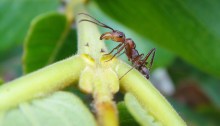
Experimental resource supplementation shifts ant-mediated defense on silver cholla

Jenna Braun, York University, Toronto, discusses her article: Experimental resource supplementation shifts ant-mediated defense on silver cholla Extra-floral nectaries (EFN) play an important role within mutualisms between plants and ants. In this relationship, ants receive a nutrient-rich food source from plants in exchange for defending the plant from herbivores. Ant species are not equally effective…
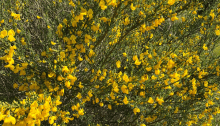
The humble broom

Peter Thomas, Keele University, UK and Marion Giertych, University of Zielona Góra and Institute of Dendrology PAS, Poland, discuss their article: Biological Flora of Britain and Ireland: Cytisus scoparius, in English and Polish Broom (Cytisus scoparius), a non-spiny relative of gorse (Ulex species), is a delightful shrub native across Europe in open areas. What makes…

Cover stories: Volume 109 Issue 2

The cover image for our new issue shows an ant standing on the tip of a Lafoensia pacari leaf in the Cerrado, Brazil. Author Kleber Del-Claro shares the story behind this stunning image, which was taken by co-author Denise Lange and relates to their recent research article “Climate seasonality drives ant–plant–herbivore interactions via plant phenology in an extrafloral…

Climate driven seasonal patterns in an ant–plant–herbivore interaction

How do seasonal changes in climate influence ecological interactions in an extrafloral nectary‐bearing plant community? Find out in recently published Journal of Ecology paper by Calixto et al. Author Kleber Del-Claro explains how climate can directly and indirectly impact ant–plant–herbivore interactions, and how we can better understand these changes by considering plant phenology over time.…

Optimal Defense Theory in an ant–plant mutualism

Here we take a closer look at a fascinating plant defense article by Calixto et al., which has recently been published in Journal of Ecology. Author Kleber Del-Claro explains different methods for anti-herbivore plant defenses and shares the results of this research, which is the first to show that ant recruitment via extrafloral nectar follows…