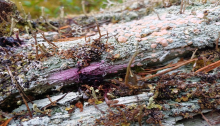
Regrown but not recovered: Forest management regime alters deadwood volume and wood-inhabiting fungal diversity

Vincent Buness, Swedish University of Agricultural Sciences, discusses his article: Distinct diversity trajectories of boreal wood-inhabiting fungi following fire vs. clear-cutting As humans, we tend to trust our senses and assume that we can perceive most of what surrounds us. When we walk through the forest, we see trees with their stems and canopy, and…
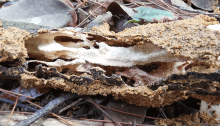
Fast growing trees also decompose fast

Donghao Wu, from the Zhejiang University in China, discusses their article: The intrinsic coordination of tree growth strategy and wood decomposability What happens after a tree dies? As plant ecologists, we often focus on how trees grow: how fast they capture carbon, how tall they become, and how long they live. But forests are not…

Wood trait-decay relationships depend on environmental context

Donghao Wu, School of Ecology, Shenzhen Campus of Sun Yat-Sen University, discusses his article: Wood trait-decay relationships vary with topography and rainfall seasonality in a subtropical forest in China Wood trait-decay relationship Deadwood stores 8% of global forest carbon, and thus it is important to understand the dominant drivers of wood decomposition rates. Many physical…

Editor’s Choice: Volume 109 Issue 4

The Editor’s Choice for our April issue is “Dynamic feedbacks among tree functional traits, termite populations and deadwood turnover” by Guo, Tuo, Ci, Yan & Cornelissen. The findings of this article imply that tree functional composition, with variation in deadwood quality through decomposition time, can help to sustain termite populations and thereby forest carbon turnover. Here…