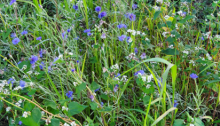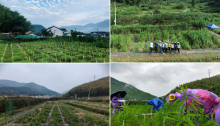
How does plant diversity recover after invasive species removal?

Shao-peng Li and Bingwei Lv, East China Normal University, discuss their article: Multidimensional diversity recovery following invasive species removal: Roles of colonization, extinction, and abundance shifts. Background Plant invasion is a global ecological challenge, and invasive species often outcompete native plants, leading to a loss of biodiversity and disruption of ecosystem functions. Removing these unwelcome…

Liana diversity and density in Ghana show positive association with precipitation, precisely opposite to pantropical trends

Bismark Ofosu-Bamfo, University of Energy and Natural Resources in Sunyani, Ghana, discusses his article: Patterns and drivers of liana community structure across five forest ecosystem types in Ghana In recent years, ecologists in the tropics have dedicated a good amount of research to understand the pattern and drivers of community assemblages of woody climbing plants,…

Extrafloral nectary tree-driven soil carbon sequestration

Yumei Pan, Xiaojuan Liu, Michael Staab, and Naili Zhang, Beijing Forestry University in China, discuss their article: Soil carbon sequestration: Facilitated effect of extrafloral nectary trees in a diverse subtropical forest Carbon: Crucial role in climate change mitigation Soil organic matter dynamics and carbon sequestration are critical for mitigating climate change. Forest soils, which account…

How does camelid intensity influence the diversity and stability of Andean grasslands?

Ana Patricia Sandoval-Calderon and Yann Hautier, Utrecht University, discuss their article: Andean grassland stability across spatial scales increases with camelid grazing intensity despite biotic homogenization Nestled high in the Andes, a vibrant yet fragile ecosystem thrives under the watchful gaze of camelids. These ancient grasslands have been shaped over centuries by the grazing habits of…

Tropical Forest Species Coexistence and Surprisingly Simple Models

Douglas Sheil, Forest Ecology and Forest Management Chair Group, Wageningen University and Research, The Netherlands, discusses his article: A simple competition model can predict rainforest tree diversity, species abundance and ecosystem functions Many tropical forests are remarkably diverse, often supporting hundreds of tree species in just a few hectares. But how can so many species…

Diversity enhances forest productivity through its effect on the number of trees within forests.

Xavier Morin, CEFE, CNRS, University of Montpellier, EPHE, IRD, Montpellier, France, discusses his article: More species, more trees: The role of tree packing in promoting forest productivity The effect of tree species diversity on forest productivity is now well-known. On average, plots with more species (in mixed forests) have a greater net productivity than plots with…

Can tree species diversity make our forest more resilient to climate change?

Eugénie Mas, from the Smithsonian Tropical Research Institute (@MasPlantphys) discusses her article: Drought effects in Mediterranean forests are not alleviated by diversity-driven water source partitioning Forest are unique ecosystems where each species of animal, plant, and microorganism interact together to provide many services, called ecosystem services. These services can benefit humans directly through wood production,…

Understanding how diversity and disturbance affect biomass stock and productivity

Erica Rievrs Borges, Institut de recherche pour le développement in France, discusses her article: Evolutionary diversity impacts tropical forest biomass and productivity through disturbance-mediated ecological pathways in both English and French. Understanding Biodiversity and Biomass We know that tropical forests are incredibly important, partly because they account for around half of global forest aboveground carbon…