Regrown but not recovered: Forest management regime alters deadwood volume and wood-inhabiting fungal diversity

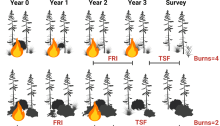
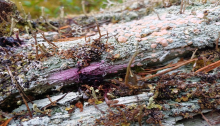
Vincent Buness, Swedish University of Agricultural Sciences, discusses his article: Distinct diversity trajectories of boreal wood-inhabiting fungi following fire vs. clear-cutting As humans, we tend to trust our senses and assume that we can perceive most of what surrounds us. When we walk through the forest, we see trees with their stems and canopy, and…
How do past disturbances shape tree growth?

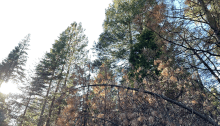
Yihong Zhu, University of California, Berkeley, discusses her article: Legacy effects under an emerging novel disturbance regime: A memory-based framework to quantify tree growth responses Emergent novel disturbance regime Moderate-severity disturbances, such as drought, pathogen irruptions, and prescribed fire, may not cause widespread tree mortality, but can leave lingering impacts on surviving trees. Such disturbances…

Tundra Fires: A Long-Lasting Legacy and Uncertain Future

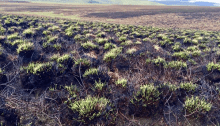
Ramona Heim, Institute of Landscape Ecology of the University of Münster in Germany, discusses her article: Arctic tundra ecosystems under fire – Alternative ecosystem states in a changing climate? Fire events in the tundra are becoming increasingly frequent, garnering more media attention. These fires strongly reshape the landscape; however, our understanding of tundra vegetation recovery…

Do trait-growth relationships change as plants age? An Australian heathland perspective

Lily Dun, Western Sydney University in New South Wales, Australia, and The University of Queensland in Queensland, Australia, discusses her article: Do trait-growth relationships vary with plant age in fire-prone heathland shrubs? When we think about plant growth, we often assume that certain functional traits—such as wood density, leaf structure, or biomass allocation—determine how fast…

Fire and Flora: Community-Level Adaptations in Mediterranean Landscapes

Bérangère Leys, UMR AMAP (Montpellier, France), discusses her article: Functional responses of Mediterranean flora to fire: A community-scale perspective As climate change increases the frequency and intensity of fires, especially in Mediterranean regions, understanding plant adaptations to fire has become crucial. Fires are a natural component of Mediterranean ecosystems; however, hotter, drier conditions and human activities are making fires more intense, underscoring the…

Editor’s Choice: Volume 109 Issue 3

The Editor’s Choice for our March issue is “Simulated Indigenous fire stewardship increases the population growth rate of an understorey herb” by Hart‐Fredeluces, Ticktin & Lake. This article presents beargrass (Xerophyllum tenax) as a model system to explore the influence of Indigenous stewardship, or its absence, on population dynamics. Here the handling Editor, Crystal McMichael, discusses differing…

Indigenous stewardship and the protection of plant biodiversity under global change

Georgia Hart-Fredeluces discusses her recently published Journal of Ecology article: ‘Simulated Indigenous fire stewardship increases the population growth rate of an understory herb‘. Find out more about about the importance of understanding Indigenous management practices to protecting plant biodiversity. Plant biodiversity is foundational to ecosystem integrity and human well-being, yet it continues to decline with…