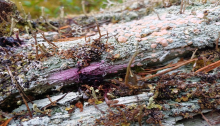
Regrown but not recovered: Forest management regime alters deadwood volume and wood-inhabiting fungal diversity

Vincent Buness, Swedish University of Agricultural Sciences, discusses his article: Distinct diversity trajectories of boreal wood-inhabiting fungi following fire vs. clear-cutting As humans, we tend to trust our senses and assume that we can perceive most of what surrounds us. When we walk through the forest, we see trees with their stems and canopy, and…

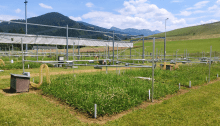
Two grasses, two pathways: How plant strategies shape drought-microbe responses under global change

Gang Yang and Zuzana Münzbergová, Charles University in Prague, discuss their article: Contrasting drought responses in two grassland plant-microbe systems under climate change Drought is becoming more frequent and intense under global change, but plant responses vary widely. Some species are adapted to tolerate stress, while others perform well only when resources are abundant. Because…

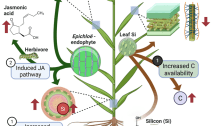
Silicon and beneficial fungi: Strengthening plant resilience

Ramalka H. Kasige, Ximena Cibils-Stewart, Adam Frew, and Scott N. Johnson from Western Sydney University in Australia, discuss their article: Interactions between beneficial fungi and plant silicon: A review Plants are continually exposed to stresses — from drought, salinity, and metal toxicity to herbivores and pathogens. To withstand these challenges, they employ multiple strategies, including…

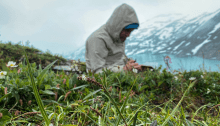
High-altitude allies: Alpine plants and their fungal partners

Skylar Burg, University of Jyväskylä in Finland, discusses her article: Abiotic conditions along altitude shape plant-fungal associations by influencing both fungal availability and association strength Setting out in the mountains High in the mountainous tundra of Norway, Sweden, and Finland, the perennial herb Bistorta vivipara, known as alpine bistort, thrives in conditions that challenge most…

Mariona Pajares-Murgó on how mutualistic and antagonistic phyllosphere fungi contribute to plant recruitment in natural communities

The interest on the microbial ecosystems that inhabit leaves is rapidly increasing due to their participation in basic ecosystem functions. One of the aspects of plant dynamics which leaf fungi can most clearly affect is recruitment, since the success of newly germinated plants can be seriously compromised by pathogenic activity or by the absence of…

Carine Emer on the intricate interactions between plants and their natural enemies in tropical forests

Once upon a time… large mammals flourished in the lush tropical forests of South America. Those giants evolved as key ecosystem engineers, acting as top-down regulators of ecological processes, either by predating on other smaller-sized animals, or feeding on plants, eating fruits and seeds, browsing and chewing leaves and branches, or even by trampling and…

The January Art Gallery

Welcome to the January Art Gallery. This month we are excited to feature found objects, video art, AI, linocuts, watercolours, immersive installation, collage and photography. Our artists are Jitka Klimešová, Jenny Jih, Sanji Yang, Pocoyo, Neal Haddaway, Annette Raffan, Iris Hill and Shengdi Cui. Shengdi Cui This art project focuses on exploring the small and…

Rainbow Research: Nature

To celebrate UK Pride Month, the British Ecological Society journal blogs are posting a Rainbow Research series, which aims to promote visibility of STEM researchers from the LGBTQ+ community. Each post will be connected to a theme represented by one of the colours shown in the Progress Pride flag. In this post, Justin Stewart discusses their…