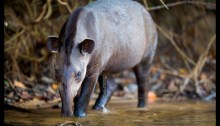
Beyond species interaction networks: The hidden role of individuals in community assembly

Liedson Carneiro, Southwestern Oklahoma State University, discusses his article: Structural differences in individual pollinator networks across bee species reveal the importance of population-level processes in the assembly of species interactions Plant–pollinator interactions are often described as networks; plant species are connected to pollinator species through their visits to flowers. This approach has advanced our understanding…
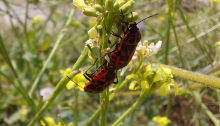
Darwin met the Red Queen

Carlos Roberto Fonseca, Universidade Federal do Rio Grande do Norte (UFRN) in Brazil, discusses his article: The Red Queen unveils the sexual and mating strategies of flowers In 1876, Charles Darwin wrote the book “The effects of cross and self-fertilization in the vegetable kingdom” to answer a simple, but important question: if self-fertilisation is the…

Insects and non-woody plants slow down tropical forest succession

Kari Sogera Iamba, University of South Bohemia and the Institute of Entomology of the Czech Academy of Sciences, discusses his article: Insects and non-woody plants slow down tropical forest succession: A community-wide experiment in Papua New Guinea We investigated the factors driving rainforest regeneration in canopy gaps created by tree falls or selective logging. Ecological…

Joshua Brian explores the link between plant damage and performance

Plant enemies like insect herbivores and fungal pathogens eat or degrade plant tissue. How does this affect performance? Photo: Josh Brian We are invasion biologists, studying how and why species become invasive. One of the biggest hypotheses in our field is the ‘enemy release hypothesis’, which says that species become invasive because they escape from…

Carine Emer on the intricate interactions between plants and their natural enemies in tropical forests

Once upon a time… large mammals flourished in the lush tropical forests of South America. Those giants evolved as key ecosystem engineers, acting as top-down regulators of ecological processes, either by predating on other smaller-sized animals, or feeding on plants, eating fruits and seeds, browsing and chewing leaves and branches, or even by trampling and…

Interview with Andrea Stephens – resource concentration by insects and effects on plants

A paper issue 100:4  in the Journal (Resource concentration by insects and implications for plant populations) by Andrea Stephens and Judith Myers explores how resource concentration by insects effects plants, using both modeling and empirical approaches. Read the abstract here. I caught up with Andrea a few weeks ago to do a video interview. Subscribe to our YouTube posts…