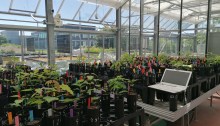
Joshua Brian explores the link between plant damage and performance

Plant enemies like insect herbivores and fungal pathogens eat or degrade plant tissue. How does this affect performance? Photo: Josh Brian We are invasion biologists, studying how and why species become invasive. One of the biggest hypotheses in our field is the ‘enemy release hypothesis’, which says that species become invasive because they escape from…

Mariona Pajares-Murgó on how mutualistic and antagonistic phyllosphere fungi contribute to plant recruitment in natural communities

The interest on the microbial ecosystems that inhabit leaves is rapidly increasing due to their participation in basic ecosystem functions. One of the aspects of plant dynamics which leaf fungi can most clearly affect is recruitment, since the success of newly germinated plants can be seriously compromised by pathogenic activity or by the absence of…

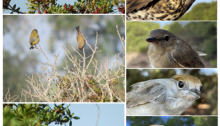
Elena Quintero disentangles the lasting effects frugivore birds have in the early recruitment of plant species

Some of the most common species of frugivorous birds known to consume and disperse Pistacia lentiscus fruits. In clockwise order starting from top left and with their migrant behaviour code in brackets: Saxicola rubicola (R), Curruca melanocephala (R), Turdus philomelos (W), Sylvia borin (TS), Sylvia atricapilla (W), Phoenicurus phoenicurus (TS), Erithacus rubecula (W), Turdus merula…

Dr Xoaquin Moreira talks species interactions in natural or agro-forestry systems

This work came up on a solid and long-lasting collaboration between four institutions (from Spain, Mexico, Netherlands and Switzerland). This collaboration focussed, to a large extent, on investigating the ecological drivers and consequences of species interactions in natural or agro-forestry systems. Our research has focused on understanding the role of “bottom-up” factors (e.g., variation in…

Mismatched responses of plant and microbial biodiversity to climate warming and anthropogenic activities in the Third Pole

Biodiversity supports the foundation for ecosystem functions and services. Extensive research has shown that global changes have significantly impacted above-ground biodiversity and its associated ecosystem functions and services. However, below-ground soil microbial biodiversity has received relatively less attention, leading to significant knowledge gaps. It remains uncertain whether below-ground biodiversity responds to global changes in a…

Succession: a key to understanding biodiversity loss and restoration

Lucy Ridding discusses the background, work and findings on her recent research for Do plant traits influence primary succession patterns for bryophytes and vascular plants? Evidence from a 33-year chronosequence on bare chalk with fellow ecologists Peter Hawes, Robin Walls, Sharon L. Pilkington, Richard F. Pywell and Oliver L. Pescott. Background We’ve been researching succession…

Volume 109 Issue 9

Volume 109 Issue 9 of Journal of Ecology is now available online! Our September issue contains a new Special Feature: Reconciling resilience across ecological systems, species and subdisciplines. This cross-journal special feature presents 30 fascinating articles published in Journal of Ecology, Journal of Animal Ecology and Functional Ecology, including the accompanying Editorial article. This Special Feature was overseen by Editors Pol…

Cover stories: Volume 109 Issue 8

The cover image for our August issue shows a female sharp-collared furrow bee visiting the flowers of a Mediterranean shrub. This image relates to the research article: Individual-based plant–pollinator networks are structured by phenotypic and microsite plant traits by Arroyo-Correa, Bartomeus, & Jordano. Lead author, Blanca Arroyo-Correa, and photographer, Curro Molina, discuss the biodiversity of Doñana National Park and…