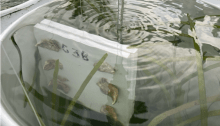
Seagrass-oyster facilitation at risk under future ocean conditions

Fiona Ralph, from Bowdoin College, discusses her article: Shifting seagrass-oyster interactions alter species response to ocean warming and acidification The Why: Eelgrass and oysters are ecosystem building species that both have economic, ecological, and cultural importance in Maine. Eelgrass populates much of the soft-sediment coastal subtidal in the Northern Hemisphere, which is also where most of…

Marine Plant Ecology

Earlier this week Journal of Ecology published a new Virtual Issue on Freshwater Plant Ecology, which you can read in full here. In this post Rich Shefferson shares a selection of recent marine plant articles! The featured papers fall into four key research themes: Population, Community, Ecosystem & Evolution. I suppose I am not alone…

Editor’s Choice: Volume 108 Issue 3

The Editor’s Choice article for Journal of Ecology’s latest issue Volume 108 Issue 3 is “Seagrass ecosystem metabolic carbon capture in response to green turtle grazing across Caribbean meadows” by Johnson et al. Associate Editor Randall Hughes explores this paper in more detail and explains what makes this paper so novel and valuable. Vegetated marine ecosystems such…

Green turtle grazing and seagrass carbon capture across Caribbean meadows

Journal of Ecology recently published an exciting new research paper by Johnson et al. “Seagrass ecosystem metabolic carbon capture in response to green turtle grazing across Caribbean meadows.” Author Robert Johnson discusses this research in more detail and presents further insights into how green turtle grazing affects carbon dynamics, within seagrass ecosystems. Green turtle abundance is…