2024 HARPER PRIZE SHORTLIST: For the next two weeks, we are featuring the articles shortlisted for the 2024 Harper Prize. The Harper Prize is an annual award for the best early career research paper published in Journal of Ecology. Joshua Brian’s ‘Release from aboveground enemies increases seedling survival in grasslands’ is one of those shortlisted for the award.
About the paper:
Our paper studied the effect of plant consumers (insects and fungal pathogens) on seedling survival – while lots of work has shown that consumers limit biomass and contribute to driving interactions among adult plants, much less has been done on how they affect recruitment. This affects the testing of key hypotheses, such as the enemy release hypothesis. This hypothesis states that invasive plants succeed because they escape from the consumers that limit them in their native range. However, few have considered enemy release early in the invasion process, and in general experiments linking enemy release with performance increases under field conditions are rare – hence our focus on seedling survival!

We set up a field experiment to test whether enemy release enhanced seedling survival for 16 different species, in two different recipient communities. This involved hand-painting over 1,500 individual seedlings with pesticides every two weeks to enforce enemy release, and over 10,000 total observations of seedlings over the summer. This definitely tested my field skills (and, in the middle of a Minnesota heatwave, my physical fitness!) to the limit. However, the help of the amazing research team and interns at Cedar Creek Ecosystem Science Reserve, USA, where the research took place, ensured everything went smoothly.
The results were surprisingly strong – enemy release boosted seedling survival by over 50%, a result which held over most of the species and both recipient communities. Resource-acquisitive species did particularly well when released from enemies, fitting nicely with theory that they are less defended and so should benefit the most from enemy release. These results suggest that enemy release may be a key factor in helping invasive plants gain an early foothold in their new ranges, even if generalist enemies soon target them. We also show which sorts of plants are most likely to receive this benefit, potentially helping to predict where the next invaders may come from. This experiment is ongoing (currently entering its fourth year!), so watch this space for lots more work on the potential benefits of enemy release to growth and reproduction once invaders are established!

About the author:
I am a postdoc working with Professor Jane Catford at King’s College London, UK. While I currently focus on plant invasions, I am interested in community ecology generally, with a particular fascination in host-parasite and parasite-parasite interactions, especially across ecological scales. My PhD was on the parasites of freshwater mussels in UK rivers, and my Masters looked at diversity in the coral-algal symbiosis on the coral reefs of Timor-Leste, so I’ve run the full gamut of marine, freshwater and terrestrial ecology! These quite disparate systems are linked by my interest in how different species interact, and what happens when their interaction ‘arena’ (whether that be a single host organism, a grassy field, or a continent) is disturbed.
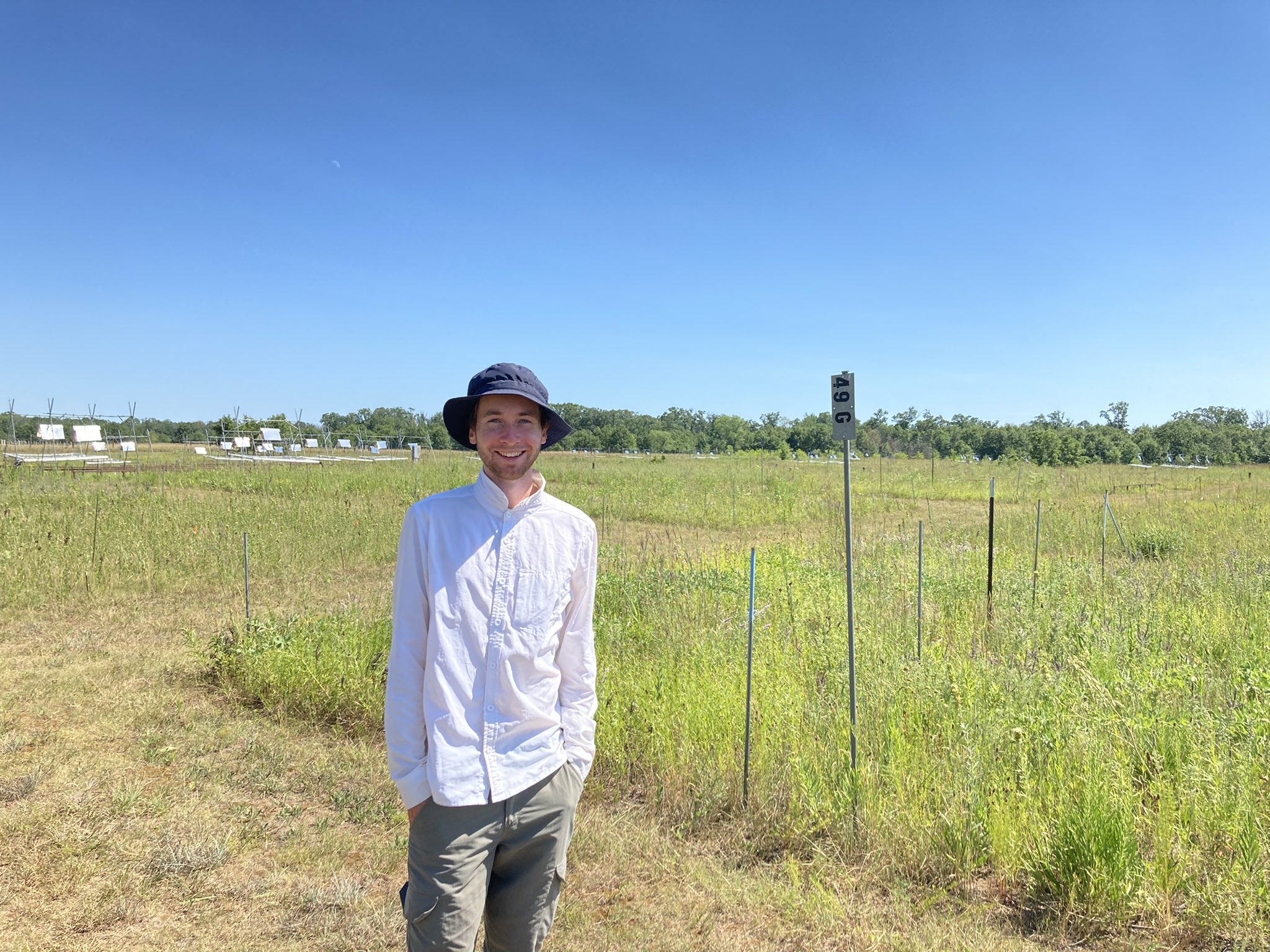
I can’t pinpoint exactly when I became interested in ecology – as an undergraduate I also did a degree in classical studies alongside my studies of marine biology, so I certainly wasn’t settled on an ecological career at that point! I think I was drawn to ecology by the dynamic nature of the natural world and its fundamental importance to a happy and healthy life on earth. There are so many interesting and worthwhile questions to ask and answer. If I was to give one piece of advice to others, it would be to talk with others and get feedback as much as possible. This paper benefited from the skills and experience of so many people – the ecological and statistical wizardry of my co-authors, but also the research coordinators and other researchers at Cedar Creek Ecosystem Science Reserve, whose thoughts and experiences in setting up field experiments was absolutely invaluable. I love ecology because there is so much to learn, both from the natural world but also from others who engage with it.
Find the other early career researchers and their articles that have been shortlisted for the 2024 Harper Prize here!

 jecologyblog.com