🏆Eminent Ecologist 2022: Hans Cornelissen (part 1)

The Journal of Ecology Editors are delighted to announce that Hans Cornelissen is our Eminent Ecologist award winner for 2022! In recognition of his work, we asked Hans to put together a virtual issue of some of his favourite contributions to the journal. Hans has also written this blog series, and was interviewed by Richard Bardgett about his motivations and career to…

Londiwe Mokoena: A grass tussock in a savanna: My journey in occupying space in the world of ecology

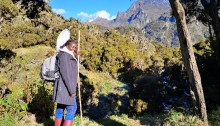
For Black History Month, the British Ecological Society (BES) journals are celebrating the work of Black ecologists from around the world and sharing their stories. The theme for UK Black History Month this year is Time for Change: Action Not Words. Londiwe Mokoena—a postgraduate student at the University of the Witwatersrand, South Africa—shares her story…

Professor Donald Pigott Obituary (1928-2022)

Written by Anthony Davy and John Lee. In a time of increasing specialisation, few British plant ecologists have been as influential on such a broad front as Professor Christopher Donald Pigott, who has died at the age of 94. He served the Journal of Ecology as editor of the Biological Flora of the British Isles…

Editor’s Choice (110:10): Finding your way in the world of forest dynamics models

The editor’s choice for our October issue is “The evolution, complexity and diversity of models of long-term forest dynamics” by Harald Bugmann and Rupert Seidl. Here, Associate Editor Pieter Zuidema explains the importance of this research:  Forests worldwide are confronted with a multitude of changes: climate change, increasing disturbances such as fires, and shifting societal demands. Forest…

Cover stories (110:9): Can disease resistance evolve independently at different ages? 

The cover image for our September issue features a pollinator approaching flowers of an alpine carnation with anthers carrying dark spores of  the anther-smut pathogen. This image relates to the research article: Can disease resistance evolve independently at different ages? Genetic variation in age-dependent resistance to disease in three wild plant species, by Emily Bruns et al.…

INTECOL 2022 Highlights

The INTECOL2022 conference (@intecol2022, #INTECOL2022) held earlier this month in Geneva (Switzerland), was a hybrid congress with the option to attend in-person or online (live or through recorded video talk). Many talks were presented online and the number of attendants in Geneva was slightly reduced compared to previous INTECOL conferences. Nevertheless, the presentations were of…

Editor’s Choice (110:9): Combining biogeographical approaches to advance invasion ecology and methodology

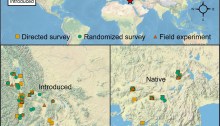
The editor’s choice for our September issue is “Combining biogeographical approaches to advance invasion ecology and methodology” by Dean Pearson et al. Here, Associate Editor Ayub Odour explains the importance of this research:  Invasions by alien plant species reduce native biodiversity, alter ecosystem processes, and subvert essential ecosystem services. Therefore, understanding the ecological and evolutionary mechanisms that…

Cover stories (110:8): Erythronium americanum, the Yellow trout lily

The cover image for our August issue features an Erythronium americanum leaf (the Yellow trout lily). This image relates to the research article: Citizen science across two centuries reveals phenological change among plant species and functional groups in the Northeastern US, by Kerissa Fuccillo Battle et al. Here, Kerissa tells us the story behind the image. This photograph shows…

Editor’s Choice (110:8): Two centuries of change

The editor’s choice for our August issue is “Citizen science across two centuries reveals phenological change among plant species and functional groups in the Northeastern US” by Kerissa Fuccillo Battle et al. Here, Associate Editor Charles Kwit explains the importance of this research:  While often equated with Henry David Thoreau, phenology and its documentation across space (e.g.…