Jingyi Ding – Harper Prize Shortlist

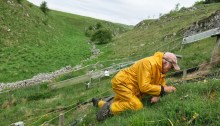
Throughout April, we are featuring the articles shortlisted for the 2021 Harper Prize. The Harper Prize is an annual award for the best early career research paper published in Journal of Ecology. Jingyi Ding’s article ‘Ecosystem functions are related to tree diversity in forests but soil biodiversity in open woodlands and shrublands‘ was one of those shortlisted for the…

Cover stories: Volume 110 Issue 3

The cover image for our March issue features a white-spectacled bulbul (Pycnonotus xanthopygos) feeding on the fruits of the desert plant Ochradenus baccatus near Eilat, Israel. This image relates to the research article: The survival contest of endozoochory: Conflicting interests in a frugivorous avian–plant mutualism, by Beny Trabelcy, Ido Izhaki, and Yoram Gerchman. Here the author Yoram…

Editor’s Choice: Volume 110 Issue 3

The editor’s choice for our March issue is “The strength and direction of local (mal)adaptation depends on neighbor density and the environment” by Germain et al. Here, Associate Editor Chengjin Chu explains the importance of this research.  Explicitly linking ecology and evolution to comprehensively reveal the interdependence structure of the entangled bank has been a long-standing…

2021 Harper Prize Shortlist: Early Career Research Award

The Harper Prize is awarded annually by the British Ecological Society for the best paper in Journal of Ecology by an early career author. We are pleased to present the shortlisted papers for the 2021 award (published in Volume 109): ⭐️ Christine Åkesson: Long-term ecological legacies in western Amazonia ⭐️ Paula Berenstecher: Worlds apart: Location above- or below-ground determines plant litter…

📚 Journal Club round-up

For anyone who missed it, we held our first Journal Club discussion last week, on Twitter! The featured paper was the Sprent Review article: Multi‐dimensionality as a path forward in plant‐soil feedback research, by Michael Gundale and Paul Kardol. To kick things off, the authors prepared a fantastic 12-minute video filmed around a campfire, in which…

Cover stories: Volume 110 Issue 2

The cover image for our February issue features a Female Asian elephant foraging in a dipterocarp forest of Peninsular Malaysia. This image relates to the research article: The ability to disperse large seeds, rather than body mass alone, defines the importance of animals in a hyper-diverse seed dispersal network, by Lisa Ong, Kim McConkey and Ahimsa Campos-Arceiz.…

Editor’s Choice: Volume 110 Issue 2

The editor’s choice for our February issue is “Not all trees can make a forest: Tree species composition and competition control forest encroachment in a tropical savanna” by Flake et al. Here, Associate Editor María Natalia Umaña explains the importance of this research.  As a tropical forest ecologist, I’ve been concerned about the increasing deforestation rates…

Grime Reviews, Series 3: Phil Grime’s impact on the present and future of plant ecology

Grime Reviews are a series of Reviews honouring eminent ecologist J. Philip (Phil) Grime, who passed away in April 2021 after a long career that touched on nearly every aspect of plant ecology. The third round of Grime Reviews will revisit Grime’s seminal contributions from an array of modern viewpoints and describe how his ideas helped drive a paradigm shift,…

Editor’s Choice: Volume 110 Issue 1

The editor’s choice for our January issue is “Biodiversity–productivity relationships in a natural grassland community vary under diversity loss scenarios” by Pan et al. Here, Associate Editor Eric Lamb explains the importance of this research.  This paper is a fascinating exploration of the complexity of diversity – productivity relationships. With the recent loss of Philip…