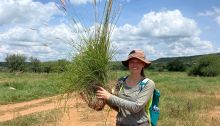
Announcing the 2024 Harper Prize Winner: Karina Guo

We’re delighted to announce that the winner of the 2024 Harper Prize is Karina Guo! The Harper Prize is awarded annually for the best paper published in the journal by an early career researcher. ‘Using machine learning to link climate, phylogeny and leaf area in eucalypts through a 50-fold expansion of leaf trait datasets’ Karina Guo,  William K. Cornwell,  Jason…

2024 Harper Prize Shortlist: Early Career Research Award

The Harper Prize is awarded annually by the British Ecological Society for the best paper in Journal of Ecology by an early career author. We are pleased to present the shortlisted papers for the 2024 award, published in Volume 112: Daiki Takahashi: Deer grazing drove an assemblage-level evolution of plant dwarfism in an insular system Eugénie Mas: Drought effects in Mediterranean forests…

Nature-based solutions offer a win-win for nature, climate, & society in Hong Kong

Ashley Bang, from the University of Oxford, won the Journal of Ecology Best Poster Award at the 2024 European Congress of Conservation Biology. In this blog post, Ashley, discusses her thesis: Opportunities to balance urbanization, climate change, and nature conservation policy agendas via nature-based solutions: A case study of Hong Kong. In light of the…

Tyler Coverdale – 2023 Harper Prize Winner!🏆

We’re delighted to announce that the winner of the 2023 Harper Prize is Tyler Coverdale! The Harper Prize is awarded annually for the best paper published in the journal by an early career researcher. Winner: Tyler Coverdale Paper: Unravelling the relationship between plant diversity and vegetation structural complexity: A review and theoretical framework “As Tyler´s succinct review points out, we…

Chenhui Chang: Reciprocal bark exchange helps to disentangle bark & wood trait effects on invertebrate diversity

2023 HARPER PRIZE SHORTLIST: Throughout March, we are featuring the articles shortlisted for the 2023 Harper Prize. The Harper Prize is an annual award for the best early career research paper published in Journal of Ecology. Chenhui Chang’s article ‘Reciprocal bark exchange helps to disentangle tree species-dependent bark and wood trait effects on invertebrate diversity‘ is one of those shortlisted…

Tara Miller: Warmer temperatures are linked to phenological mismatch among native & non-native forest plants

2023 HARPER PRIZE SHORTLIST: Throughout March, we are featuring the articles shortlisted for the 2023 Harper Prize. The Harper Prize is an annual award for the best early career research paper published in Journal of Ecology. Tara Miller’s article ‘Warmer temperatures are linked to widespread phenological mismatch among native and non-native forest plants‘ is one of those shortlisted for the…

Maria Jessen: Seedlings controlled by litter

2023 HARPER PRIZE SHORTLIST: Throughout March, we are featuring the articles shortlisted for the 2023 Harper Prize. The Harper Prize is an annual award for the best early career research paper published in Journal of Ecology. Maria Jessen’s article ‘Litter accumulation, not light limitation, drives early plant recruitment‘ is one of those shortlisted for the award: 👋 About me: from…

Jan Perret: Plants stand still but manage to hide

2023 HARPER PRIZE SHORTLIST: Throughout March, we are featuring the articles shortlisted for the 2023 Harper Prize. The Harper Prize is an annual award for the best early career research paper published in Journal of Ecology. Jan Perret’s article ‘Plants stand still but hide: Imperfect and heterogeneous detection is the rule when counting plants‘ is one of those shortlisted for…

Juliana Monteiro: Bryophyte assembly rules across scales

2023 HARPER PRIZE SHORTLIST: Throughout March, we are featuring the articles shortlisted for the 2023 Harper Prize. The Harper Prize is an annual award for the best early career research paper published in Journal of Ecology. Juliana Monteiro’s article ‘Bryophyte assembly rules across scales‘ is one of those shortlisted for the award: 👋 About me I grew up in northern…