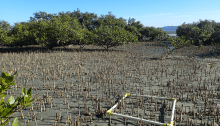
How New Zealand’s mangrove seedlings weather the waves: Lessons from monospecific forests

Lukas Meysick, Carl von Ossietzky Universität Oldenburg, discusses his article: Facilitation and constraint: Wave exposure and intraspecific interactions influence mangrove seedling morphology and resistance to dislodgement When mangrove forests come to mind, many people picture tropical coasts lined with diverse tree communities, sometimes consisting of more than 20 species in a single region. With this…

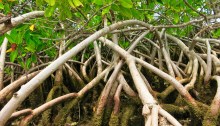
Mangrove range expansion limited by ocean currents and coastal features

Jackie Raw discusses her recent article: Dispersal and coastal geomorphology limit potential for mangrove range expansion under climate change. Find out more about the implications of this work for modelling mangrove responses to climate change. Mangroves, often described as tropical swamp lands, are classic features of warm coastlines where sea-surface temperatures are above 20°C. These…

Happy World Mangrove Day 2020!

To celebrate World Mangrove Day 2020, we’re taking a closer look at this important ecosystem and highlighting some of the fascinating mangrove papers that have been published in Journal of Ecology in recent years. In 2015, in order to raise awareness of the importance of mangrove ecosystems, the General Conference of UNESCO designated 26 July…

Stress and strategy for salt marsh plants

“Multiple trait dimensions mediate stress gradient effects on plant biomass allocation, with implications for coastal ecosystem services” by De Battisti et al. is a new research article published in Journal of Ecology. In this blog post, author Davide De Battisti summarises the recent advances in understanding how coastal plants respond to stress. Salt marshes are highly appreciated ecosystems…