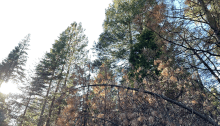
How do past disturbances shape tree growth?

Yihong Zhu, University of California, Berkeley, discusses her article: Legacy effects under an emerging novel disturbance regime: A memory-based framework to quantify tree growth responses Emergent novel disturbance regime Moderate-severity disturbances, such as drought, pathogen irruptions, and prescribed fire, may not cause widespread tree mortality, but can leave lingering impacts on surviving trees. Such disturbances…

How do hundreds of tree species occupy tropical forests? Large tree fall gaps might hold the answer

Damla Cinoğlu and Caroline Farrior, University of Texas at Austin, discuss their article: Small disturbances and subsequent competition for light can maintain a diversity of demographic strategies in a neotropical forest: Results from model-data integration Tropical forests are one of the most diverse ecosystems on Earth. They are fundamental for managing the global carbon budget and…

Recovery after disturbance is slow across space and time; can these patterns tell us how to actively restore ecosystems better?

Emma Ladouceur & Jonathan M. Chase discuss their recent article: The recovery of plant community composition following passive restoration across spatial scales. Find out more about what it takes for ecosystems to recover from disturbances and whether passive restoration is enough. Human disturbances can negatively impact species, biodiversity and ecosystems. Given enough time, will ecosystems…

Identity of Ecological Systems and the Meaning of Resilience

Author Olivier Delettre, discusses their recently published article: Identity of ecological systems and the meaning of resilience. This article proposes four definitions of resilience, each one refers to the maintenance of a different type of identity and to a different level of persistence of ecological systems. This article is part of an upcoming cross-journal Special…

Evan Gora – Harper Prize Shortlist

Throughout May, we are featuring all the articles that were shortlisted for the Harper Prize 2020. The Harper Prize is an annual award for the best early career research paper published in Journal of Ecology. Evan’s article ‘A mechanistic and empirically supported lightning risk model for forest trees‘ was one of the eight papers shortlisted for this year’s award.…

Australia’s giant forests may become increasingly at risk with climate change —What should we do?

Newly published article, finds that among Australian tall wet eucalypt forest, severe fires are likelier in hotter, drier climates – suggesting vulnerability to climate change: “Bioclimatic drivers of fire severity across the Australian geographical range of giant Eucalyptus forests” by Furlaud, Prior, Williamson & Bowman. Here, authors James Furlaud and David Bowman discuss their research…

On the speed of plants

Author Daniel Montesinos discusses his recent Journal of Ecology article: “Fast invasives fastly become faster: Invasive plants align largely with the fast side of the plant economics spectrum.” Find out more about the plant economics spectrum and how invasive plants align largely with the fast side. This mini-review is part of our upcoming Special Feature…

Is resprouting a persistence trait in tropical forests?

Author James Dalling discusses recent paper “Nutrient availability predicts multiple stem frequency, an indicator of species resprouting capacity in tropical forests” by Heineman, Turner and Dalling. Read on to find out more about variations in the resprouting ability of tropical trees. The life of a tree is seldom the unobstructed path of a single stem…