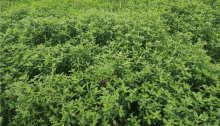
Defense against multiple enemies changes differently across latitudes in an invasive plant and its native congener

Xinmin Lu, Huazhong Agricultural University, Joshua Lynn, Manchester University, and Evan Siemann, Rice University, discuss their article: Latitudinal patterns in growth and defense against multiple enemies of an invasive species and its native congener Why are some plant species more successful invaders than others? A long-standing hypothesis is that invasive plants differ from native species…

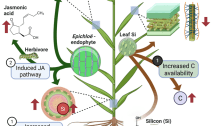
Silicon and beneficial fungi: Strengthening plant resilience

Ramalka H. Kasige, Ximena Cibils-Stewart, Adam Frew, and Scott N. Johnson from Western Sydney University in Australia, discuss their article: Interactions between beneficial fungi and plant silicon: A review Plants are continually exposed to stresses — from drought, salinity, and metal toxicity to herbivores and pathogens. To withstand these challenges, they employ multiple strategies, including…

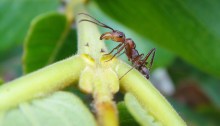
Experimental resource supplementation shifts ant-mediated defense on silver cholla

Jenna Braun, York University, Toronto, discusses her article: Experimental resource supplementation shifts ant-mediated defense on silver cholla Extra-floral nectaries (EFN) play an important role within mutualisms between plants and ants. In this relationship, ants receive a nutrient-rich food source from plants in exchange for defending the plant from herbivores. Ant species are not equally effective…

Optimal Defense Theory in an ant–plant mutualism

Here we take a closer look at a fascinating plant defense article by Calixto et al., which has recently been published in Journal of Ecology. Author Kleber Del-Claro explains different methods for anti-herbivore plant defenses and shares the results of this research, which is the first to show that ant recruitment via extrafloral nectar follows…