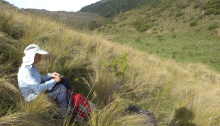
Fire shapes the balance between the persistence of open vegetation and forest expansion

Melisa A. Giorgis, Instituto Multidisciplinario de Biología Vegetal, discusses her article: Post-fire trajectories reveal a legacy effect and decoupled structural and floristic responses in a seasonally dry subtropical mountain region, in both English and Spanish. A complex debate Many areas of the world with open vegetation are at the center of extensive debates in scientific,…
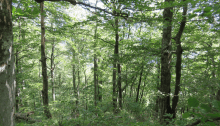
Can we really make forests more resilient? The hidden connections behind forest resilience

Pilar Hurtado Aragüés, Global Change Research Institute and Department of Biology (Rey Juan Carlos University, Madrid, Spain), discusses her article: Network modularity analysis reveals strategies for strengthening forest resistance, recovery, and resilience to disturbances Looking beneath the surface Before working on this project, I would probably have answered the question “Can we really make forests…

Regrown but not recovered: Forest management regime alters deadwood volume and wood-inhabiting fungal diversity

Vincent Buness, Swedish University of Agricultural Sciences, discusses his article: Distinct diversity trajectories of boreal wood-inhabiting fungi following fire vs. clear-cutting As humans, we tend to trust our senses and assume that we can perceive most of what surrounds us. When we walk through the forest, we see trees with their stems and canopy, and…

Is resprouting a persistence trait in tropical forests?

Author James Dalling discusses recent paper “Nutrient availability predicts multiple stem frequency, an indicator of species resprouting capacity in tropical forests” by Heineman, Turner and Dalling. Read on to find out more about variations in the resprouting ability of tropical trees. The life of a tree is seldom the unobstructed path of a single stem…