Pilar Hurtado Aragüés, Global Change Research Institute and Department of Biology (Rey Juan Carlos University, Madrid, Spain), discusses her article: Network modularity analysis reveals strategies for strengthening forest resistance, recovery, and resilience to disturbances
Looking beneath the surface
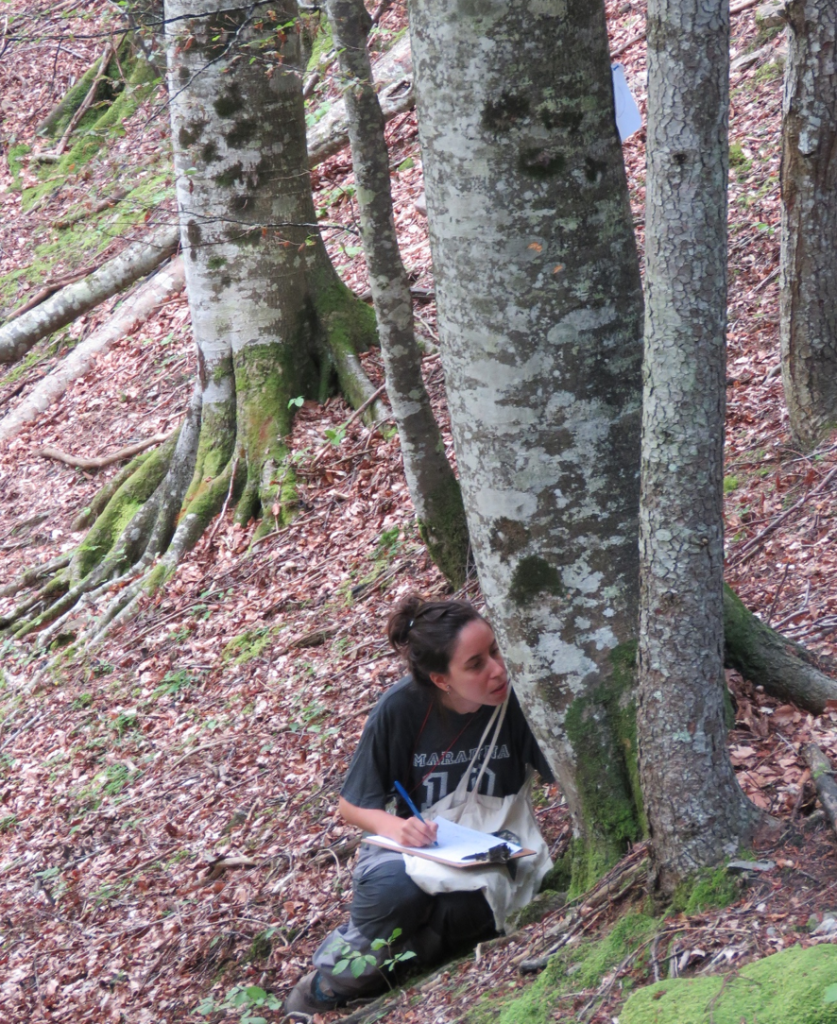
Before working on this project, I would probably have answered the question “Can we really make forests more resilient?” very differently. By then, I had already become fascinated by forests. From the beech forests stretching across Europe, to the impressive Nothofagus forests of southern Chile – they had become my favourite ecosystem. Yet I was only studying the lichens growing on tree bark.
Lichens taught me one lesson that has shaped the way I do science: overlooked organisms can reveal fundamental ecological processes. Sometimes, the key to understanding an ecosystem is not found in its biggest or most obvious components, but in the connections that hold everything together.
That perspective followed me into my first postdoctoral position within the RESONATE European project on forest resilience. Suddenly, I found myself surrounded by researchers with decades of experience studying forests, management, and responses to disturbances. My supervisor, Paco Lloret, and the rest of the team brought an extraordinary depth of knowledge about forest resilience, while I arrived convinced that paying attention to the less obvious patterns often leads to the most interesting questions. Together, we started asking what seemed like a simple question: what actually makes a forest resilient?
Connecting the evidence on forest resilience
As climate change intensifies droughts, wildfires, and other disturbances across the globe, the idea of “building resilient forests” has become central to conservation and forest management. But the more we explored the literature, the more we realised that the drivers of resistance, recovery, and resilience had rarely been compared directly. Resilience is not a single response to disturbance: it combines how much a forest changes when disturbance strikes and what happens afterwards. In this way, a forest may resist disturbance remarkably well and still recover slowly afterwards. Another may be heavily affected at first but regain its structure surprisingly quickly. Resistance (how well forests withstand disturbance), recovery (how they “bounce back” afterwards), and resilience (which integrates both processes),are closely related but they are not the same thing. If these three components do not always respond in the same way, should we really expect the same management strategy to maximise all of them? If we want forests to cope with increasing droughts, fires, and other disturbances, what should we actually be trying to promote?
To explore these questions, we stepped back from individual case studies and looked at the bigger picture. We reviewed 316 studies from forests around the world, gathering thousands of reported relationships across different forest types, disturbances, and ecological contexts. At first, the diversity of approaches felt almost impossible to compare. Every study focused on different variables, different management actions, and sometimes even different ways of defining resilience.
Instead of trying to average all those results into a single number, we decided to connect them. Using network analysis, we treated scientific literature as a web of relationships linking forest characteristics, management actions, environmental conditions, and the different components of resilience. This approach revealed broader patterns that would have been difficult to recognise by reading studies individually.
No universal recipe for resilient forests
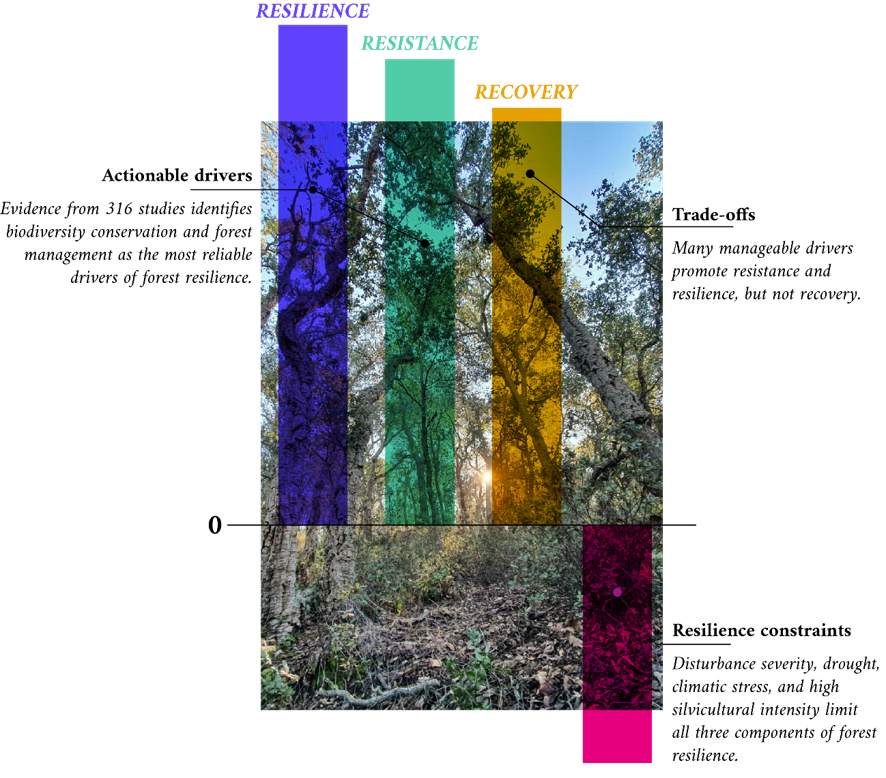
Two actors consistently stood out across forests worldwide: biodiversity and forest management. Both were repeatedly associated with forests that better resisted disturbances and showed greater overall resilience. This is encouraging because they represent aspects that society and forest managers can actively promote.
Perhaps our most important finding was that there is no universal recipe for resilient forests. Many factors that increased resistance did not necessarily enhance recovery. Some forest management practices, for example, were associated with forests that better withstood disturbances but recovered more slowly afterwards under certain conditions. Mature forests and greater functional diversity also showed this pattern: they often strengthened resistance and overall resilience but did not consistently promote recovery.
Therefore, managing resilient forests requires understanding the trade-offs between different components of resilience and deciding which objective should be prioritised under different disturbance regimes and environmental conditions.
Climate adds another layer of complexity. Drought, fire, and local environmental conditions all influenced how management actions affected forest responses. The same management strategy may therefore lead to different outcomes depending on where it is applied and which disturbance the forest faces.
Seeing the forest as a network
One of the most rewarding aspects of this project was realising that it reflected a lesson I had learned years earlier while studying lichens. Understanding ecosystems requires looking beyond individual factors and paying attention to the connections between them.
Perhaps that is the real message of resilience. Forests are not resilient because of one species, one management action, or one ecological mechanism. They are resilient because of the countless interactions that link biodiversity, environmental conditions, and management across space and time. Thus, the challenge is no longer simply to ask how can we make forests more resilient? A better question might be: which component of resilience do we want to strengthen, and under what environmental context?
There is unlikely to be a one-size-fits-all answer to building resilient forests, but by recognising the complementary roles of biodiversity, forest management, and environmental context, and by embracing rather than simplifying the complexity of forest ecosystems, we can design strategies that strengthen resilience in all its dimensions. When I now walk through beech forests, I see a network of hidden connections shaping how these ecosystems respond to change. Understanding those connections may be one of our best opportunities to help forests continue supporting biodiversity, storing carbon, and providing the ecosystem services on which both nature and people depend.


