The mechanisms of the depletion of alpine meadow seed banks due to nitrogen enrichment

Miaojun Ma, Gansu Gannan Grassland Ecosystem National Observation and Research Station, State Key Laboratory of Herbage Improvement and Grassland Agro-ecosystems, College of Ecology, Lanzhou University, discusses his article: Multiple mechanisms associated with loss of seed bank diversity under nitrogen enrichment Background Anthropogenic activities have caused an increase in atmospheric nitrogen (N) deposition, which threatens the…
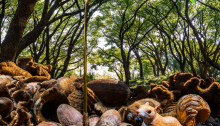
Big Seeds Are Smarter Than They Look

Si-Chong Chen (@SichongChen), Wuhan Botanical Garden of the Chinese Academy of Sciences, discusses her article: Large seeds as a defensive strategy against partial granivory in the Fagaceae Imagine you are an acorn. You’re packed with nutrients and a perfect meal for animals like squirrels and birds. But you’re not just food; you’re also a seed…

Microclimatic gradients regulate germination phenology in alpine communities

Clara Espinosa del Alba, Biodiversity Research Institute (IMIB, University of Oviedo – CSIC – Principality of Asturias), part of the Vegetation and Biodiversity Lab, discusses her article: Microclimatic variation regulates seed germination phenology in alpine plant communities, in English, Spanish, and Catalan. Background Seeds are essential for plant regeneration, but not only the quantity and…

Why it makes sense for trees to reproduce in synchrony

Mario B. Pesendorfer, Institute of Forest Ecology, Department of Forest and Soil Sciences, BOKU – University of Natural Resources and Life Sciences, Vienna, Austria, discusses his article: Positive spatial and temporal density-dependence drive early reproductive economy-of-scale effects of masting in a European old-growth forest community In temperate forests, tree populations often produce large bumper crops…

Always put eggs in two baskets? The “wisdom” of a seed-dimorphic aster to cope with environmental uncertainty.

Huixuan Liao and Qian Gan, Sun Yat-sen University School of Life Sciences, discuss their article: ‘Spatiotemporal interaction of risk-spreading strategies for a seed-dimorphic plant’ Background Maternal modification of offspring stress tolerance is a ubiquitous phenomenon in plant and animal kingdoms that affects population persistence and growth. When looking into this phenomenon, one can’t help but…

Cover stories: Volume 109 Issue 6

The cover image for our June issue shows white pine trees at the oldest forest research plot in Canada – this species being considered for assisted migration efforts in this region. This image relates to the research article: Critical seed transfer distances for selected tree species in eastern North America by Pedlar, McKenney & Lu. Lead author, John…

Michał Bogdziewicz – Harper Prize Shortlist

Throughout May, we will be featuring all the articles that were shortlisted for the Harper Prize 2020. The Harper Prize is an annual award for the best early career research paper published in Journal of Ecology. To start off this blog series, we hear from Michał Bogdziewicz! Michał’s article, “Do benefits of seed dispersal and…

Call for proposals: Leveraging natural history collections to understand the impacts of global change

Natural history collections in museums, herbaria, seed banks, and tissue banks provide some of the most valuable information sources in an ecologist’s toolbox: time series data. These collections not only permanently archive preserved specimens, but also critical historical and contemporary information about how species distributions, interactions, and phenotypes respond to global change across time scales.…

Gulls can spread weeds over large distances and between habitats

Authors, Víctor Martín-Vélez and Andy J. Green, discuss their recent study which highlights the importance of non‐frugivorous waterbirds as vectors for long‐distance plant dispersal: Spatial patterns of weed dispersal by wintering gulls within and beyond an agricultural landscape. You can also read the Press Release for this article here. Weeds are plants that spontaneously grow…