Victoria Giachetti and Martín Aguiar, University of Buenos Aires in Argentina, discuss their article: Stronger fertile island patterns enhance plant facilitation in drylands, regardless of overall ecosystem fertility
Facilitation and fertile island formation: Two key structuring processes in dryland ecosystems
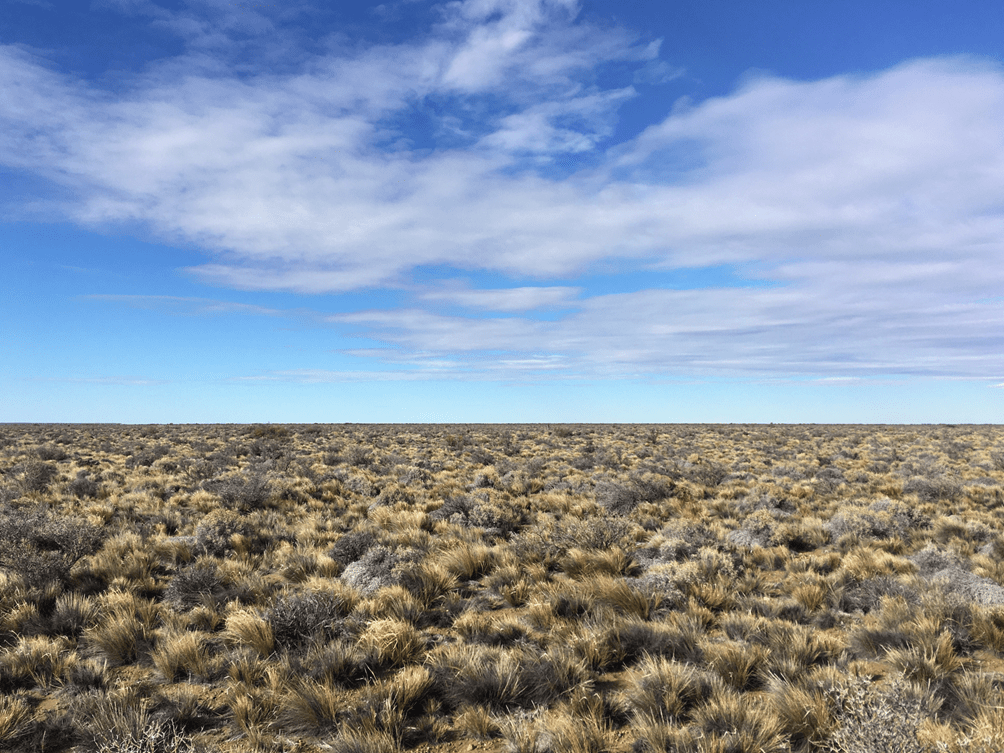
At the core of dryland ecosystem functioning, there are two tightly linked processes: fertile island formation and facilitation among plants. Fertile islands are soil hotspots of increased nutrient concentration and microbial activity driven by perennial vegetation. They form as plants produce litter and root exudates, and trap fine soil particles under their canopies. Meanwhile, plant facilitation is a key structuring process in many of the world’s ecosystems, particularly in stressful ones. In drylands, it typically involves a nurse plant providing multiple benefits to the beneficiary plants, such as resource supply (e.g., nutrients and water).
The mechanistic link between these two processes has been demonstrated at local scales, with manipulative studies showing that the increased fertility under nurse plants leads to an increased growth of the beneficiary plants. At a global scale, these two processes have also been deeply studied, but mainly separately, which led to our research idea of testing their association through meta-analysis.
Making of the hypotheses
Over the past three decades, global studies on plant facilitation have aimed at understanding its drivers, focusing largely on the importance of resource availability gradients (stress gradient hypothesis). Also, more recent studies are exploring the global drivers of fertile island formation, showing that the strength of the fertile island effect varies globally. First, we thought: if facilitation intensity is measured as the relative difference in plant performance under a nurse plant relative to the open areas, could it be predicted by the relative difference in nutrient concentrations under that nurse plant compared to the open areas? So, we hypothesized that facilitation intensity would increase with stronger fertile island patterns (higher nutrient heterogeneity at a microsite level). Furthermore, overall ecosystem fertility, which is beyond microsite patterns, also varies among global drylands. Following the stress gradient hypothesis, facilitation should be more intense in more stressful ecosystems. So, we hypothesized that facilitation intensity would decrease with increasing ecosystem fertility (higher overall nutrient availability at the broader ecosystem level).
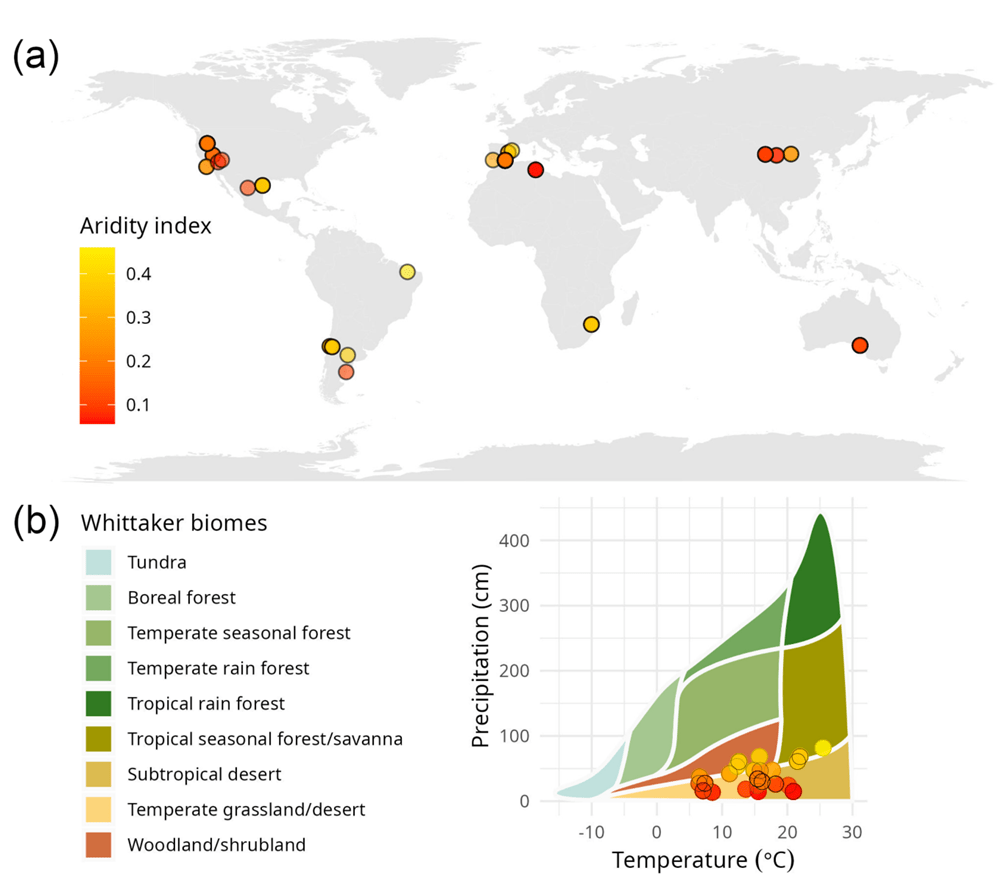
To test these two hypotheses, we conducted a meta-analysis based on 27 studies that jointly measured plant facilitation and the fertile island effect for nitrogen (N) and phosphorus (P) in drylands. We additionally retrieved N and P concentrations from global databases at a coarse ecosystem resolution. We conducted meta-regression models using the strength of the fertile island effect and the overall ecosystem fertility as moderators and assessed their significance.
Key results
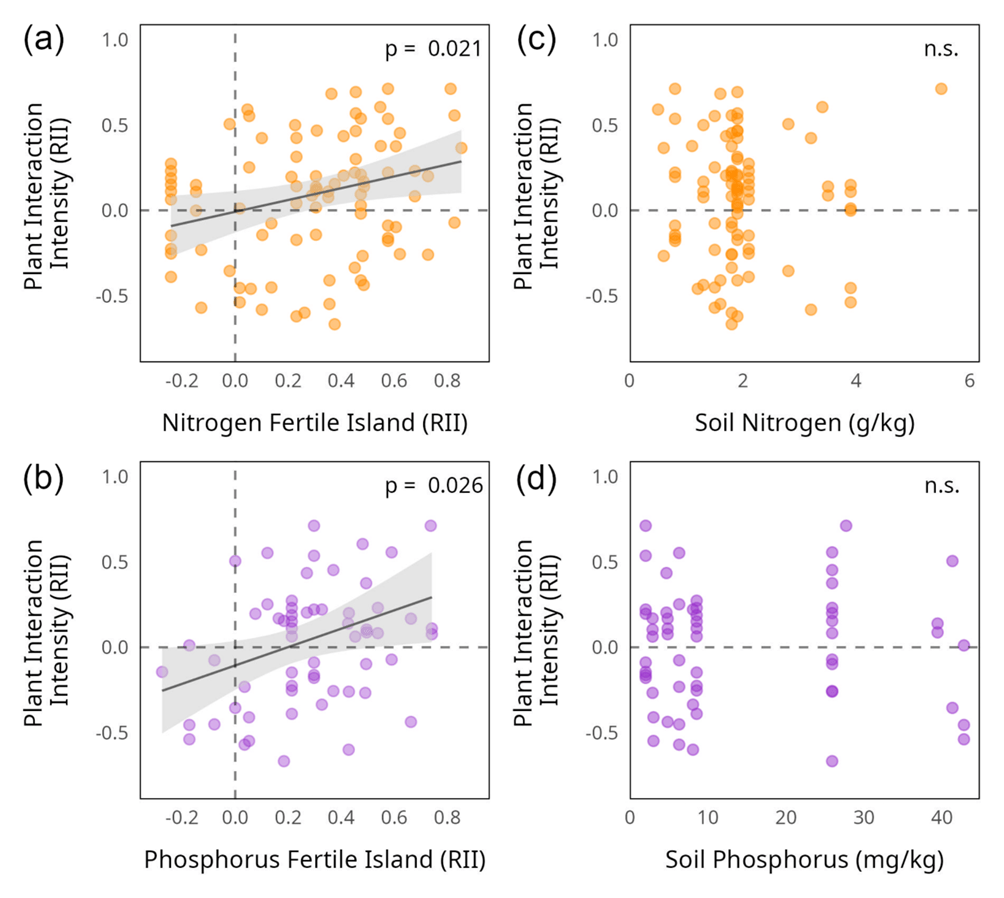
According to our first hypothesis, the intensity of facilitation was positively associated with the strength of the fertile island effect. However, contrary to our second hypothesis, facilitation intensity was not related to ecosystem fertility. Therefore, facilitation intensity increases as the difference in soil N and P concentrations between nurse and open microsites becomes more pronounced, independently of overall ecosystem fertility.
Takeaways
By integrating the role of fertile islands into plant facilitation and the variation in fertile island strength across drylands, our study reinforces the importance of nutrient microsite heterogeneity as a key feature of drylands. Specifically, our study shows that, beyond fertile island patterns being a common feature of drylands, their strength has clear implications for plant community dynamics: on average, plants perform better under nurse plants than in the open, and the magnitude of this benefit increases as the difference in soil nutrient concentration between nurse and open microsites becomes larger. Our results also suggest that the effect of fertile island strength is independent from overall ecosystem fertility. This finding calls for future studies considering both the microsite heterogeneity and the ecosystem availability of other facilitation drivers (e.g., water, light), since they may not be associated, as was the case for nutrients.
Global changes are altering nutrient cycling and plant community dynamics in drylands. In this context, our results call for further exploring of how dryland degradation processes could alter fertile island patterns and facilitation among plants.


 jecologyblog.com