Gang Yang and Zuzana Münzbergová, Charles University in Prague, discuss their article: Contrasting drought responses in two grassland plant-microbe systems under climate change
Drought is becoming more frequent and intense under global change, but plant responses vary widely. Some species are adapted to tolerate stress, while others perform well only when resources are abundant. Because grasslands support biodiversity, store carbon, and provide forage for livestock, their future functioning depends on how plants cope with increasing water limitation. Although the direct effects of drought on plants are well studied, much less is known about how drought interacts with warming and elevated CO2 to shape plant performance.
Plants, however, do not face drought alone. They host diverse microbial communities on their leaves, inside their roots, and in surrounding soils, which can influence nutrient and water uptake, stress regulation, and tolerance to harsh conditions. Because microbes are also sensitive to drought and other global change drivers, the ways in which plants cope with drought under global change are likely shaped not only by plant traits, but also by interactions with their associated microbiomes.
In our study, we asked: do plants with different ecological strategies rely on different pathways (plant traits versus microbes) to cope with drought under warming and elevated CO2?
Two grasses, two strategies
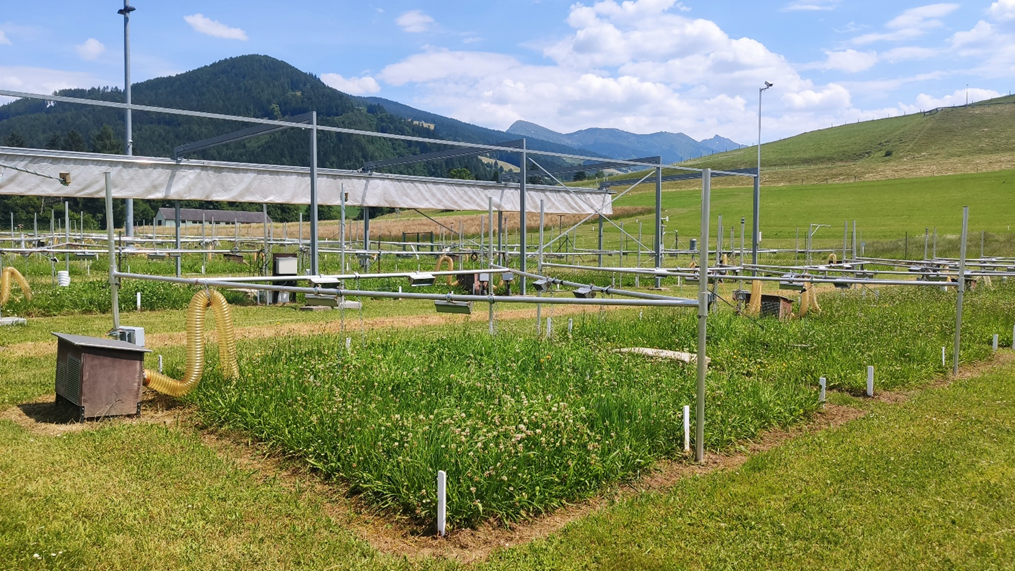
We focused on two widespread European grass species with contrasting strategies. Red fescue (Festuca rubra) is a stress-tolerant species that typically grows more slowly but is better adapted to dry conditions. In contract, perennial ryegrass (Lolium perenne) is a highly productive and competitive grass widely used in agriculture. We grew these two species in a long-term field experiment that combined a soil-moisture gradient with warming and elevated CO2, simulating future climatic conditions. Along this gradient, we measured plant functional traits and analysed bacterial and fungal communities in three compartments: the leaf endosphere, root endosphere, and rhizosphere, to capture both plant and microbial responses.
Bacteria are sensitive, fungi are stable
Across both plant species, drought strongly affected bacterial communities. Bacterial richness declined as soils became drier, especially in the root endosphere and rhizosphere. Fungal communities, in contrast, were much more stable across the drought gradient. This difference likely reflects fundamental contrasts between bacteria and fungi: bacteria tend to respond quickly to changes in moisture, while fungi can tolerate drought through their hyphal networks and physiological adaptations. Interestingly, warming and elevated CO2 modified these drought effects. Drought-related declines in bacterial richness were partly reduced under warming and elevated CO2, suggesting that climate change can alter how sensitive microbial communities are to water availability.
Different plants, different pathways
Although both grasses experienced the same drought, warming and elevated CO2, they responded in different ways. Festuca rubra had considerable flexibility in both its traits and microbial associations. As soils dried, its associated bacterial communities changed strongly, and these microbial shifts were closely linked to moisture and climatic conditions. This suggests that stress-tolerant plants like Festuca rubra may buffer drought impacts by flexibly adjusting their microbial partners as part of their drought-response strategy. In contrast, Lolium perenne followed a simpler pathway. Its responses were driven mainly by direct effects of drought, climate, and competition with neighbouring plants. Its microbial communities, particularly fungi, were relatively stable. This pattern fits with a resource-acquisitive strategy, where plants prioritise rapid growth under favourable conditions rather than flexible adjustment under stress.
Why does this matter?
Our results show that there is no single “plant-microbiome response” to drought. Instead, plant species differ fundamentally in how drought responses emerge from different combinations of functional traits and interactions with microbes. These differences matter because grassland responses to global change will depend on which plant strategies dominate and how those strategies integrate plant traits and microbiome dynamics. As water availability becomes more variable, predictions based on plant traits alone will miss important microbially mediated responses.
By linking plant functional traits with microbial responses across a realistic moisture gradient and climate treatments, our study highlights the importance of viewing plants and microbes as an integrated system. This perspective will improve our ability to understand and ultimately manage grassland ecosystems under ongoing climate change.

 jecologyblog.com