Caiyue Yang and Shaopeng Li, from East China Normal University, and Scott J. Meiners, from Eastern Illinois University, discuss their article: Compensatory and statistical-averaging effects jointly explain the decrease in species asynchrony over 60 years of succession
A long-term view of succession
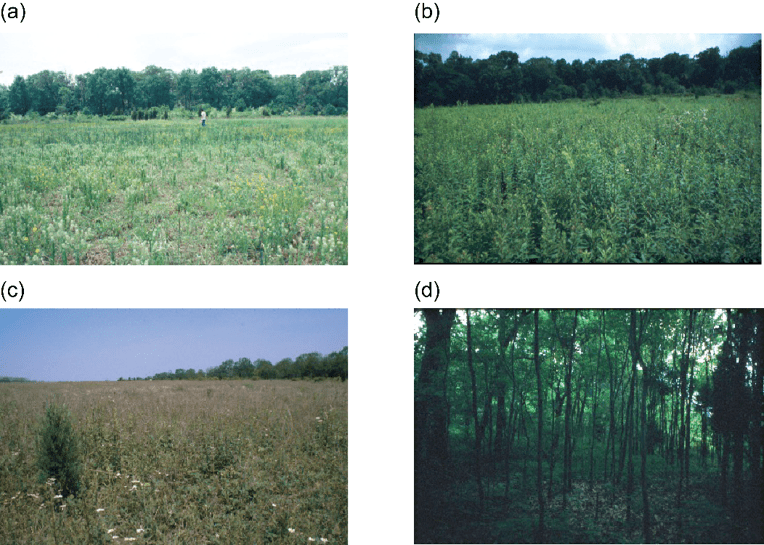
If you had walked through abandoned farmland in New Jersey in the late 1950s, you would have seen a quietly shifting landscape. Grasses and weedy plants were spreading across the fields, and shrubs were gradually appearing in scattered patches. This looked like a familiar process of plant recovery. For ecologists at the time, these fields offered an ideal opportunity to examine a long-debated question: do plant communities follow a predictable sequence towards a stable “climax”, or do they simply reflect species responding independently to changing conditions? Most previous evidence relied on comparing sites of different ages, assuming that they could stand in for different stages of succession. However, this assumption appeared unreliable because differences among sites might reflect variation in environmental conditions rather than real successional change. In 1958, Murray Buell, Helen Buell, and John Small took a different approach. Within the Hutcheson Memorial Forest, they initiated the Buell–Small Succession Study (BSS) by establishing permanent plots in ten old fields. From then on, they returned to the same plots year after year to record vegetation change. No one anticipated that this study would continue for so long. However, through the sustained commitment of generations of researchers, the BSS eventually became one of the longest continuous studies of old-field succession in the world.
A surprising result
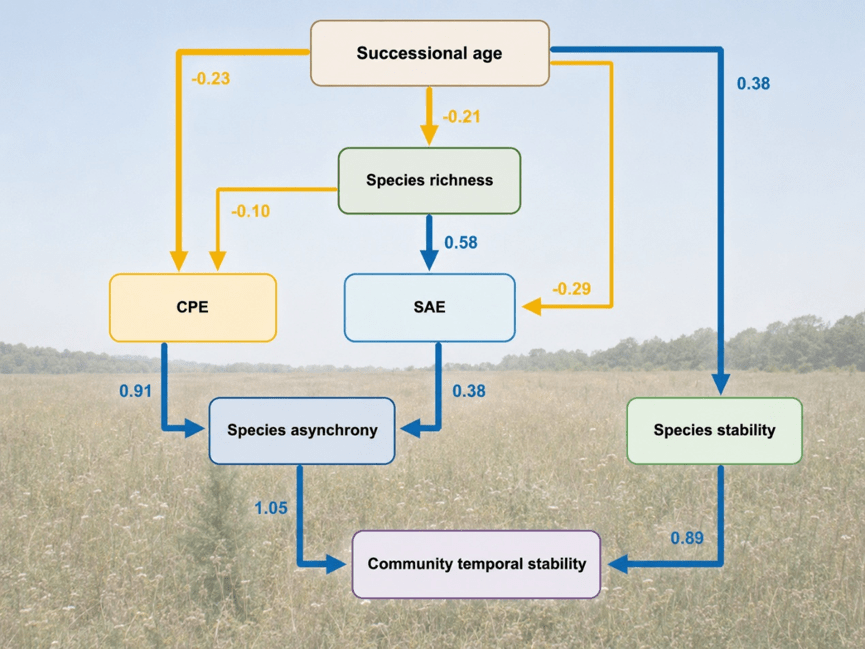
We used this unusually long record to ask a simple question: how is community stability maintained despite profound changes in species dynamics during long-term succession? Rather than focusing only on how many species were present, we looked at how species abundances fluctuated relative to one another through time. The key idea here is species asynchrony, meaning that species do not all go up and down together. Rather, their fluctuations tend to offset one another and make the entire community appear stable. This “smoothing” effect is driven not only by ecological interactions in which a decrease in one species allows the increase in another, but also by a purely statistical phenomenon in which averaging out numerous independent fluctuations naturally decreases overall variation. By separating these two components and tracking them across more than 60 years of succession, we could see how community stability changed over time. Based on classical ecological theory, we expected mature communities to become increasingly stable, with species asynchrony continuing to play an important stabilising role. In contrast, we found that both components of species asynchrony decreased as succession progressed. Species gradually became less effective at balancing one another’s fluctuations, while decreases in species richness left fewer independent fluctuations to average out variation. As a result, species asynchrony weakened rather than strengthened in later successional stages.
Lessons we learned
Our study shows that a community can remain relatively stable even while the processes supporting that stability change over time. As succession progressed, species fluctuations became less asynchronous, but individual species became more stable, helping to keep overall community stability largely unchanged. Statistical averaging and compensatory dynamics both contributed to the decreasing species asynchrony over time. These changes are easy to miss if we focus only on the whole community temporal stability. Long-term records such as the BSS provide a strong empirical foundation for investigating how stability mechanisms unfold over decades. Our findings reveal that ecological stability is an outcome that emerges from changing contributions of multiple stabilising processes over time. This perspective may provide useful insights for future conservation and restoration efforts.


