Across all the BES journals, we’ve seen a marked rise in submissions over the last year, highlighting the strong reputation and reach of our journals and published articles. However, this growth also brings increased pressure to maintain a rigorous and fair peer review system, as editors face growing challenges in securing suitable reviewers, while reviewers themselves are having to manage an increasing volume of review invitations. In this blog post we present a brief overview of the peer review process at our journals, explain what makes a good review and point you to where you can find further information and resources about reviewing for journals.
What is peer review?
Peer review is the evaluation of scientific articles by other scientists who are experts in a specific field or discipline. An essential part of the scholarly publication process, peer review assesses the quality, validity, and originality of scientific articles and can be incredibly beneficial in helping authors to improve their article before publication. Many journals, including all 7 of the BES journals also rely on peer review to help Editors assess the articles submitted to their journals and determine whether they should be published. It is integral therefore, that the peer review process is robust, independent and fair.
What is the peer review process?
For many authors, the period between submitting a manuscript and receiving a decision can seem frustratingly long. With several steps involved, it’s not always obvious what happens behind the scenes during peer review, and it can appear to take longer than expected.
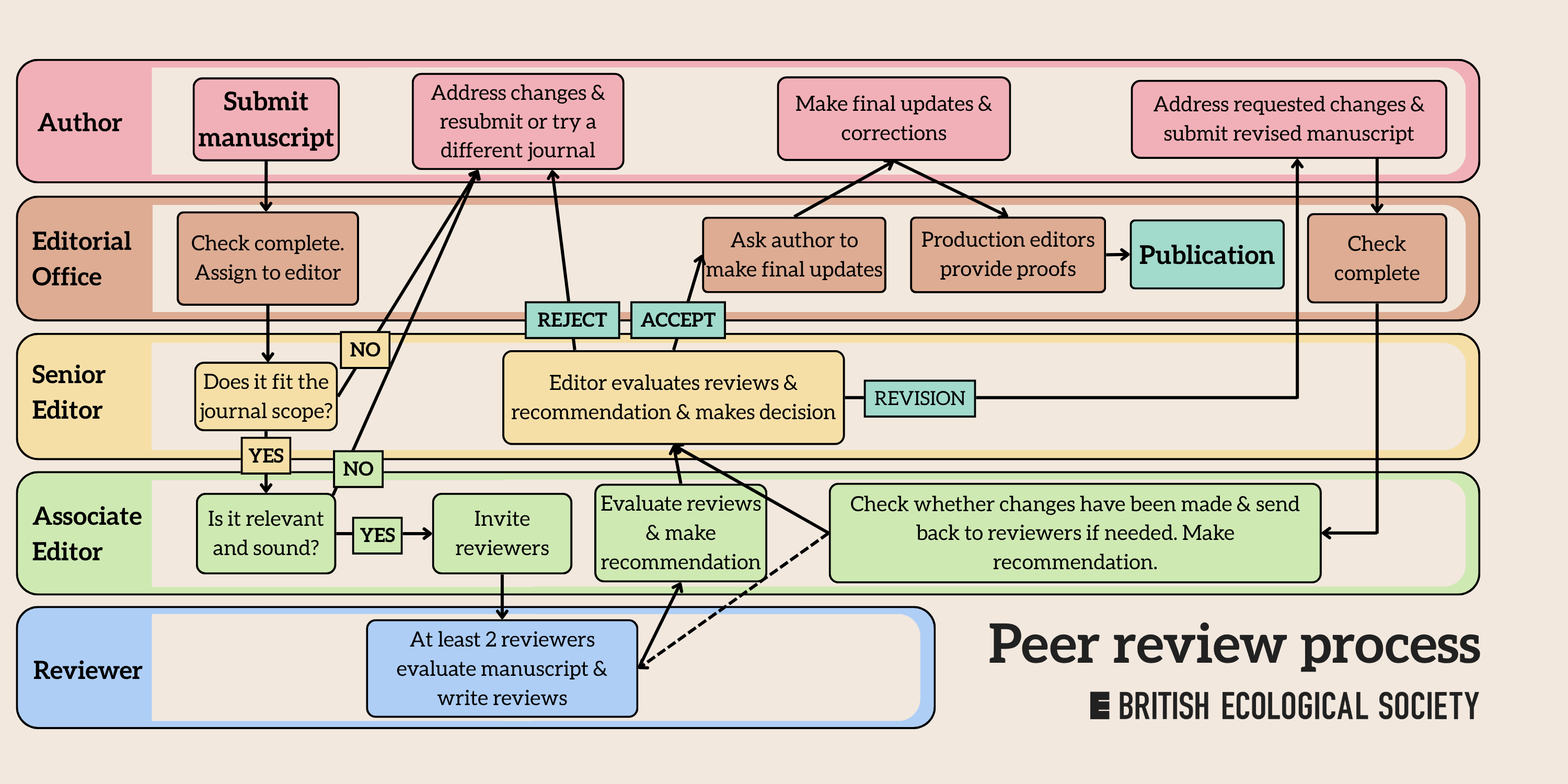
For all BES journals, when authors submit a manuscript, it will first go through checks by our in-house editorial team to ensure that all necessary information has been included and that it meets the requirements for submission according to the respective journal’s author guidelines. The manuscript is then assigned to a Senior Editor for an initial assessment. If the manuscript is not considered a good fit for the journal’s scope, it may be rejected at this stage. If it fits the scope, the Senior Editor will select an Associate Editor who is an expert on the subject to handle it. At this point, if it’s deemed appropriate, the Associate Editor will send it out to reviewers. This is often the longest part of the peer review process, as it can be challenging to find at least two reviewers that have both the relevant expertise and the time to conduct a review. Take a look at the flowchart below which shows a typical manuscript journey:
What makes a good review?
To maintain a standard of publishing high-quality and reliable papers, the peer review process plays a key role in enhancing the quality of a manuscript and identifying any errors or inaccuracies. So, it’s imperative that the quality of the reviews is also of a good standard.
If you’ve accepted an invite to review a manuscript, remember that it will be used for two purposes; by the authors to improve their manuscript, and by the editors to make their recommendation and decision.
Here are 5 tips for writing an excellent review:
- Open your review by providing a concise summary of the manuscript’s objectives, main findings, significance, (novelty if relevant to the journal), and strengths and weaknesses. And provide your overall impression – this will help the editor to quickly identify and assess whether the manuscript should proceed.
- Organise and structure your review clearly – you can divide the review up according to the sections of the manuscript e.g. Title, Abstract, Introduction, Methods, Results, Discussion and Conclusions. You can further divide the comments into major issues and minor issues. Examples of major issues would be fundamental points that the authors need to address in order for the manuscript to move forward e.g. incomplete reporting of methods or problems with the study design, and minor issues would be things like incorrect spelling or grammar, or issues with data presentation, or a missing citation.
- Be constructive in your feedback – feedback should be actionable and specific so that authors can aim to address these. Even if you think the manuscript should not proceed any further, you can still provide comments that improve the quality of their work as the authors may wish to try another journal or may have the opportunity to resubmit their work.
- Provide some positive feedback and maintain a professional and collegial tone – focus your comments on the research itself rather than the researcher. It’s helpful to think about the sort of review you’d like to receive! With that in mind, avoid any political or inappropriate comments that are not relevant to the manuscript or research. With the rise in use of generative AI, in the context of writing a review, our policy is that it should only be used to improve the language and grammar of the review you have written, and any usage must be declared.
- When making your recommendation to the editor, provide factual evidence and specific examples to justify this. Use the ‘Comments to the Editor’ section to provide details and context for your recommendation so that the Editors have clear information to make their recommendation/decision.
Most of our journals will have a ‘Comments to the Author’ section and a confidential ‘Comments to the Editor’ section, so anything that you would prefer to share with the editor but not the authors e.g. ethical issues, suspected usage of generative AI, quality of language etc. should be placed in the latter.
Other helpful guidance
– Reviewer Guidelines:
We have specific reviewer guidelines for each of our journals which can be found here:
Method in Ecology and Evolution
Ecological Solutions and Evidence
– Free Guide to Peer Review:
For a full overview and a more comprehensive guide to the peer review process (including information on ethics and FAQs), take a look at the BES’s free Guide to Peer Review (part of the Guides to Better Science series). We’ve now also published this in Chinese, Portuguese and Spanish!