Micha Davidova, Institute of Botany of the Czech Academy of Sciences, discusses their article: Direct and indirect effects of elevated CO2, warming and drought on plant-consumer interactions of Plantago lanceolata
Setting the scene
Interactions between plants and their consumers, such as herbivores and pathogens, are among the key factors shaping plant communities. At the same time, rising concentrations of greenhouse gases bring about global changes in environmental conditions that are likely to alter these plant-consumer interactions in the not-so-distant future. Research in this area is therefore becoming increasingly important, as it is crucial for predicting the responses of natural ecosystems and plant agriculture to global change, and for protecting their productivity and stability.
Plant traits are the middleman
Global change can influence consumers directly, such as invertebrate herbivores and pathogens increasing activity in warmer conditions that can increase their metabolic rates. Other effects, however, take the indirect route, where global change factors influence plant consumption by altering plant traits related to palatability. For instance, drought can lead to tough “sclerophyllous” leaves, making them harder to eat, and elevated CO2 may cause a higher ratio of carbon to nitrogen (C/N) in leaves, making them less nutritious.
Multifactorial to the max
Our study aimed to investigate these direct and indirect (plant-trait-mediated) effects of global change on plant consumption by invertebrate herbivores and pathogens. What we wanted to bring to the table is a multifactorial study approximating the complex interactions of a multitude of factors occurring in natural ecosystems.
We studied the effects of three global change factors—warming, elevated CO2, and drought—both alone and in combination. Including their combinations was especially important, as global change alters multiple environmental factors simultaneously, and their interactive effects can differ from their individual effects.
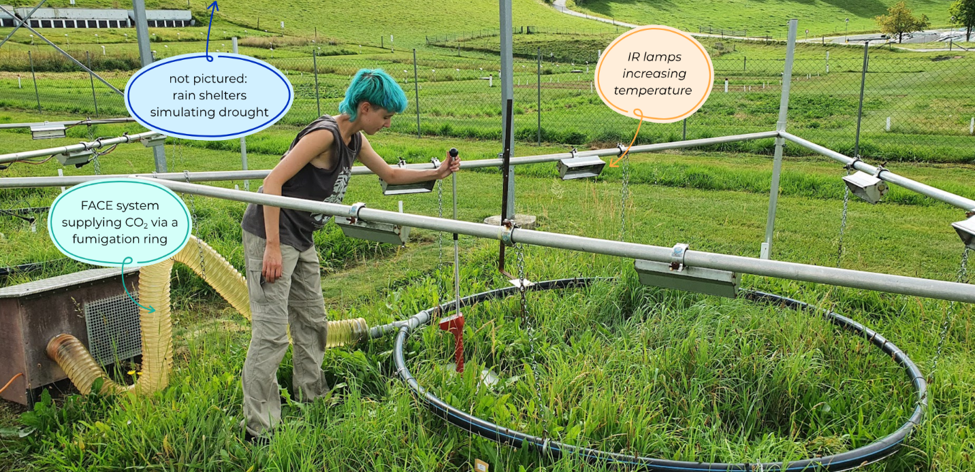
What made this research possible is ClimGrass—an outdoor experimental system at the Agricultural Research and Education Center (AREC) in Raumberg-Gumpenstein, Austria, which simulated global change conditions on grassland plots. Warming was achieved via infrared lamps, drought was induced with rain shelters, and CO2 concentration was increased using a method called Free-Air CO2 Enrichment (FACE) that uses fumigation rings. Importantly, this experiment has been running not just for a few weeks or months—at the time of our sampling in 2023, plants in this system had been exposed to the global change simulation for 10 years for warming and CO2 addition, and 7 years for drought. Researchers from around the world have utilised this unique experimental system to study the effects of global change on different aspects of plant community functioning, such as water uptake, carbon cycling, and phenology.
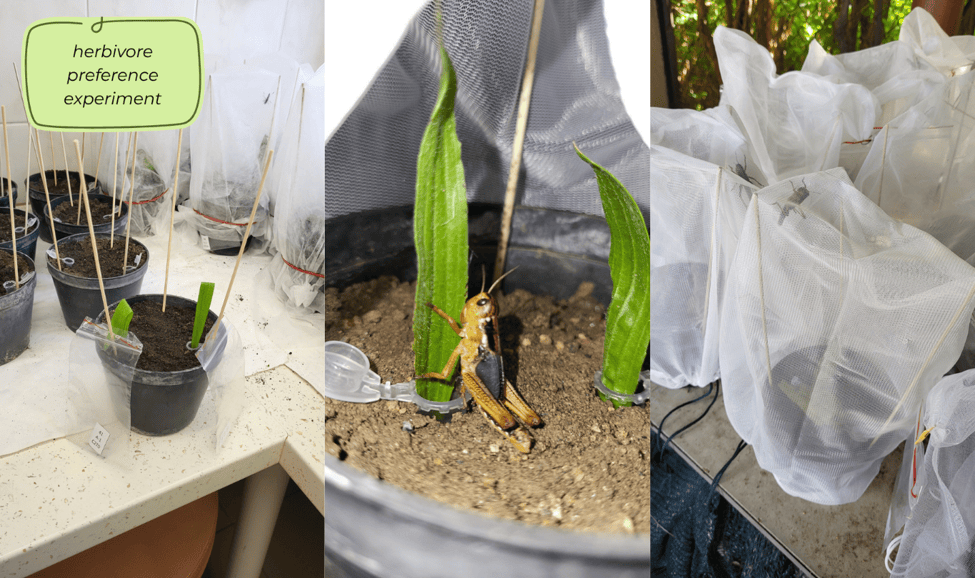
From the ClimGrass plots, we sampled leaves of Plantago lanceolata (ribwort plantain). We analysed seven leaf traits, including leaf toughness, C/N, and secondary metabolite composition. Consumption was analysed by estimating the percentage of the leaf area that had been damaged by consumers. Plant consumption research is typically dominated by chewing guilds (mostly Lepidoptera—the order of butterflies and moths), but we distinguished between different types of consumer damage, such as chewing, sucking, and powdery mildew infection. Finally, we conducted a laboratory experiment to see if the conditions from which the leaves originate affect the feeding preferences of Locusta migratoria (migratory locust).
Lessons learned
Our results show that warming, elevated CO2, and drought indeed affected plant consumption in direct and indirect ways. For example, warming directly favoured powdery mildew, and indirectly lowered damage by sucking insects by reducing the concentration of the secondary metabolite, flavonoid glycoside. Global change factors also interacted in their effects, showing the importance of studying multiple factors simultaneously.
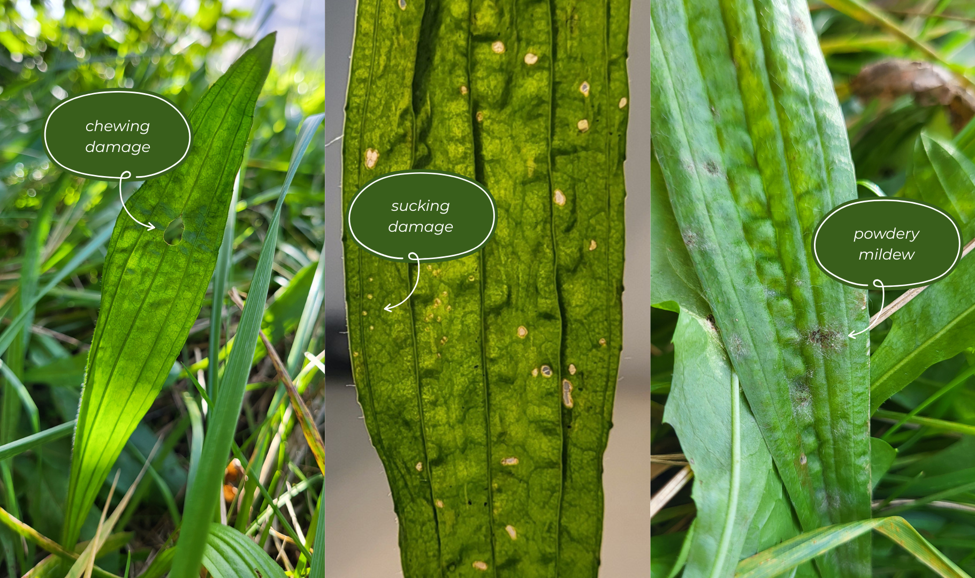
Upon closer inspection, a more intricate picture was revealed. Most notably, we observed different responses for different global change factors, plant traits, and consumption types. For example, warming and leaf toughness affected powdery mildew but not damage by chewing herbivores. Finding such differences in a single plant species within a single experimental system highlights the complexity of interactions between plants, consumers, and their environment.
Though our findings seem to have raised more questions than they answered, one message is clear: one size does not fit all. This has important implications for future research in this area. For instance, that combining all consumption types, as is often done in metanalyses, may be an overly reductionist approach that does not capture how different herbivores and pathogens are influenced by different factors. We suggest that future studies avoid excessive generalisations and attempt to study a broad range of plant traits and consumers under realistic, multifactorial, global change conditions.
To see the site and fieldwork in action, see this video from the Institute of Botany of the Czech Academy of Sciences.


