Defense against multiple enemies changes differently across latitudes in an invasive plant and its native congener

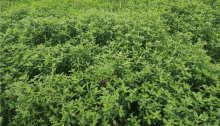
Xinmin Lu, Huazhong Agricultural University, Joshua Lynn, Manchester University, and Evan Siemann, Rice University, discuss their article: Latitudinal patterns in growth and defense against multiple enemies of an invasive species and its native congener Why are some plant species more successful invaders than others? A long-standing hypothesis is that invasive plants differ from native species…

A global invasion and divergence in plant-pathogen interactions

Ylva Lekberg, from MPG Ranch, discusses her article: Eco-evolutionary shifts in interactions between a globally invasive plant and belowground putative pathogens coincide with shifts in plant performance Some plant species become invasive in non-native ranges and outcompete native plants, reduce biodiversity, and alter ecosystem functions. Altogether, invasive species cost billions of dollars to manage. We…

Searching for early warning signals of dieback in Mediterranean forests

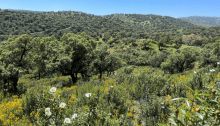
Álvaro Gaytán and Lorena Gómez-Aparicio, Institute of Natural Resources and Agrobiology of Seville (IRNAS-CSIC), discuss their article: Evidence for linkages between the root elementome and oak decline in Mediterranean systems invaded by soil-borne pathogens Mediterranean oak woodlands are among the most iconic ecosystems of southern Europe. Yet many of these forests are under increasing pressure from…

Can plant functional diversity dilute plant virus infection?

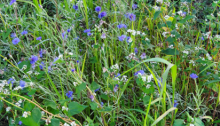
Beatriz Aguirre, Cornell University, discusses her article: Plant functional diversity does not dilute virus infection, but community virus prevalence positively correlates with net C3 grass production Greater plant diversity can protect plant communities from pathogens in wild and agricultural plant communities, and the effects of many aspects of diversity, such as genetic and species diversity,…

Plants with higher biomass accrual rates drive infectious disease outcomes in multi-host annual plant communities

Margaret W. Simon, University of Kansas, USA, discusses her article: Fast-growing annual plants drive disease spillover in multi-host communities Infectious plant diseases affect hosts in natural, agricultural, and urban systems. Modeling studies can help predict these effects, but traditional disease models were developed for animal systems. These models are not well suited for plant disease…

How is litter decomposition affected by climate change in Mediterranean forests? Soil fauna has the key

Lead author Pablo Homet discusses recently published article: Soil fauna modulates the effect of experimental drought on litter decomposition in forests invaded by an exotic pathogen. Find out more about how litter mesofauna plays an important role in litter decomposition in a Mediterranean forest. Decomposition processes of dead organic matter are fundamental for life cycling.…

Introducing Grime Reviews and call for review proposals

Journal of Ecology’s Reviews Editor, Jason Fridley, introduces our new Grime Reviews series. We are currently accepting review proposals on the subject of “Remote sensing in plant ecology”. If you are interested in contributing please email your proposal by 31 January 2021 (see below for full details). Journal of Ecology is pleased to announce a…