Xingli Xia and Jianyang Xia, East China Normal University, discuss their article: Flower-leaf sequence shapes plant phenological sensitivity to warming
Every spring, we witness nature’s awakening as flowers bloom and leaves unfold. But have you ever noticed that some plants burst into bloom before their leaves appear, while others do the opposite? This seemingly simple observation might hold crucial clues about how plants will cope with our warming world. Our research reveals a hidden pattern in the order of flower and leaf emergence among different plants, showing its impact on plant response to climate warming.
The flower-leaf puzzle
When spring comes, trees face a critical decision: should flowers or leaves emerge first? This “flower-leaf sequence” is not just botanical trivia, but rather a fundamental ecological strategy that determines how plants allocate their precious resources between reproduction and growth. Think of it like a budget decision: flower-first plants bet on stored energy from last year, investing their savings into reproduction before they can earn new income through photosynthesis. Leaf-first plants, on the other hand, prefer to generate fresh energy first, then use both stored reserves and new resources for reproduction. But which strategy do plants choose, and why does it matter?

A Surprising Discovery
To answer these questions, our team analyzed 40 years of woody plant data from the Chinese Phenological Observation Network. Because the original records had missing data, we used the Richards growth equation to reconstruct a complete picture of reproduction.
What we discovered challenged conventional wisdom. Scientists traditionally believed each plant species had a fixed flower-leaf sequence. But our data revealed something far more dynamic: 70 of 80 species showed both flower-first and leaf-first patterns at different times and places. Additionally, we found that flower-first records became more common as we moved northward. Beyond an earlier onset, climate change is fundamentally altering the synchrony of spring’s ecological processes.
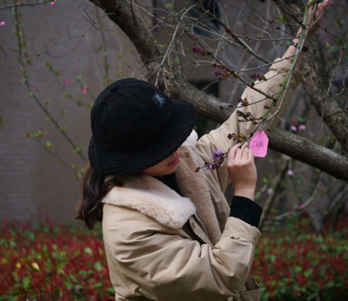
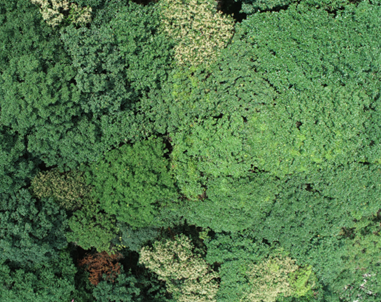
Researchers conducting phenological observations to record leaf and flowering times (left, photo credit: Xingli Xia) in a subtropical evergreen broadleaf forest at Tiantong, Zhejiang (right, photo credit: Huanfa Sun).
Why Does This Matter?
The flower-leaf sequence profoundly affects how sensitive plants are to temperature changes. Our research uncovered a striking difference. When plants flower before producing leaves, their reproductive timing is much more responsive to warming temperatures. For example, in flower-first plants, flower buds emerged 2.38 days earlier for every 1°C of warming. But in leaf-first plants of the same species, the advancement was only 1.86 days per degree. This might sound like a slight difference, but when multiplied across decades and entire ecosystems, the consequences become profound. This differential response creates ripple effects throughout ecological networks, affecting pollinators, herbivores, and other organisms that depend on precise seasonal timing.
Looking to the Future
These findings have important implications for understanding how plants will respond to climate warming. We can’t simply assume that all individuals of a species will react identically to temperature changes, variation within the same species must also be considered. With climate change, we might see plants shifting flower-leaf sequences in unpredictable ways. These strategies also raise a broader question about how such plant-level decisions scale up to impact ecosystem structure and function.
Nature’s calendar is more fluid than we once thought, but this flexibility carries subtle consequences. By learning how plants time their spring awakening, we can better anticipate the changes unfolding in our ecosystems. So, the next time you see a tree bloom before its leaves appear, pause to appreciate an elegant adaptation quietly at work in nature’s rhythm.

 jecologyblog.com