Johanne Gresse, University of Tübingen, discusses her article: Drought resistance drives population temporal stability of annuals in drylands
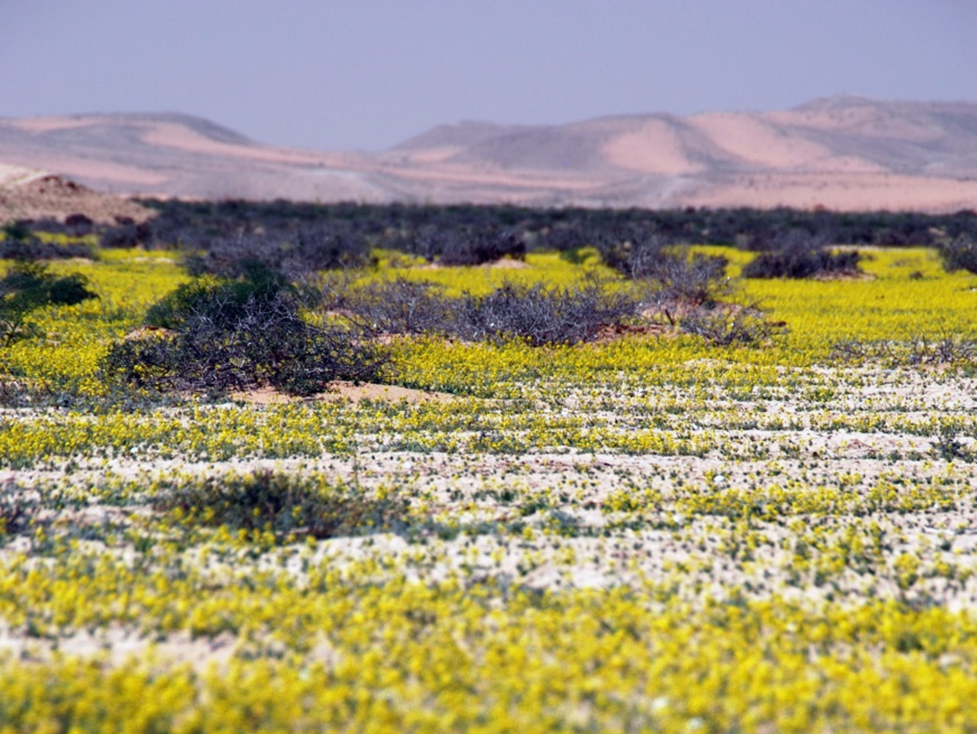
Imagine a desert after rain. For a few brief weeks, the ground bursts into a colourful carpet of annual plants. At first glance, this display seems fleeting and fragile. But when observed over many years, a pattern emerges: some plant populations fluctuate dramatically from year to year, while others remain remarkably stable. What allows certain species to persist so reliably in such an unpredictable environment?
Understanding what makes populations stable over time is crucial for explaining community stability, species coexistence, and the maintenance of multiple ecosystem functions. In drylands, where rainfall is irregular and droughts can arrive unexpectedly, explaining population stability has long been a challenge. Traditional theory has largely pointed to one solution: delayed germination. By keeping some seeds dormant in the soil, plants were thought to survive unfavourable years by effectively “waiting them out”. But is waiting really the main reason dryland annuals remain stable over time?
To answer this, we followed 178 populations of 66 winter annual plant species for 13 years, spanning Mediterranean, semi-arid, and arid climates. Each year, we recorded population sizes and measured key plant traits. These included seed traits and characteristics linked to how plants cope with drought, such as how efficiently plants use water, how well they maintain hydration during dry periods, how fast they grow, and how thick or thin their leaves are. We also considered where plants grow. In drylands, perennial shrubs create strong local environments, often cooler and shadier than open ground. We asked whether the same traits that promote stability in open areas also operate beneath shrubs.
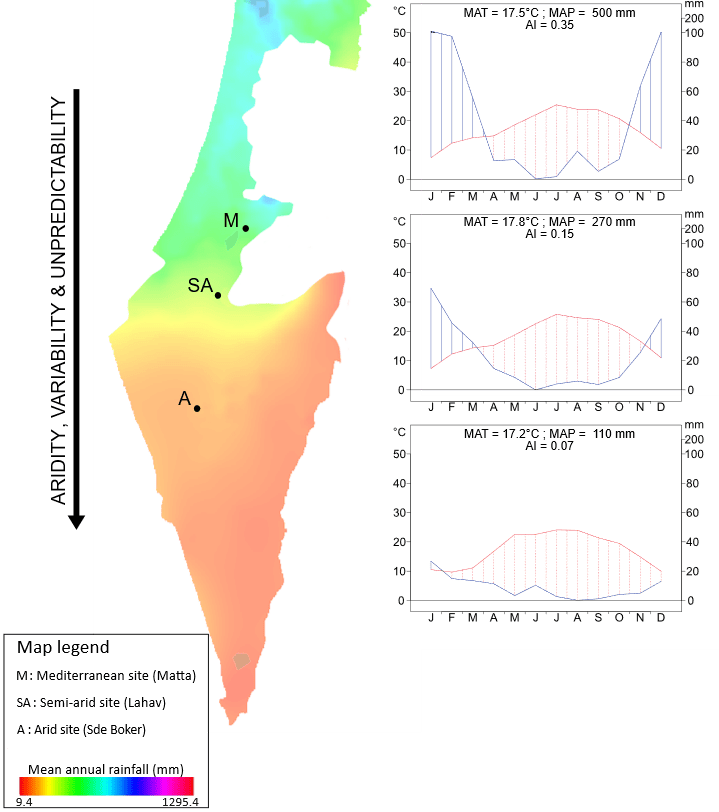
Across all three climates, one clear pattern emerged. In open habitats, drought resistance—not delayed germination—was the strongest and most consistent predictor of population stability. Species that were better able to conserve water and continue functioning during dry periods showed smaller year-to-year changes in abundance. This relationship was strongest in the arid climate, where drought during the growing season is most frequent and unpredictable. In simple terms, many desert annuals are not merely avoiding drought by growing quickly: they are actively coping with it. Their ability to withstand dry conditions helps keep populations stable even when rainfall varies strongly between years.
Under shrubs, however, this stabilising effect disappeared, likely because shrub canopies already reduce environmental extremes. Delayed germination did play a role, but only in the most arid and unpredictable open habitats, where it acted as an additional buffer alongside drought resistance
Overall, our results point to drought resistance as a key and broadly important mechanism of population stability, operating across climates from the most arid deserts to more Mediterranean climates.

 jecologyblog.com