Jiaqi Chen and Wentao Luo, Institute of Applied Ecology of the Chinese Academy of Sciences, discuss their article: Dominant species determine drought effects on grassland multifunctionality
The increasing frequency of extreme drought events poses a severe threat to grassland ecosystem multifunctionality—a metric aggregating multiple ecosystem functions. However, the ecological mechanisms driving these impacts remain contentious. Some posit that the preservation of multifunctionality under drought hinges on species diversity through complementary effects while others assert that dominant species with high mass-ratio are most important. It remains unknown whether either or both of these factors underpin multifunctionality responses to extreme drought— the debate between mass and diversity.
One drought manipulation experiment to combine diversity and dominance
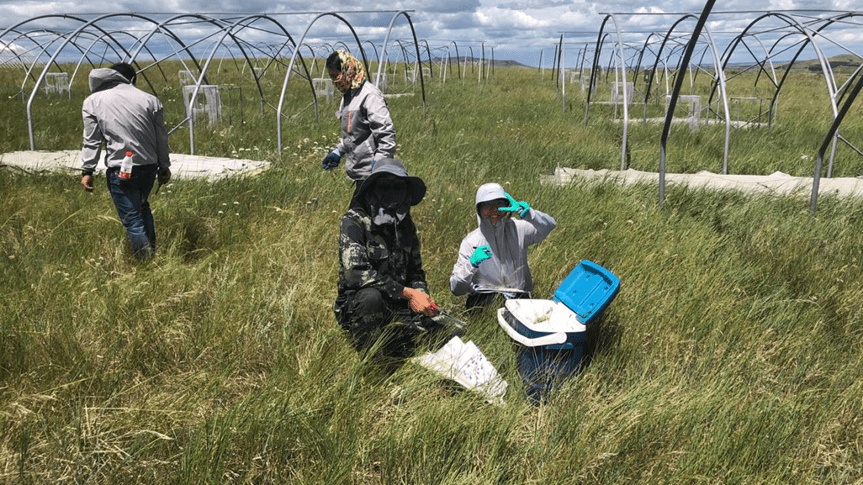
We experimentally imposed an extreme two-year drought in two C3-dominated grasslands in Inner Mongolia. Our experiment included a drought treatment and a control of ambient conditions. Compared to the control, the drought treatment diverted 66% of precipitation during the growing season (May-August). We selected ecosystem functions related to productivity and plant-soil nutrient pools to comprehensively assess ecosystem multifunctionality. Furthermore, we measured and calculated diversity across multiple dimensions—species, functional, and phylogenetic—to evaluate the underlying complementary effects. To assess the role of dominant species, we measured six plant functional traits and computed community-weighted means for each trait using biomass as the weighting factor.
Critical Finding 1: Dominant species exert a stronger influence on multifunctionality than diversity
Drought significantly reduced multifunctionality and had a substantial impact on the community-weighted means (CWMs) of functional traits. In contrast, drought had little effect on diversity (species, functional, and phylogenetic diversity). Similarly, drought was strongly coupled with CWMs of plant traits but had no significant association with the aforementioned diversity measures.
Our results indicated that the dominant species, particularly the grass Leymus chinensis, consistently exerted strong influence on community-level traits through the mass ratio effect. CWMs provided a better explanation for the response of multifunctionality to drought, because drought induced changes in community species composition, including species turnover and intraspecific trait adjustments within the dominant species. In this system, diversity-mediated effects were weak, and community diversity alone was generally insufficient for accurately predicting multifunctionality.
Critical Finding 2: Resource-conservative strategies induced by drought impair multifunctionality
Grassland multifunctionality was positively associated with resource-acquisitive traits and negatively associated with resource-conservative traits. Drought acted as an environmental filter, triggering shifts in community-level trait composition by selectively favouring species with resource-conservative strategies.
Our study indicates that drought provoked a new trade-off between acquisitive and conservative strategies. This adaptive shift toward resource conservation maintained plant growth under water-limited conditions, but at the cost of reduced grassland multifunctionality.
Why our research matters
Our research findings highlight the pivotal role of dominant species and their traits in maintaining grassland multifunctionality during extreme drought. We lend stronger support to the importance of mass-ratio than to complementary effects, finding that ecosystem functions were predominantly shaped by the traits of the dominant species, as captured by community-weighted trait means, instead of by diversity. These insights enhance our understanding of how droughts impact grassland functions and provide critical information for developing effective grassland management and conservation strategies.
We propose that grassland conservation and management strategies should prioritise not only plant diversity but also particularly the trait characteristics of dominant species. Our findings underscore the critical need to integrate these traits into adaptive management frameworks to ensure a sustainable balance between productivity and ecological stability.

 jecologyblog.com