2025 HARPER PRIZE SHORTLIST: For the next two weeks, we are featuring the articles shortlisted for the 2025 Harper Prize. The Harper Prize is an annual award for the best early career research paper published in Journal of Ecology. Paul Kühn & Raymond Umazekabiri’s ‘Nitrogen content of herbarium specimens from arable fields and mesic meadows reflect the intensifying agricultural management during the 20th century‘ is one of those shortlisted for the award.
About the paper:
What is your shortlisted paper about, and what are you seeking to answer with your research?
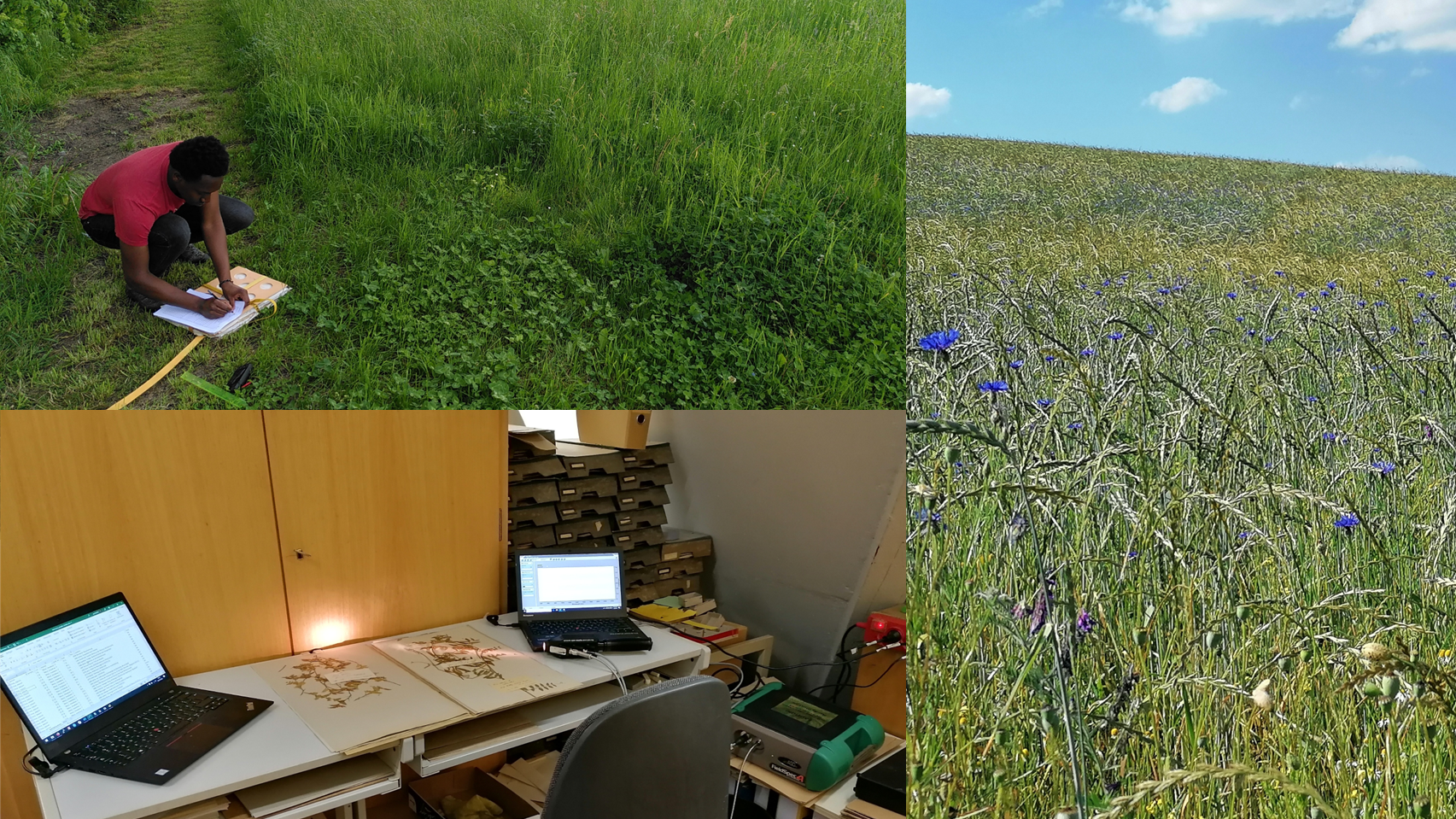
Our paper investigated the changes of functional leaf traits of European agricultural plant species over time. These semi-natural habitats can support a large amount of biodiversity but are directly dependent on management practices. Declines of plant diversity in these habitats have already been observed, but it was uncertain how management practices influenced plants and the various trade-offs in their trait profiles. By analyzing herbarium specimens with Near-Infrared Reflectance Spectroscopy (NIRS), we measured the leaf traits of hundreds of individuals plant specimens at the respective time of sampling, covering a timescale of over a century.
Were you surprised by anything when working on it? Did you have any challenges to overcome?
Although the biogeographical literature on agricultural habitats already shows that community biodiversity can be very heterogeneous, we were still surprised to notice how stark the differences in diversity were in the field, even among crop types well known for their intensive management practices like maize or rapeseed.
As for challenges, the management of meadows and crop fields of course follows its own rhythm. Farmers in the region began harvesting in early July of 2022, adding some excitement to our field campaign as we tried to sample locations before the harvesting machines moved in.
What is the next step in this field going to be?
A practical next step would be to either widen the selection of functional traits being studied or to expand the geographical and ecological context. NIRS calibration models for various other traits can be tested for accuracy and, if successful, can be used in the long-term analysis of, e.g. carbon isotopes in response to climate changes, or secondary metabolites in response to plant pathogens. On the other hand, a similar set of traits to those used here could be used to study long-term changes in forests, grasslands, swamps, or other areas affected by anthropogenic changes.
What are the broader impacts or implications of your research for policy or practice?
Our research showed that plants in agricultural habitats exhibited a clear shift in functional traits over time, with much of this being significantly related to national and state-level fertilization inputs. Furthermore, some species within the dataset differed significantly from the general trends, indicating that particular species might be unable to adjust to their new, well-fertilized environments. This underlines the importance of limiting fertilizer input to preserve the diversity of semi-natural habitats and furthermore allows conservation efforts to focus on and plan for specific plant species which are especially impacted by modern management techniques.
About the author:
How did you get involved in ecology?
Paul realized during his bachelor studies that ecological research, integrating field studies with lab results and statistics, held more excitement than many of his other courses. Since then, he’s been continually fascinated by how biological diversity is shaped and formed.
Raymond was introduced to nature by his father, who collected medicinal plants to treat digestive problems in animals and humans. Watching how plants, animals, and people were connected sparked his interest in ecological interactions and eventually led him to pursue a career in ecology.
What is your current position?
Paul currently works as a project leader for a large German nature conservation group and is studying insect diversity along the former Iron Curtain, known as the Green Belt.
Raymond is currently pursuing a PhD in Biological Sciences at Monash University in Australia, where he is evaluating data gaps in the tropics.
Have you continued the research your paper is about?
Paul and Raymond moved on to different research fields after their degrees, although by coincidence, both now work on large insect diversity studies. Paul continues to work on a follow-up publication that integrates the functional trait dataset from the publication with distribution data of plant species of agricultural habitats. For Raymond, this research sparked a new idea, and one of his PhD chapters will explore trait distinctiveness in butterflies. Furthermore, two PhD projects were initiated at their respective institutions, which build on the methodological framework of our research project to tackle new research questions.
What one piece of advice would you give to someone in your field?
When applying novel methods to a field of research, you will inevitably face a range of tough questions from experts and experienced scientists. These questions will be difficult to answer even if they aren’t directly critical of your work. Take them seriously but also remember that you’ve double- and triple-checked your own work, and have earned the right to be confident in your results.


 jecologyblog.com