Jiarong Yang and Yu Liu, East China Normal University, discuss their article: Rare tree species host a high diversity of rhizosphere fungi
Forest ecosystems are intricate webs of life where trees and their root-associated fungi form a delicate balance. One question that remains, is whether and how tree species abundance influences the fungal communities that live in their rhizosphere. If abundance indeed alters these fungal communities, our second question follows: do abundance-associated differences in rhizosphere fungal diversity help explain variation in seedling biomass? Our research group worked to shed light on this mystery, revealing a fascinating link between tree rarity and fungal diversity.
Unravelling the tree – fungus relationship
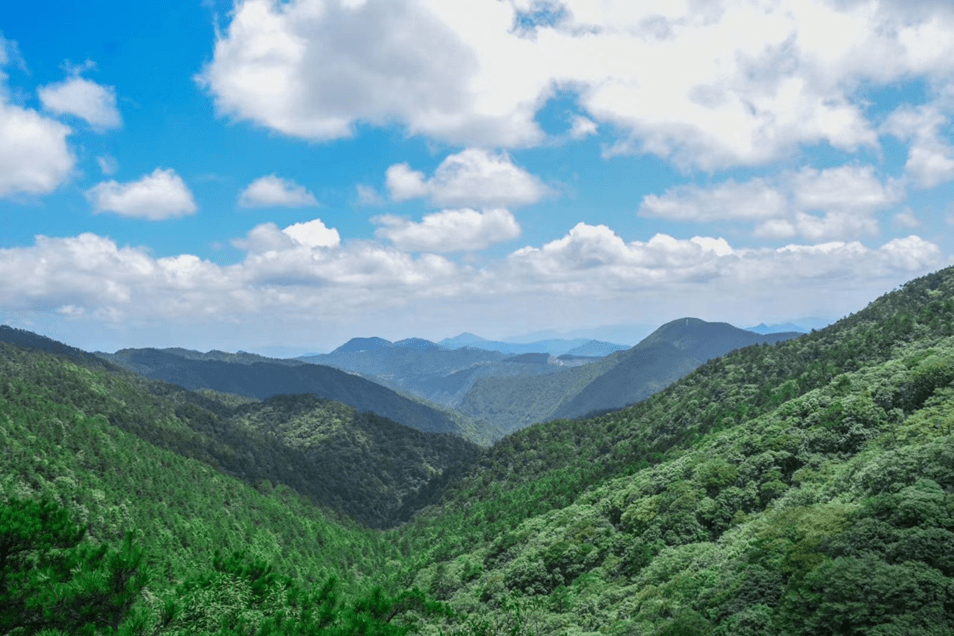
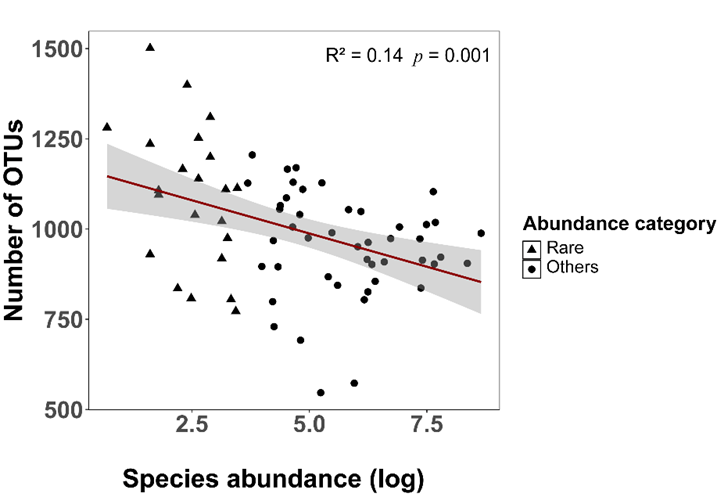
We sampled rhizosphere soils from 272 adult trees across 68 species in a 25-ha subtropical forest plot in Baishanzu in eastern China to examine the relationship between host tree species abundance and rhizosphere fungal diversity. Detection of a negative relationship would imply a reduced selection effect of rare tree species on soil fungi. As expected, we found that total rhizosphere fungal diversity declined with increasing tree species abundance. In other words, rare tree species exerted weaker selection on associated soil fungi, thus hosting a richer rhizosphere fungal community than common species.
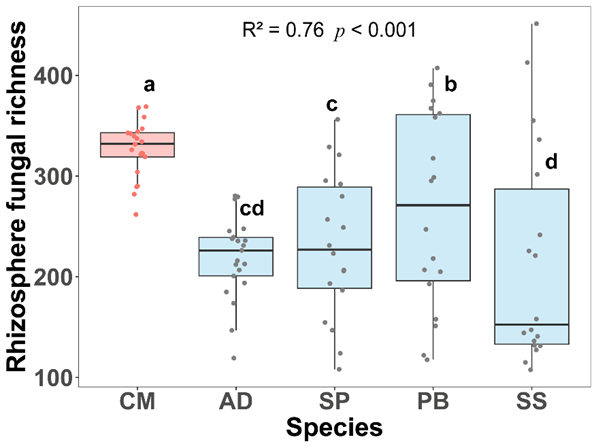
To further confirm this observation, we conducted a greenhouse experiment. We selected seedlings of five tree species with contrasting abundance and phylogenetic relatedness from the Baishanzu 25-ha plot. These seedlings were planted in pots filled with the same heterospecific soil mixture, which standardized both the soil fungal inoculum background and the abiotic soil environment. The use of heterospecific soil inoculum was intended to reduce potential biases caused by host-related microbial selection, particularly among closely related tree species (e.g., the same genus). The results mirrored the field data: the least abundant species, Callicarpa membranacea, had the weakest host selection effect, hosting the highest fungal richness.
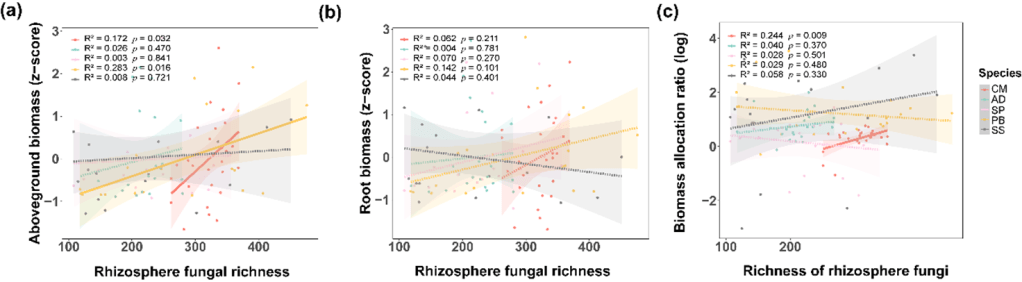
Interestingly, only with Callicarpa membranacea seedlings did we observe that total rhizosphere fungal diversity was positively correlated with both aboveground biomass and the ratio between above- and belowground biomass. This suggests that a rich fungal community may help sustain this rare tree species in the wild.
Fungal specialization patterns
Using Blüthgen’s weighted specialization index d′, we classified fungi as low (0–0.33), moderate (0.34–0.67), and high (0.68–1.0) specialization. The experiment further revealed that tree species with varying abundance in the surveyed site differed in their fungal selection preferences. In particular, C. membranacea (rare) hosted more moderate-specialization fungi, which may associate with a broader range of hosts, as suggested by their similar proportions in both the least and most abundant species. In contrast, Schima superba (abundant) hosted the highest proportion of high-specialization fungi, suggesting that high host abundance may increase fungal encounter rates and thereby alleviate dispersal limitation for specialist fungi.
Why this matters: Implications for forest ecology
This study demonstrates that rare tree species harbour higher fungal diversity in their rhizospheres than common ones, reflecting their weaker selection on soil fungi.
For forest conservation, these findings highlight the importance of preserving not just trees but also their microbial partners, for example by mitigating excessive anthropogenic disturbance. The weaker selection effect of rare tree species likely allows more fungal taxa to persist in the rhizosphere, resulting in higher total rhizosphere fungal diversity. This may confer an advantage if diverse fungal communities provide complementary functions (e.g., nutrient acquisition, pathogen suppression) that enhance host fitness. A diverse fungal community may thus help maintain the stability of rare tree populations, ultimately shaping the composition of entire ecosystems.
Conclusion
The next time you walk through a forest, remember that the trees you see are not just solitary organisms. They instead are part of a vast, hidden network of fungi that can shape tree growth, health, and survival. Understanding this relationship could be crucial for protecting our planet’s biodiversity.

 jecologyblog.com