Rui Wang, Institute of Plant Protection of the Chinese Academy of Agricultural Sciences, discusses their article: Asymmetric adaptation across a core–periphery climatic gradient drives rapid phenological evolution and range expansion in an invasive plant
When we think about plant invasions, we often picture species spreading quickly, competing with native plants, and causing problems for ecosystems and farming. But behind these visible changes, a less obvious process is often unfolding: invasive plants can evolve as they spread.
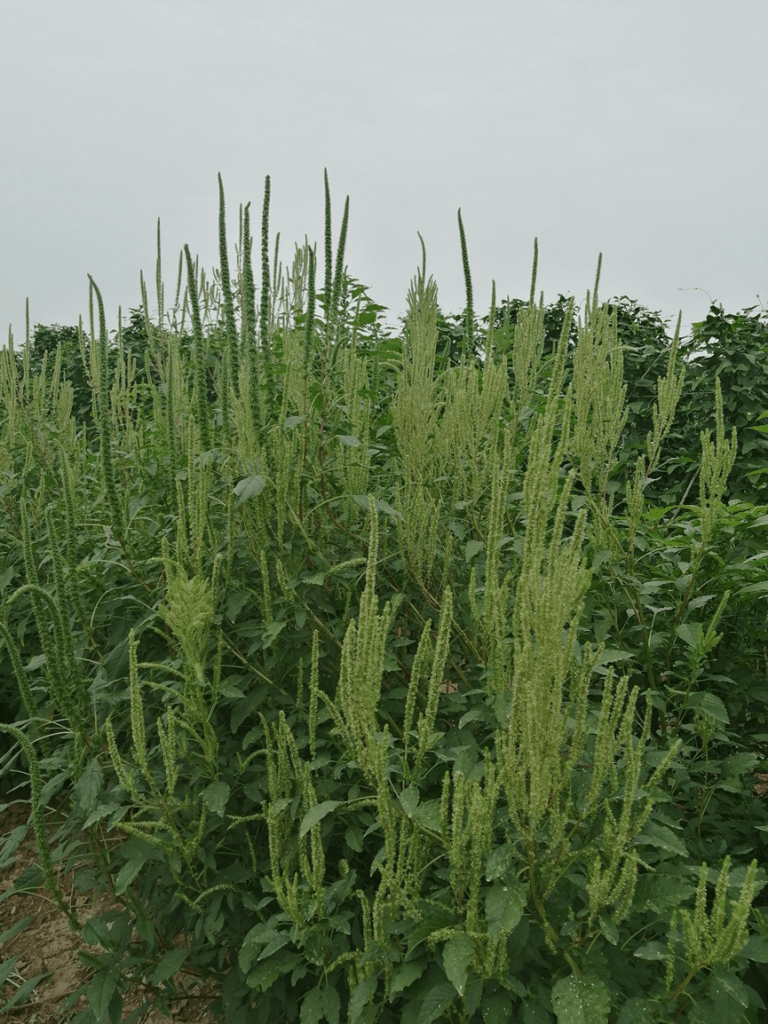
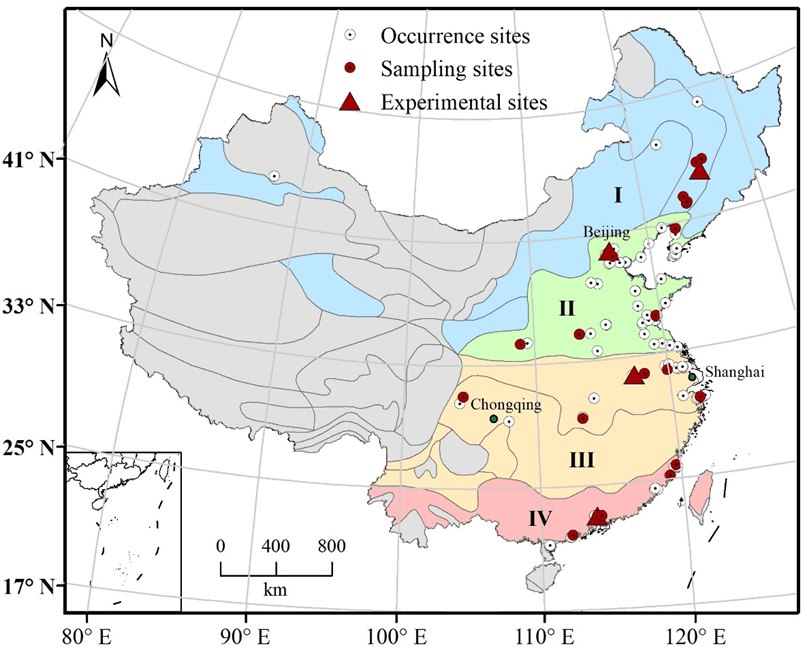
To know more, we investigated how one of the world’s most problematic weeds, Palmer amaranth (Amaranthus palmeri S. Watson), has managed to establish across a vast area in China, from the warm subtropics to chilly northern regions. The species was introduced to China multiple times from the 1980s as a contaminant in imported soybeans, reaching different climatic regions across more than 3,000 km, from 21°N to 49°N. This has created a natural core–periphery gradient, with dense populations in the warm temperate centre and sparser populations at the northern and southern edges. We wanted to know whether populations at these range edges have simply survived under harsh conditions, or whether they have changed through evolution.
A 3,000-km natural experiment
To find out, we identified four regions along this latitudinal gradient—southern edge, south-central periphery, centre, and northern periphery—and carried out a five-year field experiment. In each region, we established experimental gardens within the existing distribution of the species. We grew seeds collected from all four areas and tracked their survival, growth, and reproduction. This approach let us ask: do these populations perform best in their home environments?
Asymmetric adaptation: The north adapts, the south struggles
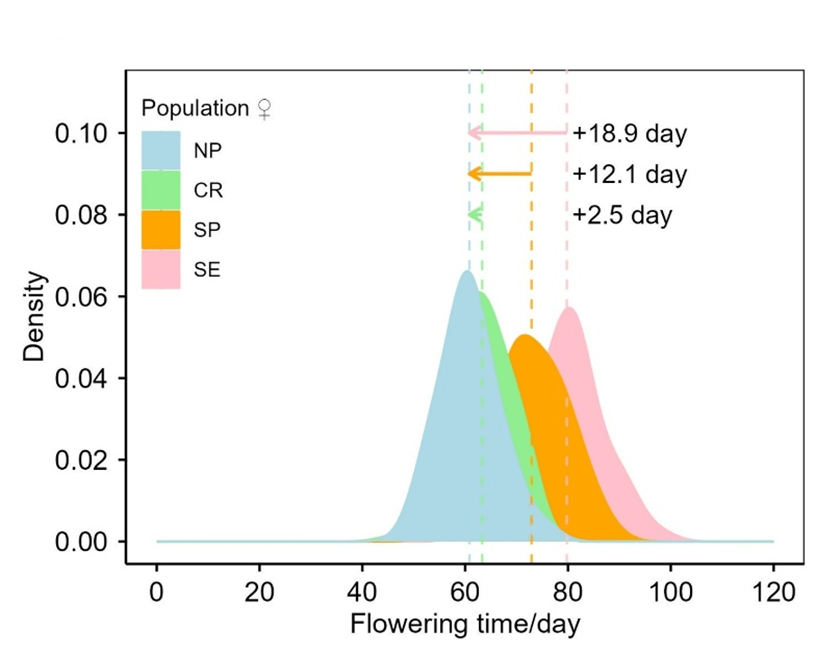
The results showed clear differences. Northern populations performed best in the north—they had evolved to flower earlier and for longer, allowing them to complete their life cycle within the short growing season. In the northern garden, these plants flowered 2.5–18.9 days earlier and flowered for 5.7–18.2 days longer than populations from elsewhere. This timing is crucial: it allows them to produce seeds before winter arrives.
Southern populations, in contrast, struggled everywhere—even when grown back in their home region. This difference reveals a key insight: range edges are not all the same. The northern frontier is a place of strong selection and rapid adaptation. The southern edge, however, seems to be a dead end, likely limited by heat and humidity rather than by growing season length.
How does rapid adaptation happen with limited genetic diversity?
Although populations from different regions differed markedly in their flowering behaviour, their overall levels of genetic diversity were relatively low. This raised another question: how can rapid adaptation occur when genetic variation is limited?
We compared how much traits differed between populations (a measure called QST) with how much their neutral genes differed (FST). The differences in flowering time were far larger than what random chance alone could explain, clear evidence that natural selection was at work.
When we scanned the genome more closely, one gene stood out: PTM (a gene involved in chloroplast-to-nucleus signalling that helps regulate flowering time). This gene is known to be involved in flowering time regulation, particularly in communication between chloroplasts and the nucleus. In our study, it was the gene most strongly linked to flowering time variation. It also showed high levels of genetic differentiation between northern and other populations, carried signs of a recent selective sweep, and was expressed at much higher levels in northern plants. Together, these multiple lines of evidence point to PTM as one of the key genes enabling adaptation at the northern range edge.
What this means for invasion biology and management
Our findings show that invasive plants can adjust to new environments through surprisingly rapid evolutionary changes. In Palmer amaranth, selection on genes such as PTM has shifted flowering timing, facilitating northward expansion—even though overall genetic diversity is low. Because introductions occurred directly into different regions, these adaptive changes unfolded independently, leading to regional variation in population performance and management priorities.
From a management perspective, populations at the leading edge of an invasion deserve special attention. These are not simply the passive result of spread; they may be actively adapting. Monitoring flowering time in advancing populations could offer clues about future expansion.
More broadly, this study shows the value of combining long-term ecological observation with genomic analysis. Field experiments give realistic measures of performance, while genomics helps reveal underlying mechanisms, offering insights into how species ranges shift over short timescales.
Invasions are not only ecological events; they can be evolutionary too. Observing these changes in real time helps us understand not just where species go, but how they survive.


