Brandie Quarles-Chidyagwai, University of California, Davis, discusses her article: Adaptational lag at high elevations depends on life stage in a California wildflower
With ongoing climate change, many plant species will have to track environmental changes through adaptation or poleward/upslope dispersal. High elevations in particular are experiencing warming temperatures, reduced snowpack, and shifting growing seasons. With limitations on how far upslope plants growing at high elevations can disperse, adaptation to warming conditions may be key for the persistence of high elevation populations. However, it is unclear if many plant species have the potential to adapt fast enough to keep up with the changes in climate.
Upslope dispersal from low elevation populations pre-adapted to warm temperatures may facilitate population persistence at high elevations. However, in Mediterranean climates, differences in elevation come with differences in seasonal conditions, and correspondingly different life history timing. For example, in our study species, Streptanthus tortuosus, high elevation plants are limited to a summer growth season due to high snowpack in other seasons. This short growth period has likely selected for a biennial or perennial life history strategy in these plants. In contrast, low elevation plants are limited to a fall through spring growth season due to hot, dry summer conditions, and often exhibit annual life histories with these longer growth seasons. Therefore, it is unclear if low elevation populations will be able to shift their life cycles to avoid winter snowpack and successfully reproduce at high elevations. In fact, one might expect low elevation plants to grow well at high elevations during mildly warm summer months but potentially struggle to either reproduce quickly enough in their first summer or survive the winter to be able to reproduce in their second summer. Conversely, high elevation plants may be maladapted to increasingly warmer summers but may be well-adapted to survive the winter into their second year.
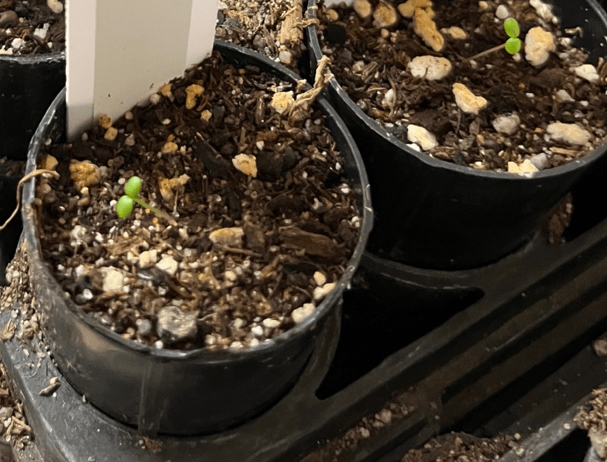
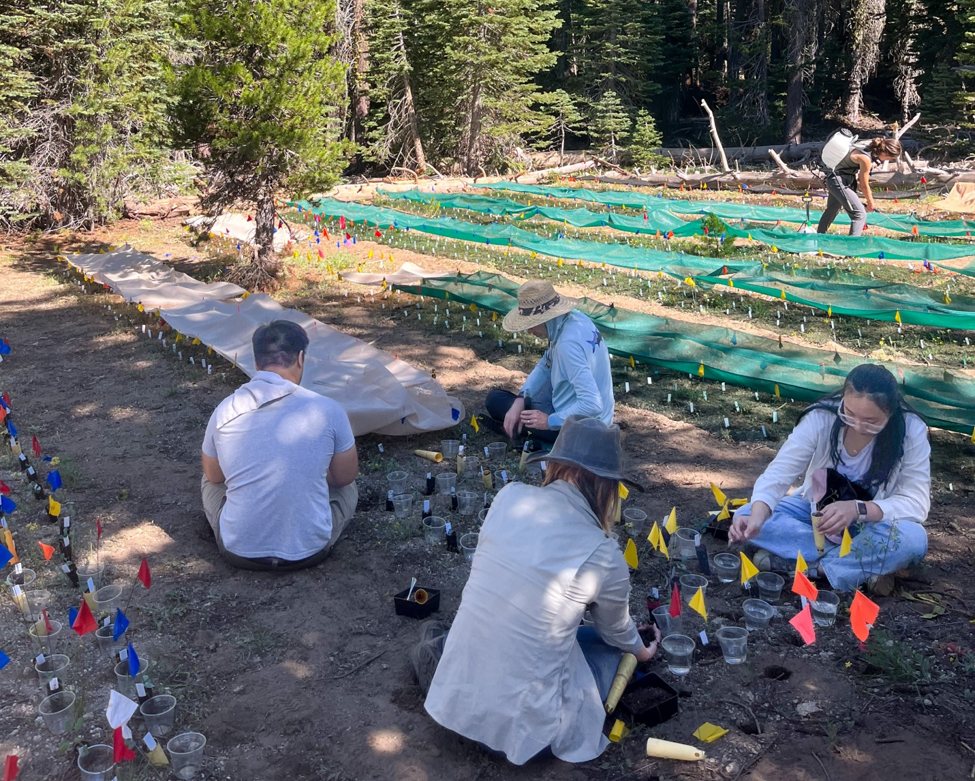
We conducted a common garden experiment at a high elevation site in the U.S. Sierra Nevada mountain range to explore season-specific differences in performance between plants from low and high elevations. 23 populations from across the latitudinal and elevational range of S. tortuous were measured for mortality, phenology, and reproductive output.
However, just as high elevation poses challenges to plants, it also does to researchers. Due to snow, the road to our field site closes every winter. Therefore, we had to make an educated guess about when the snow would melt to know when to start preparations for the field planting. High elevation populations of S. tortuous require 8 weeks of chilling in order to germinate; a mechanism that prevents germination in the fall. We also wanted to give the plants time to grow big enough to be able to survive being transplanted to the field. Therefore, we had to start planting seeds at least 11 weeks before we expected our site to be accessible for transplanting.
When the snow had melted and the plants were ready to be transplanted, new challenges arose. The closest area to park near our field site is about 500 feet away with ~40 feet elevation gain. There is also no access to water at our field site, so we rented a water tank from UC Davis, put it on the back of a pick-up truck, and filled up water backpacks to carry from the parking area to the field site. Once everything we needed was up at the site, we got to work transplanting!
What did we find? As expected, low elevation plants had higher survival through the first summer than high elevations plants. However, counter to our expectations, low elevation plants also survived the winter much better than high elevation plants. It isn’t all bad news for the high elevation plants though; they survived to reproduce in their second year better than low elevation plants.
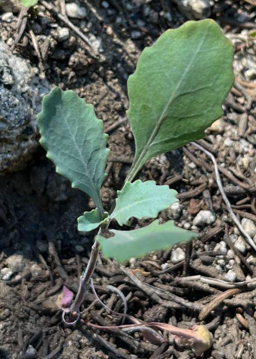
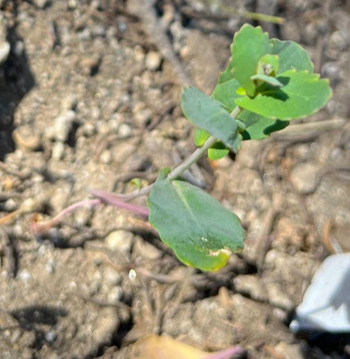
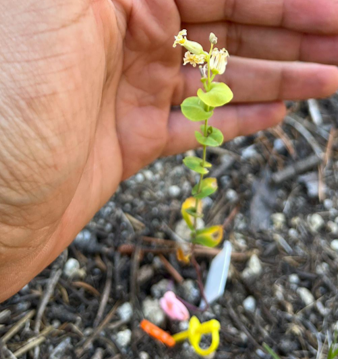
Experimental S. tortuosus plants at different stages (vegetative (left), budding (top), flowering (bottom)). Photos by Brandie Quarles-Chidyagwai.
The path to persistence for high elevation plants may be one that combines adaptations of low elevation populations with those that allowed high elevation populations to be more successful in their second year of life. In the conservation world, this is known as assisted gene flow. Future studies will look into the potential success of that strategy for this species. In general, our results highlight the importance of measuring fitness at multiple life stages when evaluating climate adaptation. If we had only measured survival to reproduction in the second year, we would have very different and misleading conclusions.


