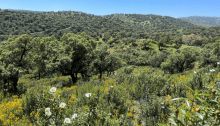
Searching for early warning signals of dieback in Mediterranean forests

Álvaro Gaytán and Lorena Gómez-Aparicio, Institute of Natural Resources and Agrobiology of Seville (IRNAS-CSIC), discuss their article: Evidence for linkages between the root elementome and oak decline in Mediterranean systems invaded by soil-borne pathogens Mediterranean oak woodlands are among the most iconic ecosystems of southern Europe. Yet many of these forests are under increasing pressure from…

Subordinate grasses invest more underground during drought — and it makes all the difference

Alberto Canarini (University of Bologna, Italy), Pierre Mariotte (Agroscope, Switzerland), Yolima Carrillo (Western Sydney University, Australia), Raúl Ochoa-Hueso (University of Cádiz, Spain), and Barbara Drigo (Adelaide University and CRC SAAFE, Australia) discuss their article: Enhanced belowground functioning is associated with higher plant resistance against drought: implications for ecosystem functions A long-standing puzzle in grassland ecology…

How the strategies of bilberry roots to access nutrients vary at small scales and with changes in nutrient availability

Barbara Meyers, University of Freiburg in Germany, discusses her article: Soil nutrient availability rather than spatial nutrient heterogeneity shapes the intraspecific response of root architectural, morphological and mycorrhizal traits in Vaccinium myrtillus Roots make up for a large proportion of plant biomass and play a central role in several plant functions: accessing water and nutrients…

How Plants Play the Game of Survival

Ruiling Liu and Wenyong Guo, East China Normal University, discuss their article: Grime’s CSR theory revisited: A whole-plant view of vascular plant functioning across contrasting environments You might think plants are quiet and slow, but their lives are full of strategy. Some race ahead, dominating fertile fields, while others hang on stubbornly in rocky cliffs…

Understanding fine root decomposition in the context of the root economics space (RES)

Saheed Olaide Jimoh (@sahjim05), University of Wyoming, discusses his article: Traits associated with the conservation gradient are the strongest predictors of early-stage fine root decomposition rates Background Fine root decomposition is a process that converts dead plant materials into their component elements, supporting nutrient cycling, regulating carbon storage, and sustaining organic matter pools in ecosystems.…

Soil fertility drives plant life down-under

Rachel Standish discusses her recent article: Mycorrhizal symbiosis and phosphorus supply determine interactions among plants with contrasting nutrient-acquisition strategies. Find out more about the importance of below-ground mechanisms for understanding factors determining community structure. The south-west region of Western Australia is a drawcard for plant nerds. Geographic isolation, a stable climate, and ‘quiet’ flat landscape…

Rainbow Research: Nature

To celebrate UK Pride Month, the British Ecological Society journal blogs are posting a Rainbow Research series, which aims to promote visibility of STEM researchers from the LGBTQ+ community. Each post will be connected to a theme represented by one of the colours shown in the Progress Pride flag. In this post, Justin Stewart discusses their…

Editor’s Choice: Volume 109 Issue 2

The Editor’s Choice for our February issue is “Spatial mapping of root systems reveals diverse strategies of soil exploration and resource contest in grassland plants“ by Lepik et al. This article combines fine‐scale measurements of plant root distributions with spatial statistics, yielding new insights into plant behavioural strategies. Here the handling Editor, JC Cahill, provides an overview…