Alberto Canarini (University of Bologna, Italy), Pierre Mariotte (Agroscope, Switzerland), Yolima Carrillo (Western Sydney University, Australia), Raúl Ochoa-Hueso (University of Cádiz, Spain), and Barbara Drigo (Adelaide University and CRC SAAFE, Australia) discuss their article: Enhanced belowground functioning is associated with higher plant resistance against drought: implications for ecosystem functions
A long-standing puzzle in grassland ecology is why some plant species survive drought better than others. Our research points to an answer that lies almost entirely out of sight, beneath the soil surface.
We focused on a distinction that ecologists have long recognised but rarely measured in detail: the difference between dominant and subordinate plant species. Dominant species are abundant, produce lots of biomass, and tend to control the structure of a plant community. Subordinate species are present throughout a community but “keep a low profile”. They seem like secondary players — yet during droughts, they often hold their ground while dominants lose biomass. Why is this? And, what are the implications?
From single traits to whole strategies
Previous work has tried to explain drought resistance by looking at individual plant traits — leaf toughness, root depth, and water-use efficiency. But plants are not defined by single traits. They follow integrated strategies that reflect trade-offs between growth, survival, and how they interact with the living world around them, including soil microbes.
We wanted to know whether these broader life-history strategies could explain why subordinate and dominant species respond so differently to drought — and crucially, what is happening belowground when drought strikes.
Drought experiments across two Australian grasslands
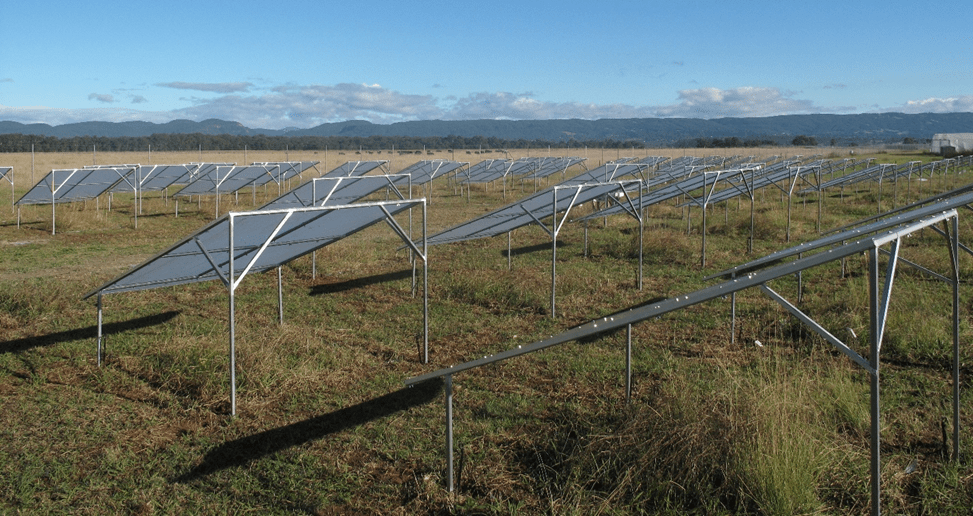
We worked at two drought experiment sites in Australia. At each site, rainfall shelters reduced precipitation by 50% for years, creating realistic drought scenarios. We focused on two grass species present at both sites: Paspalum dilatatum (a dominant C4 grass) and Cynodon dactylon (a subordinate C3 grass).
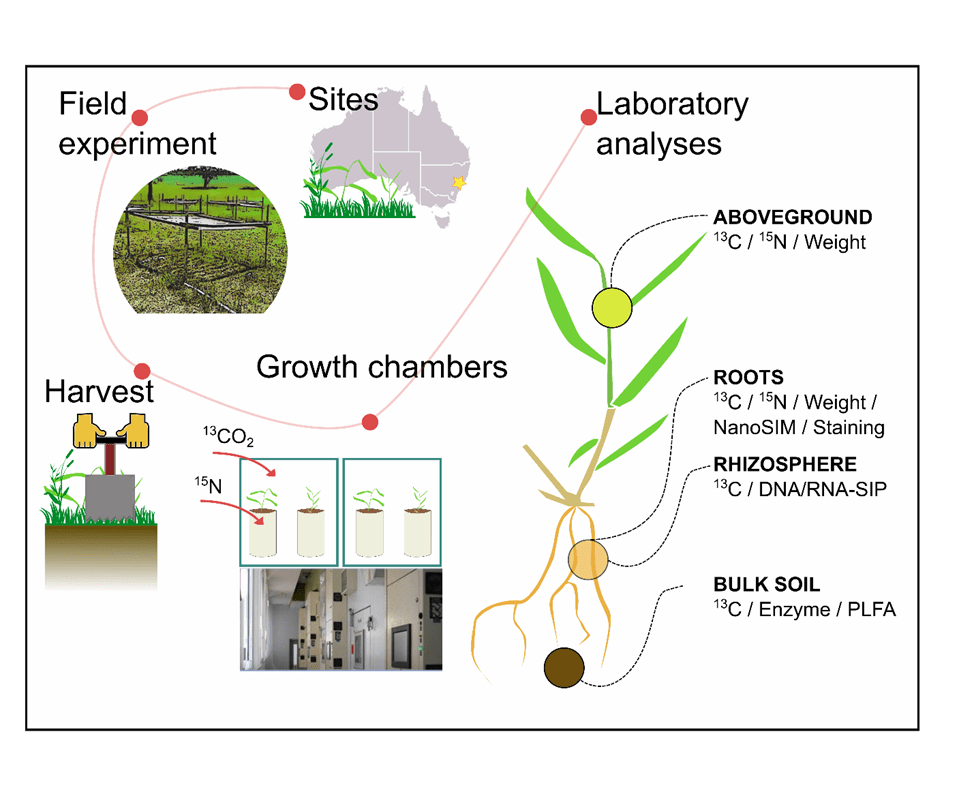
To track exactly what each species was doing with carbon and nitrogen during drought, we collected intact soil monoliths with both target plant species from drought and control plots and brought them back to the lab. We then used a dual-labelling technique: we fed the plants a pulse of isotopically ‘heavy’ carbon dioxide (¹³CO₂), added a form of heavy nitrogen (¹⁵N) to the soil, and tracked isotope movement over 24 hours — into shoots, roots, surrounding soil, and soil microbes.
The subordinate species goes underground
Under drought, the subordinate species pushed significantly more carbon into the soil around its roots, while taking up considerably more nitrogen than the dominant species. These combined responses underpinned the subordinate species’ greater drought resistance.
We also found that the subordinate species deepened its partnership with arbuscular mycorrhizal fungi (AMF) — microscopic fungi that colonise plant roots and help extract nutrients from the soil in exchange for carbon. Under drought, the subordinate grass developed significantly more fungal structures (arbuscules) inside its roots, while the dominant species did not. It is particularly interesting that we found similar concentrations of carbon transferred to the fungal partner in both species, yet the subordinate species appeared to obtain more nitrogen from the soil. This may suggest a more efficient or more favourable partnership.
What about the soil microbes?
The soil microbial community responded too, though more subtly. Under the subordinate species, we found slightly higher relative abundances of bacterial groups associated with drought tolerance and nitrogen cycling. The microbial community under the subordinate species also shifted its enzyme activity, investing more in breaking down carbon-rich organic compounds — a pattern typical of soils that have been exposed to long-term drought.
Why does this matter?
Grasslands cover around 23% of the Earth’s land surface and are critical for carbon storage and biodiversity. As droughts become more frequent and intense due to climate change, understanding which species and processes keep grassland ecosystems functioning is increasingly urgent.
Our results suggest that subordinate species act as stabilisers of soil processes during drought. Species that invest more carbon belowground and obtain more nutrients in return may help sustain soil functions — such as decomposition, nutrient cycling, and carbon storage — that would otherwise falter under water stress.
Our study examined only two species, and more work is needed across different grassland types and climates. But it provides a mechanistic basis for why subordinate species matter — and why protecting plant diversity, including species that might seem unremarkable at first glance, could be essential for maintaining resilient grasslands in a drier future.
The story behind the study
This project began in 2016, when five early-career scientists from different countries and with complimentary expertise happened to be working in Australia at the same time: Alberto (Italy), Pierre (France), Raúl (Spain), Yolima (Colombia), and Barbara (Italy). Between the University of Sydney and Western Sydney University, we realised we had access to two unique drought experiments — and decided to combine forces.
The work itself was intense: long days collecting soil cores in the field, preparing isotope labelling experiments, and carefully separating shoots, roots, and soil. But it was also one of those moments in science when enthusiasm, curiosity, and friendship give birth to fun collaboration.
Soon after the experiments finished, our paths diverged as we moved to new postdocs and faculty positions around the world. Keeping the project moving forward across institutions and continents was not always easy. Yet ten years later, we finally published the study in Journal of Ecology — a reminder that good collaborations can last far beyond the field season that started them.
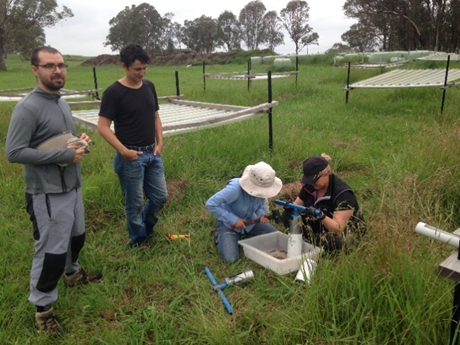
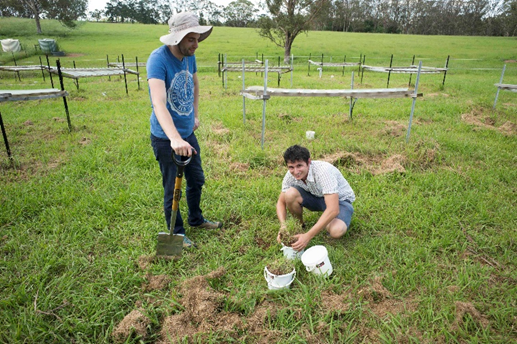
Pictures at John Bruce Pye Farm experimental facility, The University of Sydney. In the left picture, from left to right: Raul, Alberto, Yolima, Barbara (photo by Pierre Mariotte). In the second picture (right), from left to right: Pierre and Alberto (photo by Feike A. Dijkstra).


Pingback: Belowground studies from the Journal of Ecology – Plant Life Belowground