Guochun Shen and Jing Yang, East China Normal University in Shanghai, China, discuss their article: Shifts in above- and belowground trait dissimilarity under competition mediate the future impact of neighbors
When we walk into a forest, it is easy to picture trees competing for light, water, and nutrients. Some seedlings race upwards and cast their neighbours into shade; others invest in deeper and wider root systems to exploit limited belowground resources. We often treat these differences as fixed properties of species, as if each tree carried a permanent label such as ‘tall canopy species’ or ‘deep‑rooted species’. Yet, trees are not static, they adjust their functional traits – measurable features such as height, leaf area, or root structure – depending on who their neighbours are and how those neighbours behave. These adjustments can also follow very different patterns above‑ and belowground.
In our recent study, we wanted to know: how do tree traits change when individuals grow with neighbours, and how do these neighbour‑induced changes affect competition and coexistence?
Why a dynamic, multidimensional trait space matters
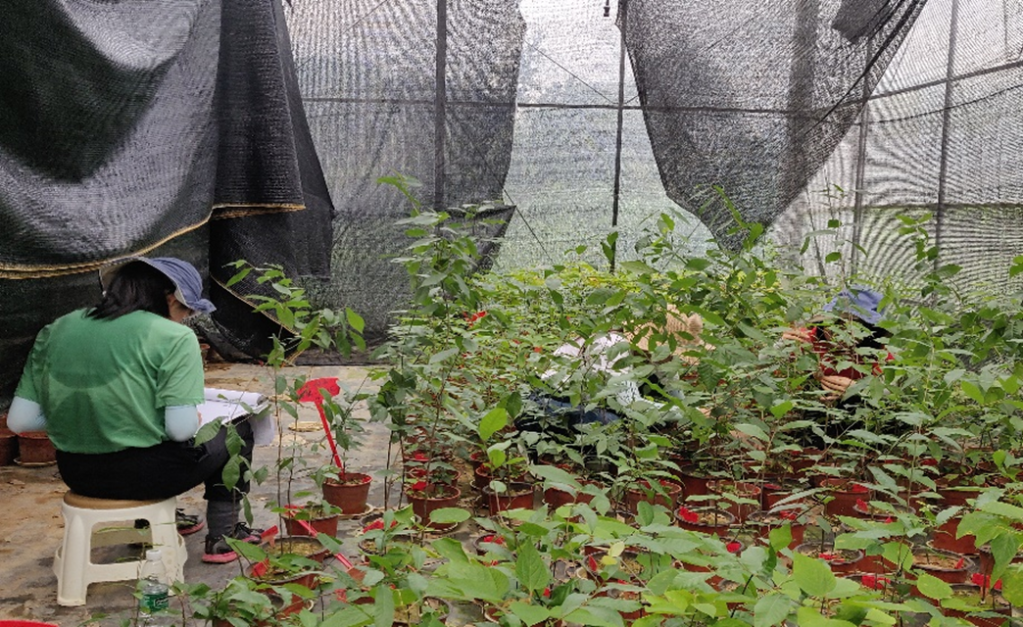
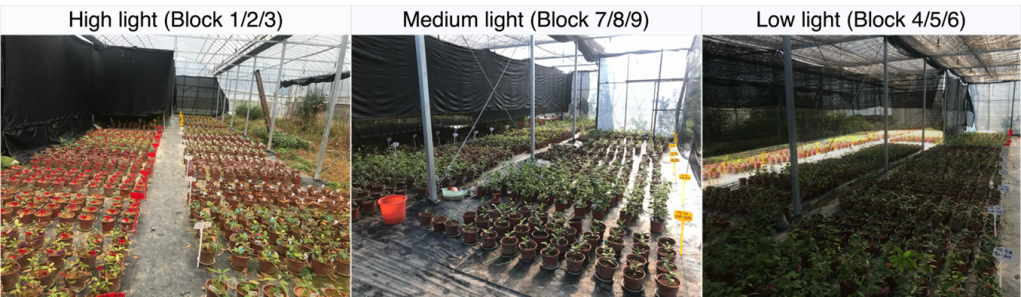
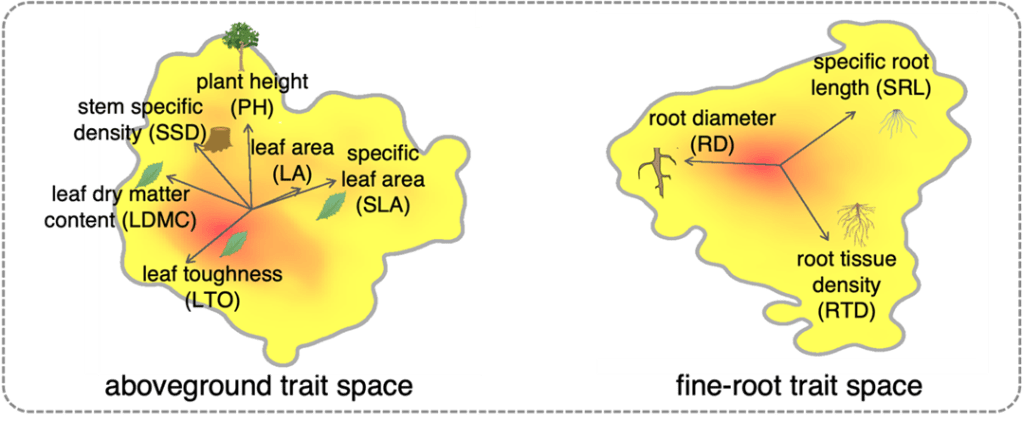
Answering this question requires moving beyond the common practice of treating functional traits as fixed values analysed one by one. In trees, competitive strategies emerge from coordinated shifts and trade-offs across multiple traits, and these traits can change plastically in response to neighbours and resource conditions. This means that interspecific trait dissimilarity is not necessarily static within a given environment, but can shift dynamically as competition unfolds. To examine this, we conducted a three-year greenhouse experiment at the Tiantong Forest Ecosystem Station in eastern China, growing 5,818 seedlings of seven common tree species either in competition-free pots or in mixed-species pots. We measured aboveground and fine-root traits for each seedling and used them to construct separate multidimensional trait spaces, allowing us to test how neighbour presence alters interspecific trait dissimilarity and how these shifts shape competition intensity.
Divergent shifts aboveground and in fine roots, but the same goal
In our study, competition drove contrasting shifts in multidimensional trait dissimilarity. When seedlings grew with neighbours, species became more similar in aboveground trait space, suggesting greater convergence in light-acquisition strategies. By contrast, species became more different in fine-root trait space, indicating greater differentiation in how they acquire belowground resources. These contrasting patterns show that trees do not rely on a single way to cope with competition. Instead, they use two seemingly opposite but complementary strategies that both help reduce competitive pressure. Aboveground trait similarity likely reflects more similar competitive abilities for light, which can weaken competitive asymmetry among seedlings. In contrast, greater fine-root dissimilarity likely reflects greater niche differentiation in belowground resource use, which can also reduce competition. In simple terms, trees meet in the middle aboveground and spread out belowground, but both adjustments point to the same goal: reducing competition and creating more room for species to live together.
Looking ahead: Why this matters
Our study carries a simple but important message for trait‑based ecology: functional traits are not static labels attached to species, and competition is more than a filter acting on fixed differences. In real communities, trees respond to neighbours through coordinated, multidimensional trait adjustments – converging aboveground while diverging in fine-root traits – to ease competitive pressure across space and time. If we want to understand species coexistence and predict biodiversity under environmental change, we need to move beyond individual traits and static averages, and instead pay attention to trait plasticity in multidimensional trait space and its relationship to neighbour interactions. These subtle, coordinated shifts are likely to contribute to the remarkable diversity of forest ecosystems.