Donghao Wu, School of Ecology, Shenzhen Campus of Sun Yat-Sen University, discusses his article: Wood trait-decay relationships vary with topography and rainfall seasonality in a subtropical forest in China

Wood trait-decay relationship
Deadwood stores 8% of global forest carbon, and thus it is important to understand the dominant drivers of wood decomposition rates. Many physical and chemical traits have “afterlife” effects on the turnover rate of deadwood, including wood density and nitrogen content. This is because the colonization and decomposing activities of microbes and insects all depend on wood traits. Notably, wood traits explained nearly half of the global variation in decomposition rates, whereas climate variables only explained one fifth. Therefore, understanding the wood trait-decay relationship is central in predicting wood decomposition rates and deadwood carbon fluxes.
Environmental dependency
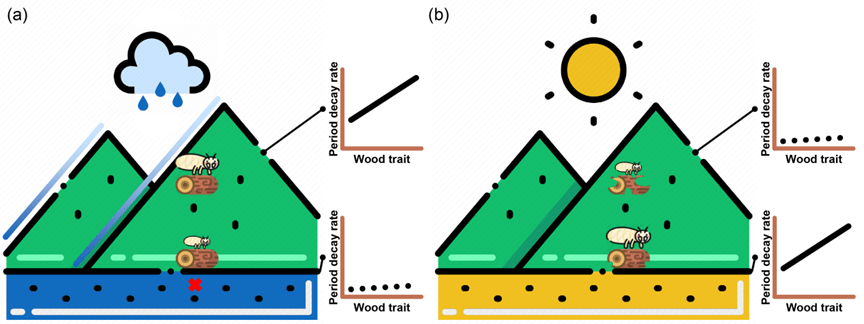
It is stressed that spatial and temporal variation of environments can directly shift optimal trait values and thus change ecosystem functioning. It is far less acknowledged that environmental changes may indirectly change and even reverse the trait-function relationship. As the first study to address the environmental dependency of the wood trait-decay relationship, we posited that unfavorable environments can suppress decomposer activities and weaken the wood trait-decay relationships. More specifically, waterlogged soils in valleys during the rainy season may decrease termite activities and wood decomposition rates, especially of palatable deadwood species. By comparison, wood trait-decay relationships could be less affected at ridges and hilltops during the rainy season.
Wood decomposition experiment
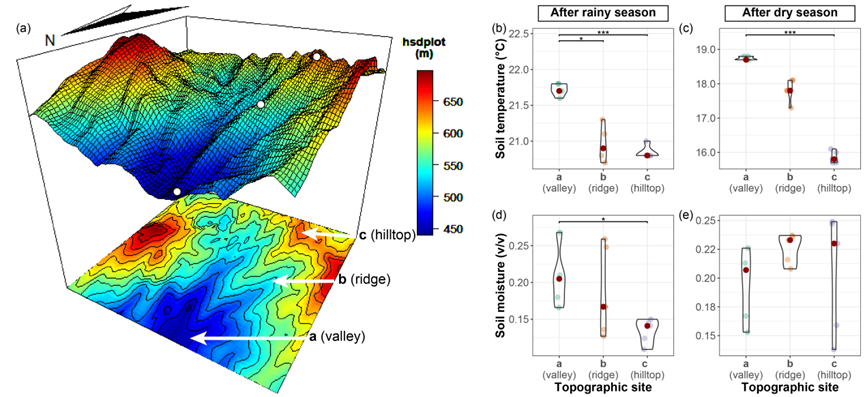
We tested this hypothesis in a 50-ha forest plot in subtropical China, where we selected 137 tree species for wood decay experiments and placed wood samples at three topographic sites (valley, ridge, and hilltop) varying in microclimate. We measured eight physical and chemical traits to determine the most influential wood properties for termite feeding activities and wood decomposition rates. The experiments were initiated at the end of November 2021. We harvested samples after the rainy season or after a whole year (rainy-plus-dry season). Mass loss and volume loss (i.e. termite feeding activities) of the first harvest were attributed to the rainy season, while the difference between two harvests were attributed to the dry season.
Key findings
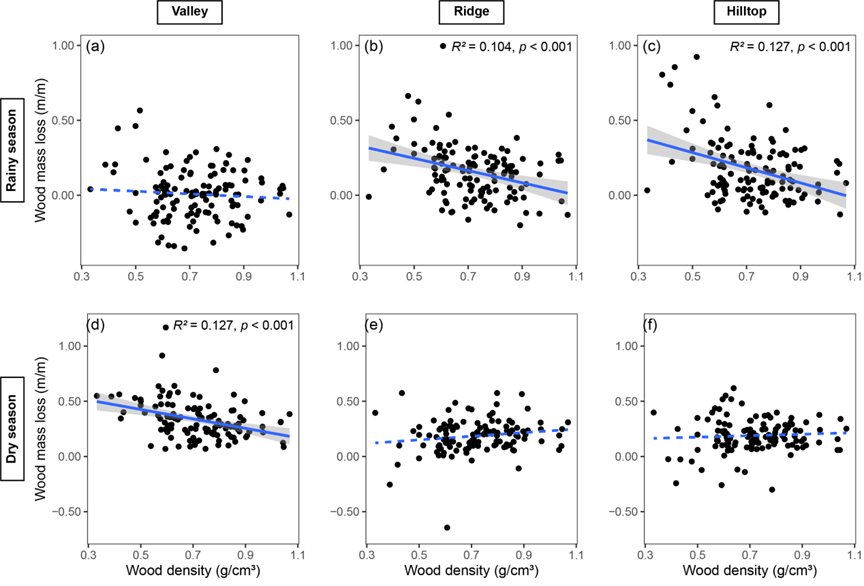
We found that termite feeding activities and wood mass loss during the rainy season were decreased by soil waterlogging in the valley but not on the ridge or hilltop. Wood density predominantly controlled termite feeding activities and wood mass loss, but its negative effects appeared at the ridge and hilltop only during the rainy season, and in the valley only during the dry season. Notably, warmer soil temperatures in the valley accelerated termite activities during the dry season, causing similar final wood mass loss as higher-elevation sites.
Implications
Our study reveals that environmental effects on wood decomposition are not only mediated by trait changes directly, but also via the spatiotemporal variations of wood trait-decay relationships indirectly. Notably, future droughts may reduce soil waterlogging and accelerate termite activities and the decomposition of lower-density wood, particularly in valleys. We are concerned that deadwood carbon stocks could become larger C sources if the suppressive effects of rainfall are alleviated under future droughts, especially in regions where termites are dominant decomposers.

 jecologyblog.com