Taichi Nakata, Kyushu University in Japan, discusses their article: Adaptive trait divergence of annual plants in response to urban habitat diversity in a megacity
As we walk through cities, we often notice flowers blooming in the gaps in pavement, along roadsides, or in parks. Despite the drastic alterations of their natural habitats by human activity, some plants continue to thrive resiliently in urban environments. Research into such urban-dwelling plants has been increasing in recent years. However, few studies have examined how the diversification of urban habitats affects trait evolution and divergence in plants, and even fewer have evaluated whether such evolutionary divergence is adaptive or merely neutral.
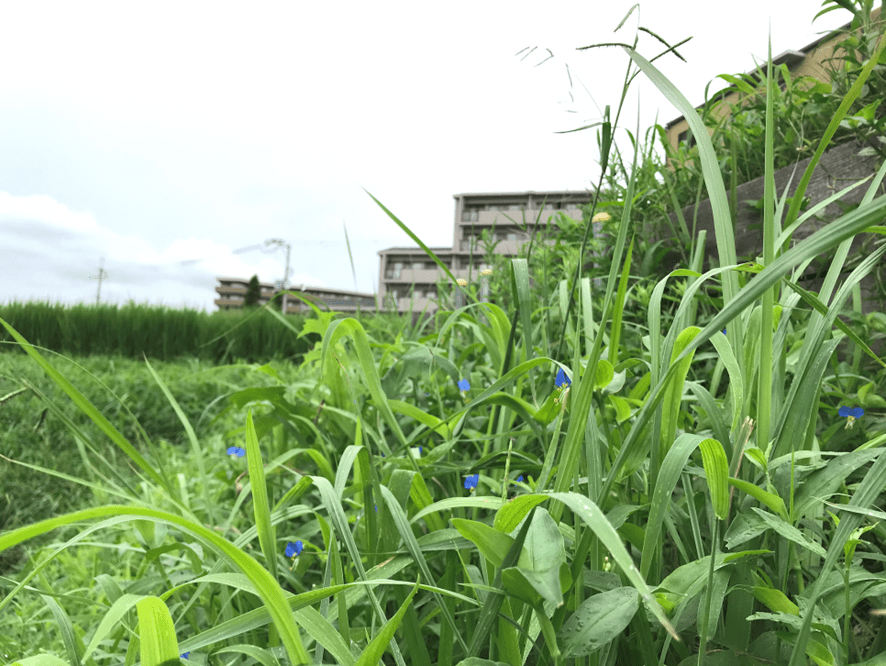
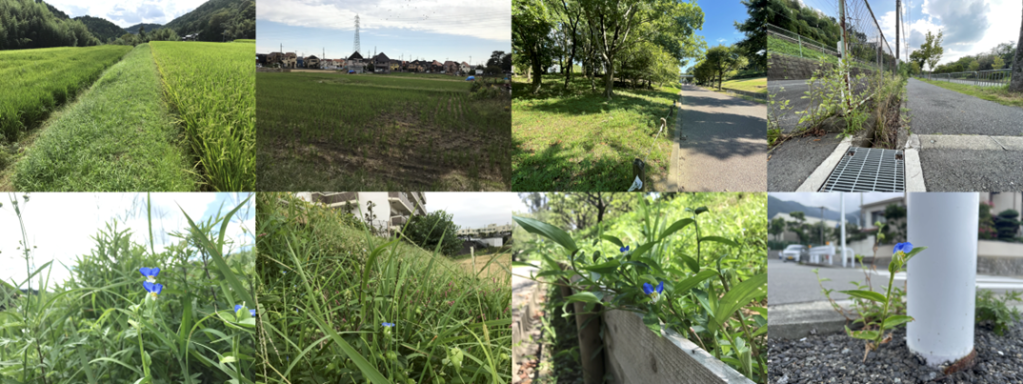
Our research group has focused on the native annual herb Commelina communis (Asiatic dayflower), which grows across a wide range of habitats—from satoyama landscapes (traditional Japanese rural landscape) to highly urbanised environments. We collected seeds from rural agricultural lands, urban agricultural lands, urban parks, and roadside habitats across the Kyoto–Osaka–Kobe metropolitan area, one of the world’s major megacities, and germinated them for trait measurements.
To characterise the physical environment of each habitat, we conducted field surveys to measure soil pH, soil water content, and canopy openness (as an indicator of shading), and used satellite data to estimate land surface temperature. To determine whether observed trait differences among habitat types were due to local adaptation or neutral evolution, we also analysed genome-wide single nucleotide polymorphisms (SNPs) for each individual using the MIG-seq method.
Comparisons of environmental factors revealed that across all urban habitats, land surface temperature and soil pH were consistently higher than in rural sites. Yet, the urban habitats differed from one another: roadside habitats were drier, urban agricultural land were more exposed to sunlight, and urban parks were more shaded due to tree planting and surrounding structures.
Trait measurements showed that urban dayflower populations generally had greater height, larger leaves, and fewer stems and leaves than rural populations. Within urban areas, flowering in urban agricultural lands occurred later than in urban parks. Across all urban habitats, increased land surface temperature was associated with greater plant height and leaf area, and with a reduced number of stems — patterns that were particularly pronounced at roadside sites. The delayed flowering in urban agricultural land populations appeared linked to higher light availability compared with parks.
Moreover, apical growth during early development was enhanced in the neutral-soil conditions of urban agricultural lands and roadsides, whereas it was suppressed in the darker and more acidic soils of city parks and rural agricultural lands.
Finally, comparisons between neutral genetic differentiation (FST) and quantitative trait differentiation (QST) among populations grown in a common garden revealed that QST values for all traits were greater than FST. This strongly suggests that the observed trait divergence among populations has arisen through adaptive evolution to urban environments rather than by chance.
This research represents the first step in elucidating how plants are evolving within the novel and diverse ecosystem of the city. Moving forward, we aim to delve deeper into the mechanisms by which common dayflower adapts to urban environments, through common garden experiments that replicate complex urban conditions, as well as with field observations.

 jecologyblog.com