Diana Bertuol Garcia, University of Victoria, discusses her article: Long-term aridity shapes grassland drought resistance and modulates the roles of plant diversity and functional composition
As ecologists, we often ask how ecosystems cope with change. This question now feels more urgent than ever. Around the world, ecosystems are facing habitat loss, overexploitation, invasive species, rising temperatures, shifting fire and rainfall patterns, and more frequent extreme events such as heatwaves and droughts. Together, these pressures threaten the stability of ecosystems, that is, their ability to maintain structure and function. Therefore, understanding what helps ecosystems remain stable amid disturbances is crucial, not only for advancing ecological knowledge but also for biodiversity conservation and natural resource management under global change.
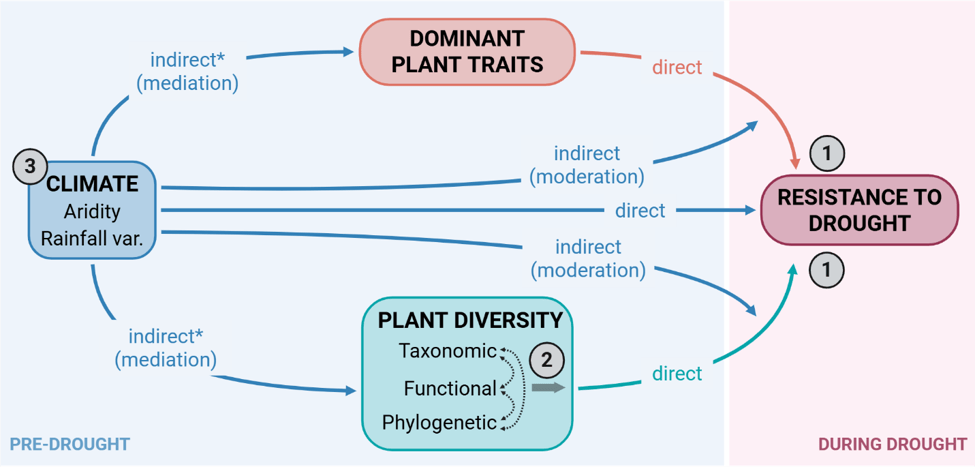
However, despite decades of research, there are still no clear answers as to what drives ecosystem stability. Instead, several hypotheses have been proposed. One well-known idea is that biodiversity increases stability, as ecosystems with more species tend to be more stable. But the causes of this pattern are less clear. It may not simply be the number of species that matters, but how different those species are. Ecologists refer to those differences as functional diversity, that is, the range of characteristics influencing how individuals acquire resources, grow, survive, and reproduce (i.e., their functional traits). When species differ in their functional traits, they may compete less for resources and are less likely to respond similarly to a disturbance, helping the ecosystem remain stable. In contrast, another hypothesis focuses on the traits that dominate in a community (i.e., the functional composition of the community). According to this view, stability depends less on diversity itself and more on whether the dominant species have traits that allow them to cope well with stress and disturbances. On top of this, abiotic conditions, such as climate, are less studied but are likely to play an important role. However, most studies examine these factors separately. We still know relatively little about how diversity, functional composition, and climate interact to shape ecosystem stability, particularly for resistance to extreme events.
In our study, we sought to bring these ideas together. Instead of testing one hypothesis at a time, we asked: which factors matter most when they are considered simultaneously? To address this issue, we focused on grasslands and their resistance to extreme drought. Grasslands cover up to a third of the Earth’s land surface, hold great biodiversity, and provide essential benefits to people, such as food production and carbon storage. However, they are increasingly threatened by more frequent and intense droughts. While previous research has explored drivers of drought resistance in grasslands, to our knowledge no study had attempted to combine multiple biotic and abiotic mechanisms to assess their relative importance and combined impact on resistance.
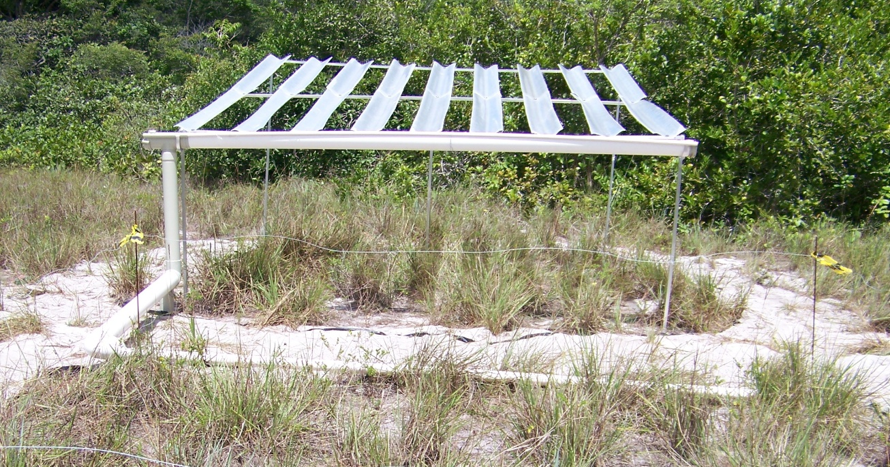
To answer the questions above, we used data from the International Drought Experiment, a coordinated global research effort of the DroughtNet network. Across many sites, researchers simulated extreme drought using rainout shelters with strips of transparent panels that intercepted a fixed proportion of rainfall. The level of rainfall reduction was tailored to each site to simulate a drought expected to occur only once every 100 years at that location. For example, sites with historically stable rainfall required only a small reduction to reach extreme conditions while more variable sites needed larger reductions. This standardised approach allowed us to compare drought resistance across grasslands spanning a wide range of climates.
We found that both plant diversity and functional composition explained some variation in drought resistance, with functional composition having a more important role than diversity. However, not all variation was explained by these factors. Climate also played a major role, particularly the long-term water availability of the site (i.e., the site’s aridity, a measure that accounts for water inputs through rainfall and water losses through evapotranspiration). In fact, aridity influenced drought resistance in multiple ways. It had a direct effect with more arid grasslands being less resistant to extreme drought. But it also acted indirectly by shaping plant diversity and functional composition, which in turn affected resistance. Finally, aridity also altered how these biotic factors relate to resistance. For example, the relationship between plant diversity and drought resistance was weaker in more arid sites.
Overall, our study highlights two main lessons. First, we suggest that looking at multiple mechanisms together can provide a more integrated picture of what drives ecosystem stability. Focusing on biotic factors alone is not enough, and we also need to consider the environmental context in which ecosystems exist. Second, our results indicate that arid grasslands may be especially vulnerable to climate change. As droughts become more frequent and intense, these systems could face increasing pressure. This makes them a priority for conservation and restoration efforts.


