Inge Althuizen, Norwegian Research Center AS (NORCE), discusses her article: Climate-induced shifts in plant investment strategies regulate ecosystem carbon cycling across alpine grasslands
Alpine ecosystems provide a diversity of ecosystem services, including carbon storage. These cold ecosystems and carbon stored in them are particularly sensitive to climate change. But what are the mechanisms underlying carbon exchange, the uptake and release of carbon, and how are they affected by climate change? In our study, we dove into these questions by disentangling the different pathways through which climate change can affect ecosystem carbon exchange.
Vestland climate grid
For our research we used the western Norwegian fjord landscape as a climate change laboratory, as it covers a wide range of bioclimatic variation on a regional scale. Here, twelve semi-natural grasslands were selected to represent different climatic conditions, representing three temperature levels (alpine, sub-alpine, boreal) with each level increasing approximately 2 degrees Celsius in mean growing season temperature – replicated at four levels of precipitation (with each level increasing about 700 mm in mean annual precipitation). Using this climate grid, we studied how different climate conditions shape vegetation communities and could affect ecosystem functioning.
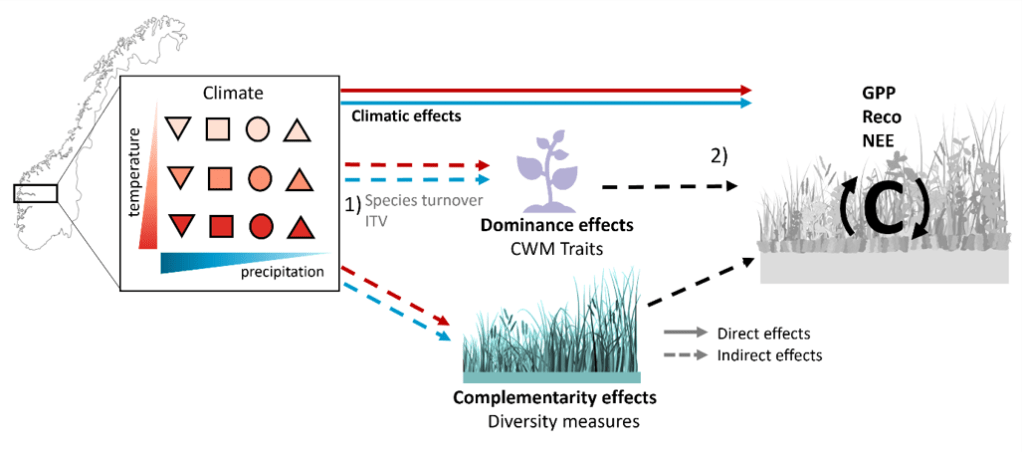
At each site, we made extensive measurements of plant community composition and ecosystem carbon exchange to capture the local biotic and abiotic heterogeneity within sites. We measured ecosystem carbon exchange using a static chamber method, where a clear plexiglass chamber connected to an infrared gas analyser is used to measure the change in CO2 concentration over time to estimate carbon uptake (gross primary productivity: GPP) and carbon release (ecosystem respiration: Reco). We also collected local plant functional traits to account for both species turnover and trait variation within species experiencing different climate conditions (intraspecific variability; ITV). We then combined these data to assess how climate impacts carbon cycling across these grasslands.

Pathways of climate change
The first pathway through which climate can affect ecosystem carbon exchange is the most obvious. The rate of many biological processes is limited by temperature and water availability, and climate warming should therefore increase the rates of photosynthesis, respiration, and decomposition. We indeed found that sites with higher summer temperatures had higher rates of carbon uptake and release.
A second pathway operates through the plant communities. Changes in climate can favour the growth of plant species with different rates of photosynthesis and respiration. We found that there is a shift in plant investment strategy along our climatic gradients. Plant communities in warmer sites were characterized by tall, fast growing species with more acquisitive leaf traits, while colder, wetter sites had communities with shorter growing species and more conservative leaf traits. We found that this shift in plant investment strategy played a major role in driving ecosystem carbon cycling, with plant communities with resource acquisitive strategies having higher rates of carbon uptake and release. This plant community mediated effect of climate was greater than the direct effect of temperature.


Two contrasting mechanisms have been proposed for how plant community composition could regulate ecosystem functioning. One focuses on the most dominant species in the communities, arguing that they are most important for driving ecosystem functioning. Another perspective argues that diversity is key, because a more diverse community with complementary traits will ensure that the community can maintain functioning under a wide range of environmental conditions. The large contribution of mean traits in explaining variability in rates of ecosystem carbon exchange across our climatic gradients shows that dominant species strongly determine carbon cycling. The negative effect of diversity of traits (functional dispersion) further highlighted the importance of dominant traits for ecosystem functioning.
Short-term vs long-term implications for carbon balance
Alpine regions are warming rapidly, which can lead to species turnover and shifts in plant investment strategies in the long-term. However, the effects of changes in vegetation composition will occur more slowly than the instantaneous effects of temperature and precipitation change on biogeochemical processes. In the short-term, the greater sensitivity of ecosystem respiration to temperature compared to carbon uptake will likely lead to greater carbon emissions for alpine grasslands with global warming. In the long-term, a shift from conservative to more acquisitive plant investment strategies will stimulate both carbon uptake and release.


