Elinor Fajer, Harvard University, and Peter Pellitier, University of Utah, discuss their article: Ectomycorrhizal communities underlie trade-offs between greater long-term tree growth and reduced soil carbon concentrations in boreal forests
Boreal forests are one of the most carbon-rich ecosystems on Earth. Belowground, the soils store massive amounts of carbon-rich organic matter, and aboveground, long-living trees store carbon in their biomass. It’s unclear how these carbon pools will be affected by future climate change: will boreal forests continue to act as a carbon sink and help to draw down more CO2 from the atmosphere, or will changing conditions flip the ecosystem to a carbon source?
To better understand the complexities of carbon cycling in boreal forests, we need to evaluate the system from a biological lens.
Hiding in plain sight: The role of ectomycorrhizal fungi
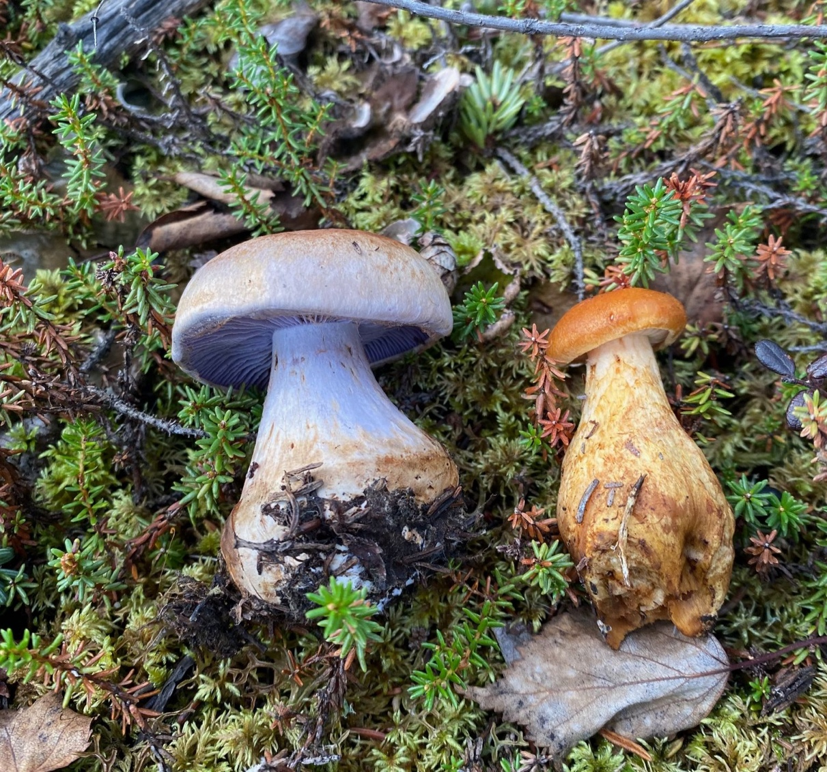
Boreal forests are teeming with mushroom-forming fungi. Belowground, the hidden mycelia of these fungal communities are playing major roles in affecting where carbon and other nutrients are stored, mobilized, and lost. For instance, saprotrophic fungi decompose tree stumps, dead biomass, and other organic matter and release carbon from boreal forests as CO2 into the atmosphere. On the other hand, ectomycorrhizal fungi form symbiotic associations with plant roots and help trees access critical nutrients from the soil, promoting tree growth and carbon sequestration.
Certain ectomycorrhizal fungi have incredible enzymatic capacities to ‘mine’ for organic nitrogen from hard to access, recalcitrant soil organic matter. This can be an especially important source of nitrogen for trees in highly nitrogen-limited boreal forests. Because of possible interactions with other dominant fungi in soil, it remains unclear whether this ectomycorrhizal nitrogen mining promotes or reduces the storage of carbon in the soil.
Our study set out to uncover linkages between fungal nitrogen acquisition and ecosystem carbon storage in boreal forests.
A fun(gal) road trip across Alaska
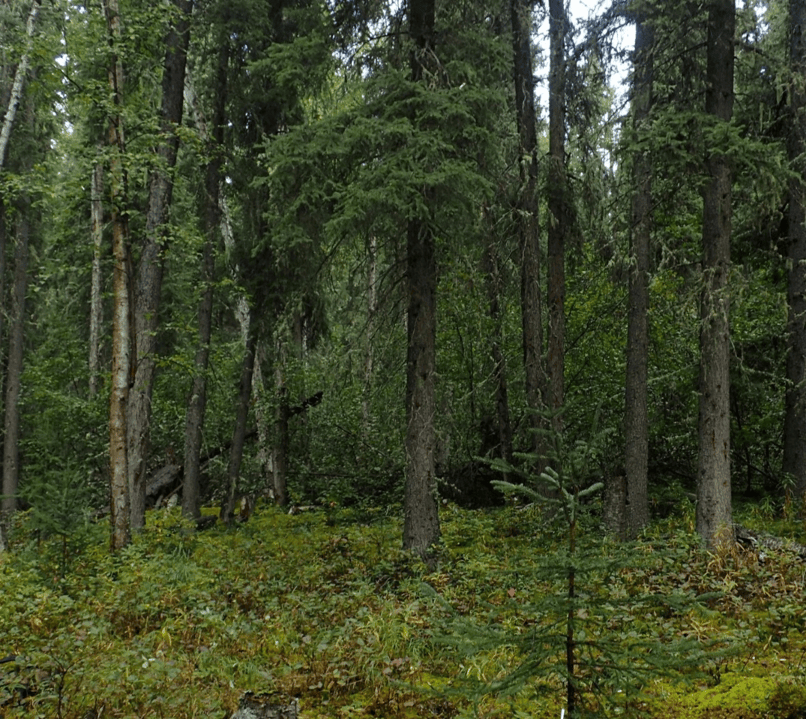
To determine how ectomycorrhizal fungi influence tree growth and soil carbon stocks, we sampled along a ~1500 km stretch of white spruce-dominated forests of central Alaska, USA. These sites span a wide gradient of climatic and soil conditions, and dominant trees have been continuously monitored through the Cooperative Alaska Forest Inventory (CAFI) since 1993. For white spruce trees at each site, we collected root and soil samples, along with other site measurements, and then paired these data with long-term records of tree growth. With the root and soil samples, we employed DNA meta-barcoding to identify fungal communities associated with individual focal trees.
What did we find?
It’s generally believed that processes of decomposition and tree growth are primarily driven by environmental factors like precipitation, temperature, and soil chemistry. However, by utilizing GAM models that accounted for these environmental factors, we found that fungal community factors like fungal richness and composition were significant predictors of tree growth rates and soil carbon concentrations in boreal forests.
Across our sites, we found an overall negative relationship, or trade-offs, between tree growth and soil carbon, and specific ectomycorrhizal fungal taxa were linked with faster tree growth and lower soil carbon concentrations. This trade-off in above- and below-ground carbon stocks is consistent with growing evidence that organic nitrogen acquisition by ectomycorrhizal fungi can stimulate tree growth at the expense of the oxidation (and potential loss) of soil carbon. Further research is required to identify the molecular mechanisms and biotic interactions by which ectomycorrhizal fungi might reduce soil carbon stocks while promoting aboveground productivity.


