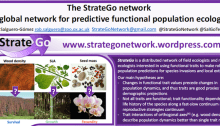
When are traits functional?

A trait is any aspect of an organism that defines it with respect to a concept. A trait may be color, when examining heat absorption; accent, in the case of humans when attempting to approximate nationality; specific leaf area (i.e., area to dry mass ratio of a leaf) when interested in investment in photosynthetic machinery…


How do pine trees guard against drought?

Swiss Federal Institute for Forest, Snow and Landscape Research (WSL) press release Do young pines build up food reserves at the expense of growth to enable them to survive longer in the event of a drought? This controversial hypothesis is refuted by a new study carried out by the Swiss Federal Institute for Forest, Snow…

Harper Prize Highly Commended Paper 2016: Ecological Legacies of Civil War on Savanna Tree Cover

Each year, as well as selecting an overall winner for the Harper Prize (see Martina’s interview), the editors of Journal of Ecology also select two highly commended papers. This year we had two fantastic highly commended papers by Kris Kramer-Walter et al. titled ‘Root traits are multidimensional: specific root length is independent from root tissue density and…

Interview with Harper Prize Winner 2016 Martina Treurnicht

The Harper Prize 2016 for the best paper published in Journal of Ecology by an early career researcher has been awarded to Martina Treurnicht.  Martina and colleagues collected 3454 population-level records from across the global range of these species in the Cape Floristic Region of South Africa. The findings of her paper entitled ‘Environmental drivers of…

Interactive Effects of Rainfall, Fire and Herbivory on Plant Resprouting

In this new podcast video, Katherine Giljohann presents the findings of her recent study, accepted for publication in Journal of Ecology, and titled “Interactions between rainfall, fire and herbivory drive resprouter vital rates in a semi-arid ecosystem“. This study was part of Katherine’s PhD project which looked at optimal management planning for biodiversity conservation in disturbance-prone environments. The video…

Fascination of Plants Day

18th of May 2017 is Fascination of Plants Day, an event which was launched under the umbrella of the European Plant Science Organisation (EPSO) to encourage people around the world to celebrate the importance of plant science. As readers of Journal of Ecology, you are probably fascinated by plants (as much as me), so let’s…

Logging of Borneo’s Rainforests: Impacts on Plant Communities

Timm Döbert, from CSIRO in Australia, recently had a paper published in Journal of Ecology entitled “Logging increases the functional and phylogenetic dispersion of understorey plant communities in tropical lowland rainforest”. Below, his co-author Bruce Webber describes the context of the research and highlight the main findings of their study. How does logging affect the diversity of rainforest understorey plant…

Plant-microbe interactions in nutrient and water limited Australian soils

Holly Vuong, from CSIRO in Canberra, Australia, recently had a paper published in Journal of Ecology entitled “Host species and environmental variation can influence rhizobial community composition”. Below, Holly presents the context of her study on plant-microbes interactions in nutrient and water limited Australian soils and summarizes the findings of her experiment. Out of about 1,350 Acacia species in…

Harper Review 2017 – meet the author

Last year, Journal of Ecology initiated a new Harper Review series which is named after past BES President and Journal of Ecology Editorial Board member, John L. Harper. In tribute of his of work, you can read some of his excellent papers in this special virtual issue. The series is designed to be thought provoking, authoritative and of broad interest to the ecological community.

Insights into the AAET-MEDECOS Conference

  The MEDECOS XIV International Conference and XIII AEET meeting was held last week (January 31st – February 4th) in Seville (Spain). If you could not make it, you can hear all about it in the new blog post below from our Associate Editor, Ignasi Bartomeus. Ignasi has kindly agreed to share his thoughts with you on the…