Harper Prize Highly Commended Papers 2017: Plant-Soil Interactions (Part 2)

In this second Harper Prize video podcast, I present the findings of my highly commended paper entitled ‘Stoichiometric N:P flexibility and mycorrhizal symbiosis favour plant resistance against drought‘. This experiment was carried out at The University of Sydney (Australia) with Alberto Canarini and Feike Dijkstra through a postdoctoral fellowship from the Swiss National Science Foundation.…


Harper Prize Highly Commended Papers 2017: Plant-Soil Interactions (Part 1)

Each year, as well as selecting an overall winner for the Harper Prize (Jenny Zambrano, see previous blog post), the editors of Journal of Ecology also select two highly commended papers. This year the two highly commended papers are from Connor Fitzpatrick et al. titled ‘Phylogenetic relatedness, phenotypic similarity and plant–soil feedbacks‘ and myself, Pierre Mariotte et al.…

Winner of the Harper Prize 2017: Jenny Zambrano

The winner of the Harper Prize 2017 is Jenny Zambrano. Jenny’s paper, ‘Neighbourhood defence gene similarity effects on tree performance: a community transcriptomic approach’, takes a community functional phylogenomic approach to understand how defence genes drive tree community structure and dynamics. Jenny originates from Colombia and is currently a postdoctoral fellow at the National Socio-Environmental…

Eminent Ecologist 2018: David Wardle (part 3)

The Journal of Ecology editors are delighted to honour David Wardle in our continuing Eminent Ecologist series. David has put together a special Virtual Issue of some of his excellent contributions to the journal and has written a series of blog posts reflecting on his work. Read Part 1, Part 2 and Part 3 on the Journal of Ecology blog. NITROGEN…

Eminent Ecologist 2018: David Wardle (part 2)

The Journal of Ecology editors are delighted to honour David Wardle in our continuing Eminent Ecologist series. David has put together a special Virtual Issue of some of his excellent contributions to the journal and has written a series of blog posts reflecting on his work. Read Part 1, Part 2 and Part 3 on the Journal of Ecology blog. SWEDISH…

Eminent Ecologist 2018: David Wardle (part 1)

The Journal of Ecology editors are delighted to honour David Wardle in our continuing Eminent Ecologist series. David has put together a special Virtual Issue of some of his excellent contributions to the journal and has written a series of blog posts reflecting on his work. Read Part 1, Part 2 and Part 3 on the…

David Goodall Obituary (1914-2018)

Eminent ecologist David W. Goodall passed away a few weeks ago at the age of 104. David was well known for his work in plant community ecology, notably through major advances in statistical methods to analyze vegetation patterns. His friend, Peter Minchin (SIUE, USA) kindly proposed to write some words about David’s research over his long…

Tropical peat swamps: Restoration of endangered carbon reservoirs

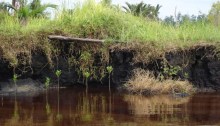
University of Göttingen press release According to current knowledge, the land biosphere absorbs 30% of the CO2 produced by humans and thus contributes significantly to reducing global warming. Tropical peat swamp forests are among the most important terrestrial carbon reservoirs, but they are increasingly being cleared. Data on their regenerative capacity have so far been…

Spotlight on an endangered herb: Hypericum cumulicola

For Endangered Species Day 2018, Pedro Quintana Ascencio and Eric Menges have written a blog post about their recently published paper on the population dynamics of Hypericum cumulicola, an endangered herb across a range of landscape drivers. We are convinced that limited spatial replication and short study intervals can hinder our ability to adequately understand and predict population dynamics.…

Seeing the woods through the saplings

Erika Berenguer and colleagues recently had a paper on human-modified tropical forests published in Journal of Ecology. Erika tells us more about her paper below… Walking through an undisturbed Amazonian forest is one of those unique experiences – the abundance of sounds, colors, and smells can be overwhelming. Underneath towering trees, smaller trees in line with…